
Breed Histories · 26 September 2026
The History of the English Cocker Spaniel
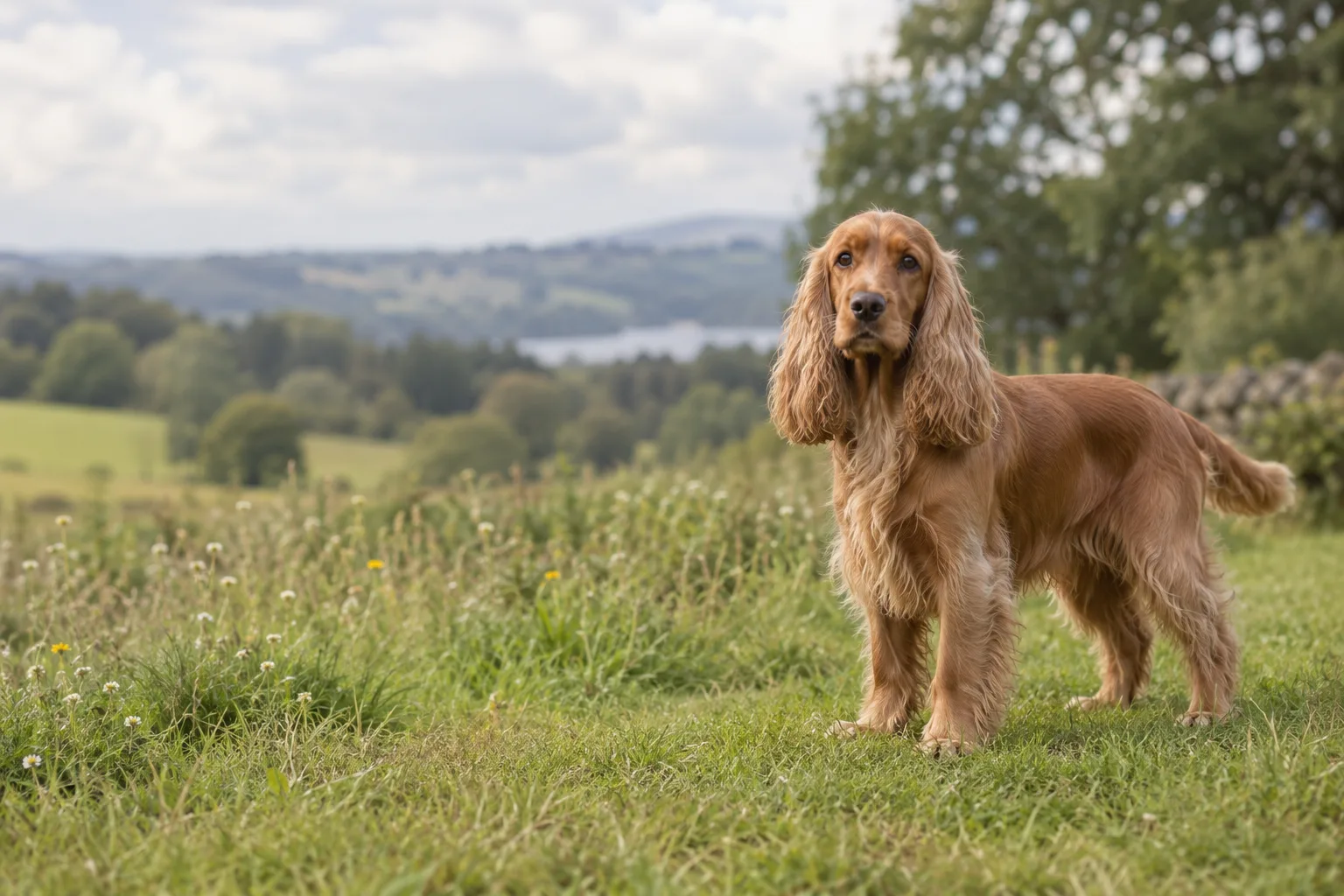
Ask a room of dog people why a Cocker Spaniel never stops wagging, and you will get answers about temperament. We would rather start with the job. Almost everything about this breed, from the low, busy nose to the tail that seems to run on its own battery, comes from one piece of work in one kind of ground. Follow that work back and the dog makes sense.
This is the long version of the story that sits on the breed page. We have stuck to what the Kennel Club, the American Kennel Club, the breed clubs and published breed histories will support, and where a popular tale cannot be pinned down, we say so.
A spaniel before it was a Cocker
The word "spaniel" is old, and so is the type. Dogs of this general kind, medium sized, feathered, and bred to work close to the gun or the net, appear in British and French hunting writing from the Middle Ages onwards. The old explanation for the name is that it points to Spain, and that is the one most often repeated, though nobody can prove it from a single source.
What matters for the Cocker is what those early spaniels were asked to do. They went into thick cover, hedgerow, bracken and bramble, and pushed game out into the open. For centuries that was the whole point of them. They were not one breed. They were a family of working dogs, sorted by what the job needed, not by a written standard.
The name "Cocker" comes from the woodcock. A small, low spaniel could get under the tangle where woodcock sit tight, and flush the bird for the gun. The dogs that were good at it were called cocking spaniels, and the name shortened over time. It is a tidy piece of etymology, and it is well supported. It also tells you something about size. A woodcock dog had to be small enough to work under cover and sturdy enough to work all day.
For a long stretch of the nineteenth century, spaniels were divided mostly by weight and function. Smaller dogs were used as cockers and larger ones as springers, and puppies from the same litter could be classed differently depending on how big they grew. That detail is worth holding on to, because it explains why the story of the Cocker and the story of the Springer are tangled together for so long.
The Kennel Club, Obo and a breed on paper
The Kennel Club was founded in 1873, and with it came stud books, shows and written descriptions. Spaniels were among the first gundogs to be put into that system, and the sorting was not tidy. Dogs were shown by weight class, and it took years of argument to agree what a Cocker actually was.
One name appears in almost every breed history: Obo. Whelped in 1879 and owned by James Farrow, he was a black dog, and he is widely described as the foundation sire of the modern English Cocker. Nearly every pedigree of the breed can be traced back to him, and the breed's early enthusiasts treated him as the dog that fixed the type. We would add a note of care here. Breed histories give Obo enormous weight, and the pedigrees back that up, but a single sire never makes a breed on his own. He is the best documented name in a crowd of dogs whose records are thinner.
The Kennel Club recognised the Cocker Spaniel as a separate breed in 1892. Before then, the smaller spaniels had been shown in a mixed class. The Springer followed as its own breed some years later, in 1902. From that point, Cockers were bred as Cockers, and the shape most people would recognise today began to settle: a compact body, a square muzzle, long low-set ears and a gentle but bright expression.
Today the Kennel Club standard puts the height at withers at about 39 to 41 cm for dogs and slightly less for bitches. That is a dog you can lift into a car boot, yet one that will still go through a hedge after a pheasant. It is a good reminder that the size was chosen, not accidental.
Ware, the show ring and the split in the breed
If Obo fixed the type, the twentieth century turned it into a phenomenon. The breed's great name of the period is H. S. Lloyd and his Ware kennel. His dogs, both solid colours and particolours, dominated the show scene between the wars, and Ware Cockers took Best in Show at Crufts more than once in the 1930s. Their influence is still visible in pedigrees today, and in the sheer variety of colours the breed carries: black, liver, red, golden, blue roan, orange roan, and the tricolours.
Here the story forks, and it is worth being plain about it. The Cocker was a gundog first, but it was now also a show dog and a family dog, and those roles pulled the breed in different directions. Show lines developed a heavier coat, a more domed head and a more exaggerated outline. Working lines stayed lighter, leggier and faster, and were bred for drive at field trials and on shoots. Both are English Cocker Spaniels on paper. In the hand and in the house they can feel like different dogs, and any honest history has to say so.
The breed also grew enormously popular. For many years in the middle of the twentieth century, Cockers were among the most numerous dogs registered with the Kennel Club, and that success carried its own risks. A popular breed attracts breeders who are not always careful, and the breed clubs have spent decades working on health testing and sensible breeding as a result. Like every breed, the Cocker also saw its kennels thinned by the shortages and rationing of the Second World War, and rebuilt afterwards from the dogs that had been kept going.
Across the Atlantic, and two breeds from one
The story crosses the sea in the late nineteenth century. Spaniels came to America from Britain, and Obo's line was part of that traffic. The American Spaniel Club was founded in 1881, and the AKC had Cocker Spaniels in its early stud books.
Then something interesting happened. Breeders in America began selecting for a smaller dog with a shorter back, a more rounded head and a much heavier coat. Over several decades the American Cocker and the English Cocker drifted apart. The AKC recognised the English Cocker Spaniel as a separate variety in 1935 and as a fully separate breed in 1946. In Britain, the Kennel Club came to the same conclusion much later, listing the American Cocker as its own breed in 1970.
So when someone in the UK says "Cocker", they mean the English one, and when someone in the US says "Cocker", they very often mean the American. The two share a root and a name, but they are distinct breeds with different standards. The AKC lists the English Cocker at around 16 inches for dogs, which is the same dog in different units.
One popular story deserves a gentle correction. It is often said that the breed's ancestors arrived on the Mayflower. The Pilgrim accounts do mention a spaniel on board, but nothing connects that animal to the English Cocker, and we would treat the tale as a piece of folklore.
What the history means for living with one
Everything above lands in your kitchen, sooner than you would like. Here is how the history shows up day to day.
A dog bred to quarter thick cover all day needs to use its nose and its legs. A short lap of the block is not the same as a real walk, and a bored Cocker will find its own work, usually involving shoes, laundry or the neighbour's hedge. Working lines in particular can be a great deal for a first-time owner. If you want a companion rather than a field trial dog, ask the breeder about the temperament of both parents and how they live.
The nose leads. A dog whose ancestors flushed woodcock will follow a scent across a field and forget that you exist. Recall training matters, and it is easier to start young, with something better than the scent on offer.
The ears and coat are part of the package, not an accident. The long, feathered ears that helped protect the dog in cover also hold moisture and trap debris, so they need regular checking and drying. The coat needs brushing, and show lines need more of it than working lines. That is a cost of the breed's history worth knowing before you fall for the look.
The tail is a piece of living history too. Working spaniels were traditionally docked to protect the tail in heavy cover. In England and Wales the practice was banned in 2007 for pet dogs, with an exemption for certain working dogs, and the same broad idea applies in Scotland with its own rules. In the US, docking remains common, and the AKC standard allows it. If you meet both an undocked Cocker at a UK dog show and a docked one at an American field trial, you are simply seeing two legal traditions of the same working past.
Finally, the temperament. The Cocker's reputation for being merry and eager to please is earned, and it is a product of dogs that had to work closely with people. Merry dogs that are under-exercised or left alone for long hours can become anxious or noisy. That is not a fault in the breed. It is a mismatch between an old job and a modern living room.
See the plate
We think a breed is best understood when you can see it as a whole: the working dog, the show dog and the family dog in a single outline. That is what the archive plate for the English Cocker Spaniel tries to do. It is an original digital engraving, made for the archive, and it sits on the breed page alongside the short history. Take a look, and see whether you can spot the woodcock dog in it.
See it in the archive: The English Cocker Spaniel archive plate