
Breed Histories · 26 September 2026
The History of the Shih Tzu
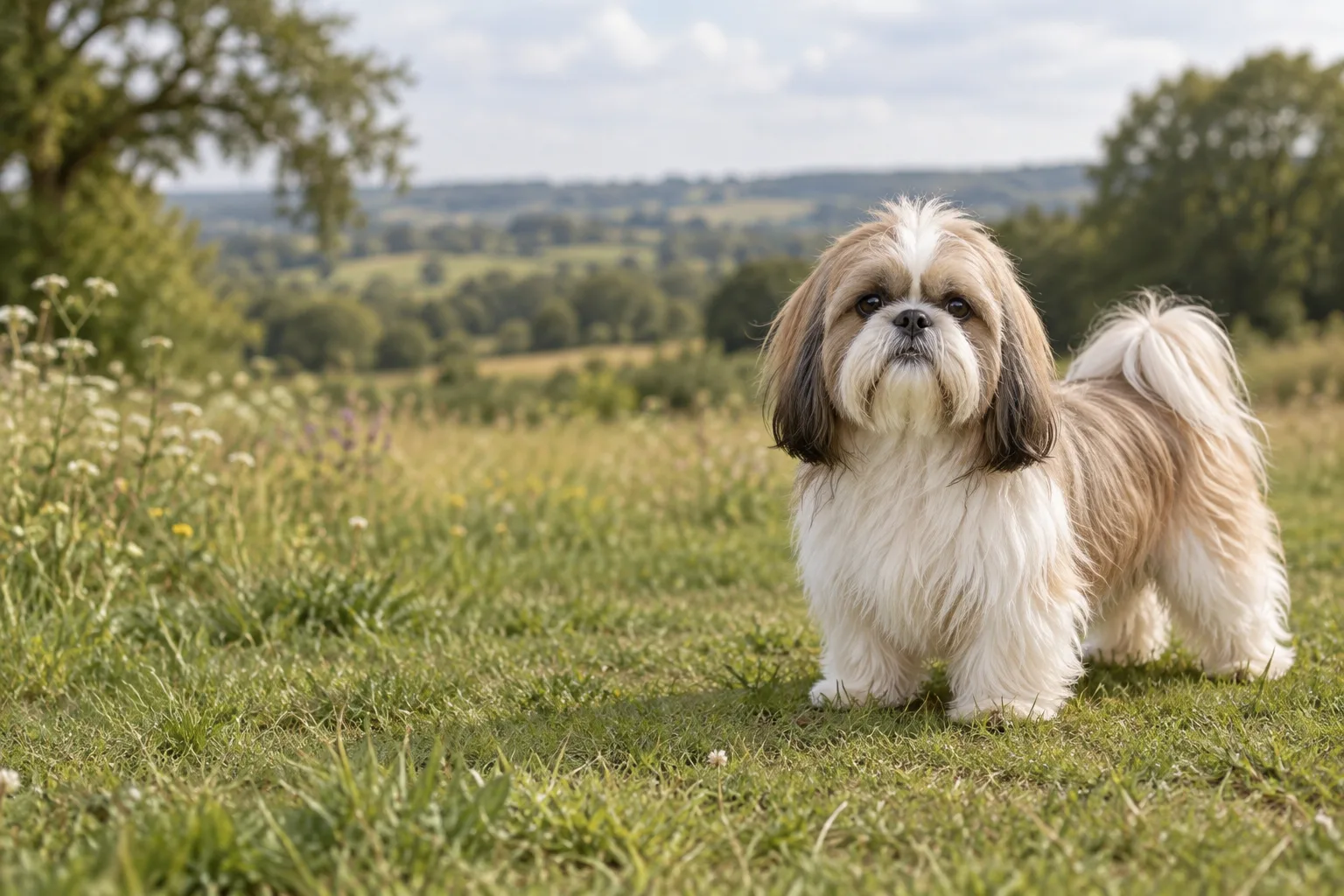
Have you ever wondered why a dog with a face like a small, cross-looking chrysanthemum behaves as if the sofa were a throne? We think the answer is in the history, and the Shih Tzu has a better one than most. It is a story of palaces, gifts between rulers, a collapsed dynasty, a handful of survivors and a great many post-war sofas.
We keep this breed's short entry in the archive, but a short entry cannot hold all of this. So here is the longer version, written the way we like to write these: with the well documented parts kept apart from the parts that are only ever repeated.
A dog from the roof of the world and the imperial court
The Shih Tzu's story starts where Tibet and China meet, and it is honestly a little blurred there. The version most breed histories tell is that small, long coated dogs from Tibet were sent as gifts to the Chinese imperial court, and that the court's own breeding then turned them into something new. The Dalai Lamas are the givers in that telling, and the gifts are usually placed in the seventeenth century. We would ask you to treat the exact year and the exact giver with some care. It is the accepted outline, not a document you can hold in your hand.
What is much more firmly established is the company the breed keeps. The Shih Tzu belongs with the Lhasa Apso and the Pekingese in the old tradition of Asian companion dogs. When researchers published a large genetic study of dog breeds in 2004, the Shih Tzu was among the breeds that sat closest to the base of the dog family tree, grouped with other older Asian breeds. That does not make it a wolf in a topknot, and it does not prove any particular palace story. It does tell us the breed's roots are deep, and that the lion dog was not invented in a Victorian drawing room.
The name is easy to get right, and often gets told wrongly. In Mandarin, shih tzu means lion, and the breed is often described as the lion dog. It was not bred to be a lion, and it certainly was not bred to fight one. The lion in Chinese and Buddhist imagery is a guardian and a symbol, and a small, proud, flowing haired dog was a living echo of it. Some accounts add that the hair on the face grows upward, like the petals of a chrysanthemum, and that gave the breed a second nickname. We love that detail, and we would call it charming rather than proven.
The job: to be beside a person, all day
Here is the point we most want to make about the Shih Tzu, and it is the one that explains almost everything else. The breed was not made to herd, hunt, guard a farm or catch rats. Its work was company. It lived inside, close to people, in households where a dog's entire purpose was to be looked at, kept near and enjoyed.
Look at the dog and the job is written all over it:
- The face. A short muzzle, large dark eyes and a broad, round head. It is the face people find easiest to read, which is not an accident in a dog kept for closeness.
- The coat. A long, flowing double coat, far more decoration than working coat. Nobody sends a dog like that through brambles.
- The carriage. A tail carried in a curve over the back, and a proud, slightly swaggering walk. It is a dog that expects to be admired and usually is.
- The size. Small and sturdy, built to be lifted, carried and settled on a cushion.
The character follows the same logic. A dog selected across generations for how well it lives with people tends to be affectionate, alert and rather convinced of its own importance. It is happier in the middle of the household than out in the garden on its own. Ask a Shih Tzu to spend the day alone in another room and you are asking it to do the one thing its history never prepared it for.
Here we should be honest about what we cannot tell you. There is a good deal written about the breed's exact life inside the palace, how many dogs there were, who kept them and what they were fed. Much of it comes from later retellings. The figure most often named in the breed's imperial period is the Empress Dowager Cixi, who ruled in the later nineteenth and early twentieth centuries and is widely credited with taking a close interest in palace dogs, and in the breeding of them. That is a commonly cited part of the story. Where a claim comes only from a single retelling, we would rather leave it out than dress it up.
Nearly lost, then saved by a few dogs
The dynasty that kept the palace dogs came to an end in 1912, when the last emperor of the Qing abdicated. A breed that had depended on the court's households lost its patrons, and the decades that followed in China brought upheaval, war and hardship. The dogs that had lived in imperial comfort were dispersed, and the breed in China went from cherished to scarce.
The turning point in the West came in the 1930s. The name most tied to it is Lady Brownrigg, who brought a pair of dogs from Peking to England in the first half of that decade. The Shih Tzu and the Lhasa Apso were at that time muddled together, and dogs of both types were shown in Britain under the name Apso. It took the efforts of early enthusiasts to separate them, and the Shih Tzu Club was formed in England in 1934, an important moment in giving the breed its own identity. The Kennel Club went on to recognise the Shih Tzu as a breed in its own right, and the breed's first Challenge Certificates in Britain followed after the Second World War.
You will often read that every Shih Tzu alive today descends from a very small group of foundation dogs, and the number most often quoted is fourteen, imported to Europe across the middle of the twentieth century. It is one of the best known numbers in the breed, and it is repeated in breed histories, so we mention it. We would still describe it as the widely quoted figure rather than a count we have checked ourselves. What is beyond doubt is the shape of it: a small gene pool, a war that interrupted breeding, and a handful of committed breeders who kept the line going.
That handful matters for today. A narrow foundation is one reason responsible breeders and breed clubs pay such close attention to health and to careful pairing.
Across the Atlantic, and onto the sofa
The breed reached the United States after the Second World War. The usual account, and a very believable one, is that American servicemen who had been stationed in Britain and Europe brought dogs home with them in the years that followed. The American Kennel Club records the Shih Tzu being admitted to its Miscellaneous Class in 1955, and giving the breed full recognition in 1969. An American breed club had by then been formed, and the dog that a few enthusiasts had carried across the ocean began to appear in show rings and, much more quickly, in homes.
In the UK the Kennel Club places the Shih Tzu in the Toy Group, and the AKC does the same. That fits the job it was made for. It has been a companion from the start, and the modern show ring and family home have simply carried that job forward.
What that history means if you live with one
The history is not decoration. It is practical guidance, and this is how we read it.
- It wants your company. A dog bred to be beside people for centuries is not going to be at its best left alone for long stretches. If your working week means an empty house, plan for that before you fall for the face.
- The coat is a commitment. A coat that was meant to be admired needs daily care to stay comfortable. Many owners keep it shorter for that reason, and there is no shame in it. Look after the skin and the eyes, and ask your groomer or your breeder what suits your dog.
- The face has consequences. A short muzzle and prominent eyes are lovely, and they also mean the breed can be prone to breathing and eye problems. Both the Kennel Club and the AKC publish breed information, and it is worth reading before you choose a puppy. Choose a breeder who health tests and who is happy to talk about it.
- Stubborn is not the same as stupid. The Shih Tzu was never asked to obey a shepherd's whistle. Expect a dog that thinks about your request, and reward it warmly. Patience and small treats get further than volume.
- Heat matters. Flat faced dogs can struggle when it is hot, in the UK's rare heatwave as much as in an American summer. Keep walks to cool parts of the day.
We should also say what we have left out. The Shih Tzu is surrounded by lovely stories, including tales of emperors who refused to let anyone else own one, and of dogs that were carried in sleeves. Sleeve dogs belong more properly to the Pekingese, and the emperor stories are exactly the kind we cannot support from a source we would stand behind. If you have heard them, you have heard a good tale. Just do not mistake it for a record.
What remains, once the myths are set aside, is enough. A companion breed of deep age, shaped by an imperial court, brought close to loss when that court fell, carried into Britain by a small group of admirers and into America by homesick servicemen, and now one of the most familiar faces in either country. Every dog in that line was a small, proud decision by someone who wanted company badly enough to keep a breed alive.
If you would like to see this one as we drew it, the archive plate for the Shih Tzu is an original digital engraving, and it sits on the breed's page on the site. Have a look at the face, and see whether you can spot the chrysanthemum.
See it in the archive: The Shih Tzu archive plate