
Breed Histories · 26 September 2026
The History of the West Highland White Terrier
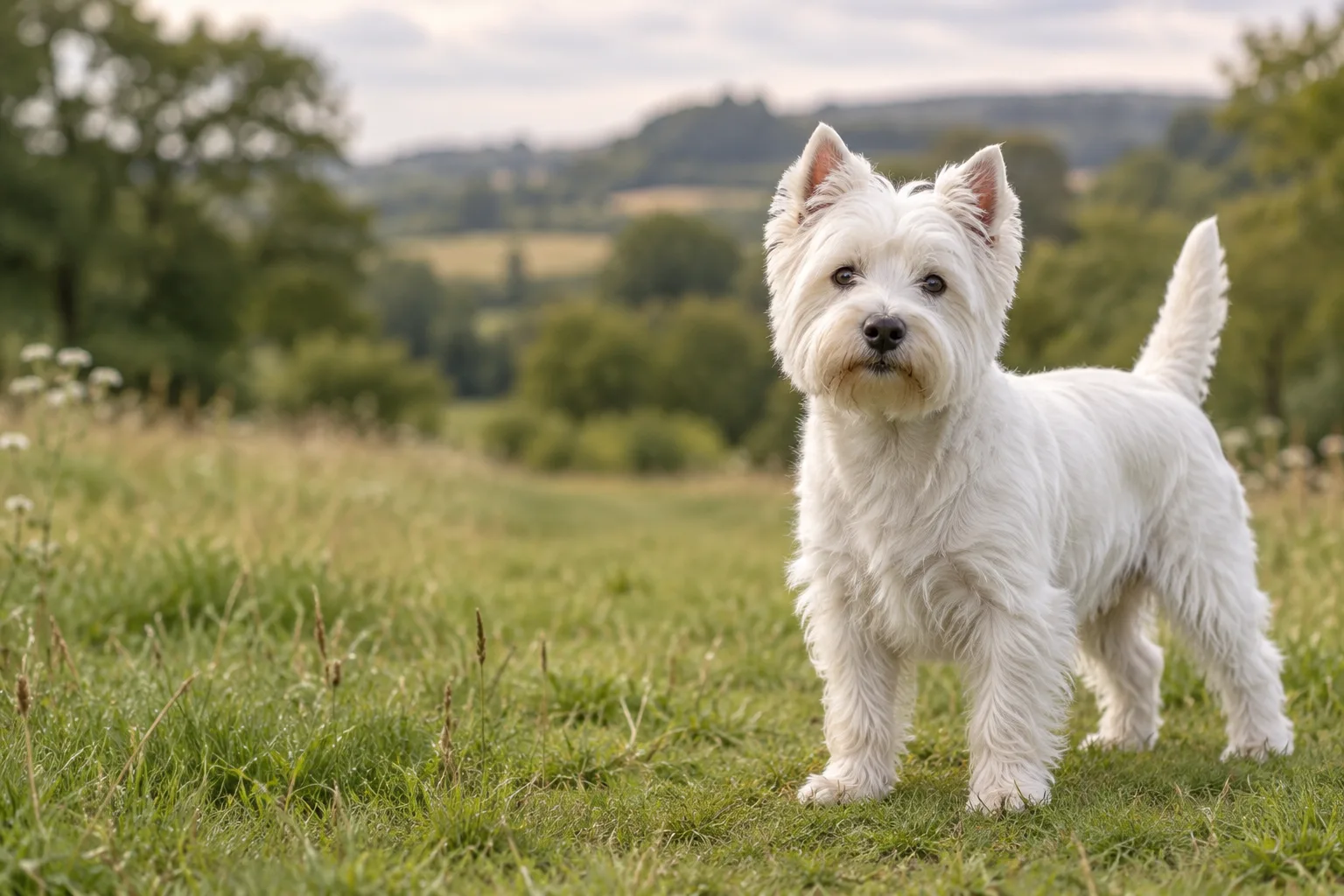
Why does a small white dog, bred to look smart on a lead, still behave as though the garden is a rock pile with a fox somewhere underneath it? Because for most of its story the West Highland White Terrier was not an ornament. It was a tool. Once you know what the tool was for, almost everything about the breed makes sense.
We keep this history the way we keep all the others in the archive: the dates, places and people that The Kennel Club, the American Kennel Club, the breed clubs and the published breed histories agree on are set down as history. The tales that cannot be supported are marked as tales. Where the record is thin, we say so rather than tidy it up.
A terrier from the Highland coast
The Westie's home is the west of Scotland, above all the rocky, broken country of Argyll and the neighbouring Highland coast. It was farming land, and farmers there had a long-standing problem. Foxes took lambs and poultry. Badgers and otters were pests as well. The ground was not open field. It was boulders, screes and cairns, piles of stone with narrow gaps running deep inside.
What suited that country was a dog with a very particular set of qualities. It had to be small enough to squeeze between stones and follow quarry underground. It had to be hard enough to stay in there and face an animal that could bite back, and bold enough to do it without waiting for instructions. It also needed a coat that could take wet, briars and scrapes. It did not need to be handsome, and for generations nobody much cared whether it was.
Those dogs were the small working terriers of Scotland, and they were the common stock behind several breeds we now think of as separate: the Scottish Terrier, the Cairn Terrier and the Westie among them. Their colours varied. Sandy, red, brindle, grey, black and cream all turned up, and pups of more than one colour could appear in the same litter. The Westie is often described as a white cousin of the Cairn for that reason. The two were not clearly divided in the early days, and it took some time before the breed clubs and kennel clubs drew firm lines between them.
The Malcolms, the Roseneath dogs and a famous story
The name most often attached to the Westie's early history is the Malcolm family of Poltalloch in Argyll. Colonel Edward Donald Malcolm is the family member most closely linked with the breed, and the white terriers kept at Poltalloch were for a time known as Poltalloch terriers. They were working dogs first, and the Malcolm kennel bred them steadily for white.
A second strand of the story runs through the Roseneath peninsula, on the Argyll estate of the Duke of Argyll, where white terriers were also kept. Roseneath Terrier was a name used for the type for a while, and it matters later on, because it was the name under which the breed first appeared in America. Other breeders elsewhere in Scotland were also keeping and showing white terriers around the same period, so the breed does not have one neat founder, whatever the shortest version says.
Now for the tale. The best known account says that Colonel Malcolm was out after a fox when one of his dark terriers was mistaken for the quarry and shot, and that he resolved then and there to breed a dog nobody could mistake again. It is a very good story, it gets repeated everywhere, and we cannot point to a source that proves it. It fits with something we do know, which is that a white dog is easy to see against brown rock and heather, and that this was a practical advantage for a hunter with a gun. Treat the shooting story as a story. The practical reason is the safer thing to say.
One more point deserves plain stating. White in these terriers was not always welcome. Among the wider family of Scottish working terriers, white or pale pups were, by many accounts, sometimes regarded as weaker and not worth keeping. What changed at Poltalloch and elsewhere was a deliberate decision to breed for white and to keep the strength. That is what turned a stray colour into a breed.
From working dog to show ring
The move from the hillside to the show bench took place around the turn of the twentieth century. The breed's own history runs from the working kennels of the nineteenth century into organised showing, and by the early years of the 1900s there was a club, a standard and a growing number of exhibitors who wanted the white terrier recognised in its own right.
The name settled on West Highland White Terrier, and by 1908 the breed was recognised in the show world in Britain under it. Across the Atlantic the American Kennel Club recognised the breed in the same period, first as the Roseneath Terrier and then, a little later, under the West Highland White Terrier name we use now. If you are researching a particular date for a particular dog, check the registry of the country you care about. Recognition, first registration and first show classes were not always the same year, and different books give slightly different ones.
Showing changed the dog, as it always does. The working terrier had been chosen for its nerve and its body, and the look followed from those. Once judges and breed standards took over, the look was written down: a small, compact, strongly built dog, a hard white double coat, a broad head carried with a confident air, dark eyes and a black nose. Every one of those features has a working reason behind it. The double coat sheds rain and mud. The strong jaw and short, sturdy legs did the digging and the gripping. The upright, sharp ears and lively expression suit a dog whose job was to keep alert and react quickly.
The Westie's tail is worth a mention on its own. A carrot shaped, straight tail, not too long, was not just a matter of taste. In the working story it is often described as a handle, something a person could grab to pull a dog out of a tight hole. That explanation is widely repeated among breeders and owners, so we offer it as the traditional reading, not as a proven fact of design.
Two world wars and a breed that had to be rebuilt
Like most British breeds, the Westie did not pass through the twentieth century untouched. The First and Second World Wars disrupted breeding across Britain, with kennels reduced, food rationed and the number of dogs bred cut back. Breed histories describe the years around the wars as a period when the number of good breeding dogs fell and carefully built lines were at risk. We are not going to put a number on how many dogs were lost, because we have not found a source that supports one, but the pattern was the same for many breeds and the Westie was among them.
What carried the breed through was the same thing that made it in the first place: a small group of committed breeders who kept the standard in their heads and their best dogs in their homes. When peace came, showing and breeding picked up again, and by the middle of the century the Westie had moved decisively from a specialist's terrier to a popular companion. It became a familiar sight in British homes, and in time in American ones, as a dog that was small, sturdy, easy to spot and full of character.
What all this means for living with one
Here is the practical part, and it is where history earns its keep.
The digging is not a fault. A dog bred to go to ground after quarry will dig, and a garden bed is a very good imitation of a cairn. Give it a sandpit, a dedicated corner or a fenced area, and it will usually be happier than if you simply forbid the whole lawn.
The chase is real. A terrier bred to pursue small animals will often notice a squirrel, a cat or a rabbit before you do. That is why a secure lead and a reliable fence matter, and why even a well trained Westie can turn deaf the moment something small and fast runs across the path.
The confidence is genuine, and so is the stubbornness. Working terriers had to make decisions alone underground, with nobody there to ask. The result is a dog that often thinks it knows best. Short, varied, good humoured training works better than long drilling, and a dog that has been given a job tends to do better than one left to invent its own.
The coat needs the right care. The hard outer coat of a traditional working terrier was meant to be tough, not soft and fluffy. Many owners and groomers use hand stripping or careful trimming to keep the texture and colour right, and it is worth asking a groomer who knows the breed rather than assuming any clip will do. Westies are also known to be prone to skin problems in some lines, so if a dog is scratching a lot, the sensible step is a conversation with your vet, not a guess.
It is a small dog with a big opinion. That trait comes straight from the Highland kennels. A Westie will happily walk for miles and then sit on the sofa, but it wants to be part of what is going on, not left in the corner. If you are in the UK or the US, the same holds: the climate and the culture differ, but the dog inside the white coat is the same one that once worked the rocks of Argyll.
Understanding the job behind the look does one more thing for you. It stops you trying to fix the parts of the dog that were put there on purpose.
The archive plate for the West Highland White Terrier is an original digital engraving, drawn to sit alongside this history. When you have finished reading, have a look at it on the breed page and see how many of the working features above you can find in the drawing itself: the coat, the head, the ears, the tail, the way it stands.
See it in the archive: The West Highland White Terrier archive plate