
Breed Histories · 26 September 2026
The History of the German Shepherd Dog
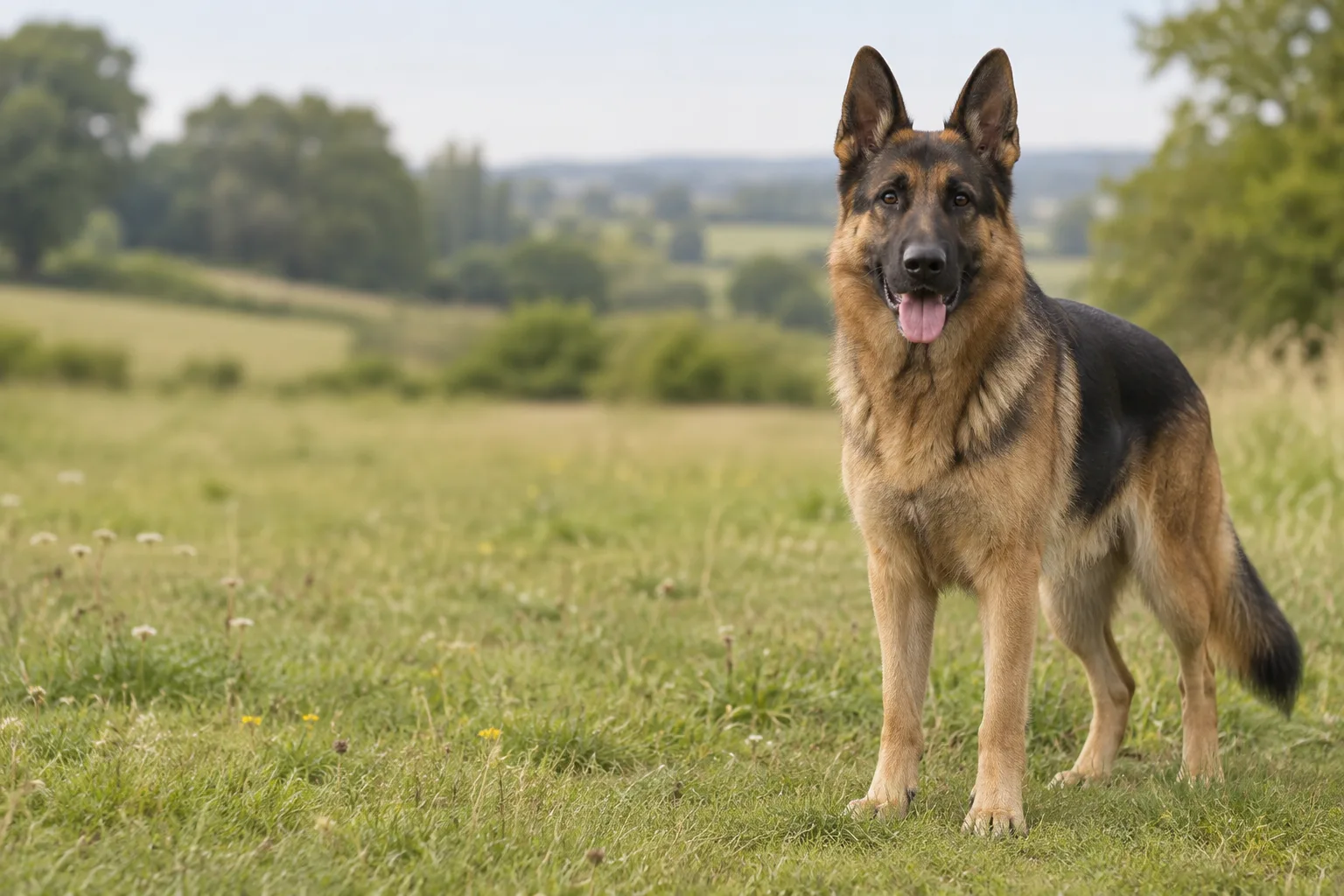
Why does a German Shepherd seem to be waiting for you to give it something to do? Most dogs will settle for a sofa. This one watches your face, reads the room and wants a task. That is not an accident of temperament. It is what the breed was built for, and it is written into its history more plainly than in almost any other.
We keep a breed page for the German Shepherd Dog, with the short version. This is the long one: the flocks, the man, the wars, the change of name and the working life that followed. Where a popular story cannot be supported by the Kennel Club, the American Kennel Club, a breed club or a published breed history, we have left it out or named it as a myth.
Before the breed: a country of shepherds' dogs
The German Shepherd is a young breed. Dogs that herded sheep in Germany are old, but a single breed with a written standard did not exist until the very end of the nineteenth century. Before that, shepherds kept the dogs that did the job in their own district, and those dogs varied. Working dogs in Thuringia, Württemberg and Bavaria differed in coat, ear and build. What mattered to a shepherd was that the dog worked, not how it looked.
The work itself is worth understanding, because it shaped the animal. Many German flocks were kept on open, unfenced ground beside crops. The dog's task was less about rounding sheep up in the way a collie does and more about patrolling the boundary. It kept the flock moving along a route, and it kept the sheep off the neighbouring fields. That takes stamina, a steady head, and the willingness to work at a distance and take direction. It also takes a dog that will stand its ground against a stray animal or a thief. Those are the qualities people still describe in the breed today: endurance, obedience, watchfulness and nerve.
Then the world changed. Industrialisation spread, railways and roads grew, and the old pastoral way of life began to shrink. Fewer shepherds meant fewer jobs for the dogs. The regional types could easily have dwindled away with the work that made them. One man decided that they should not.
The captain, and the dog called Horand
That man was Max von Stephanitz, a retired cavalry officer who had studied at a veterinary college in Berlin. He admired the intelligence and usefulness of the shepherd dogs he saw and believed they should be improved as working animals, not just admired. In 1899 he went to a dog show at Karlsruhe, where he was struck by a yellow and grey dog with a wolf-like look, called Hektor Linksrhein. He bought the dog and renamed him Horand von Grafrath.
Horand became the first dog entered in the stud book of the Verein für Deutsche Schäferhunde, the society for German Shepherd Dogs, which von Stephanitz founded that same year in Karlsruhe with a fellow enthusiast, Arthur Meyer. Horand was registered as number one, known as SZ 1. That entry is the nearest thing the breed has to a birth certificate.
Horand was bred widely, and his descendants, including the dog Hektor von Schwaben, became the backbone of the early breed. The breeders of the time relied heavily on close breeding to fix the type quickly. That worked for consistency, and it is also one reason why later breeders and clubs have paid such close attention to health and to the spread of the gene pool.
What von Stephanitz believed matters as much as what he did. He insisted that the dog's value lay in its work. A handsome German Shepherd that could not do a job was, to him, a failure. The society promoted herding tests and working trials, and it pushed the breed towards what the Germans call a Gebrauchshund, a dog for use. That principle is still the spine of the breed, and it is why the German Shepherd has so long been a police, search and service dog as well as a family companion.
A word on wolves. Horand's wolf-like appearance has fed a very old myth that the breed is part wolf, or was created by crossing dogs with wolves. It was not. The look is the look of a lean, upright, prick-eared working dog, and it does not make the German Shepherd anything other than a domestic dog.
Wars, new names and a film star
The breed's first great test of its reputation came with the First World War. German Shepherds served as messengers, sentries and search dogs, and as Red Cross dogs finding the wounded. Soldiers from Britain, the United States and other nations met the dogs in the field, and many brought a taste for the breed home.
Here the history turns awkward, because the dog was German and the war had just ended. In the United States the American Kennel Club had recognised the breed in 1908 as the German Shepherd Dog. In 1917 it was renamed the Shepherd Dog, and the original name was restored in 1931. In Britain the Kennel Club registered the breed in 1919 as the Alsatian Wolf Dog, after the border region of Alsace, and the word Wolf was later dropped. The name Alsatian stayed on for generations, and it was not until 1977 that the breed was officially called the German Shepherd Dog again in the UK. Plenty of British owners still say Alsatian, and now you know why.
The breed's fame in America owes a great deal to one dog. Rin Tin Tin was found as a puppy in September 1918 by an American serviceman, Corporal Lee Duncan, at a wrecked kennel in Lorraine, France. Duncan took him home, and the dog became a star of silent and early sound films in the 1920s. Whatever people made of his films, they made the German Shepherd a household breed. Rin Tin Tin died in 1932.
The breed also found a gentler public role. Dorothy Harrison Eustis, an American who had been breeding and training working German Shepherds in Switzerland, wrote about the training of guide dogs for the blind. That led to the founding of The Seeing Eye in New Jersey in 1929. Her early guide dog work is remembered through Buddy, a German Shepherd bitch who was partnered with a young man named Morris Frank. Guide dog work in Britain began in the early 1930s, and German Shepherds were among the first dogs used there.
Von Stephanitz died in 1936. The years that followed in Germany were dark, and the breed society did not escape the politics of the regime. We do not think a breed history should skip that, and we do not think a short summary can do it justice, so we leave it here as a note that the breed's story is part of Europe's wider story too. Working German Shepherds continued to serve in both world wars and afterwards in police and military units in many countries.
What the history means if you live with one
The story above is not just a curiosity. It explains the dog on your kitchen floor.
A dog bred to patrol a boundary all day needs something to do all day. If it has no job, it will invent one. That can mean shadowing you from room to room, barking at the postie, herding children, or taking apart a cushion. The fix is not a longer lead on the same walk. It is training, scent games, tasks, and real exercise that engages the mind as well as the legs. Many owners in both the UK and the US find that a German Shepherd is happiest with a regular routine and something to learn.
A dog bred to be steady and watchful also needs careful early socialisation. Watchfulness is useful in a working dog. In an under-socialised pet it can turn into nervousness or suspicion of strangers. Meeting a wide range of people, places, sounds and other dogs early, and calmly, is not optional advice for this breed. It is the difference between a confident guardian and an anxious one.
Health deserves the same honesty. Hip and elbow problems are well known in the breed, and hip and elbow scoring schemes exist so that breeders can make better choices. If you are buying a puppy, ask to see the results for both parents and ask what the breeder is doing to keep the line sound. Coat types and body shape also vary between lines. Some are bred mainly for the show ring and some mainly for work, and the two can look and behave rather differently. Ask what a dog was bred for before you fall for a photograph.
Size is worth knowing too. The breed standard places adults at roughly 55 to 65 centimetres at the shoulder, with males taller than females, and the dog is strong for its height. That matters for a family with small children, a small flat or a lead that gets tugged.
The wider point is simple. The German Shepherd was designed by people who wanted a dog that would think, work and stay close to its handler. Give one that partnership and it repays you in a way few breeds can. Leave one bored and alone and it will tell you so.
We have engraved this breed for the archive, as an original digital engraving plate. You will find it on the German Shepherd Dog page, alongside the dog's picture. It is the best place to look next, and it is the same dog, drawn after the fact of all this history.
See it in the archive: The German Shepherd Dog archive plate