
Breed Histories · 26 September 2026
The History of the Australian Shepherd
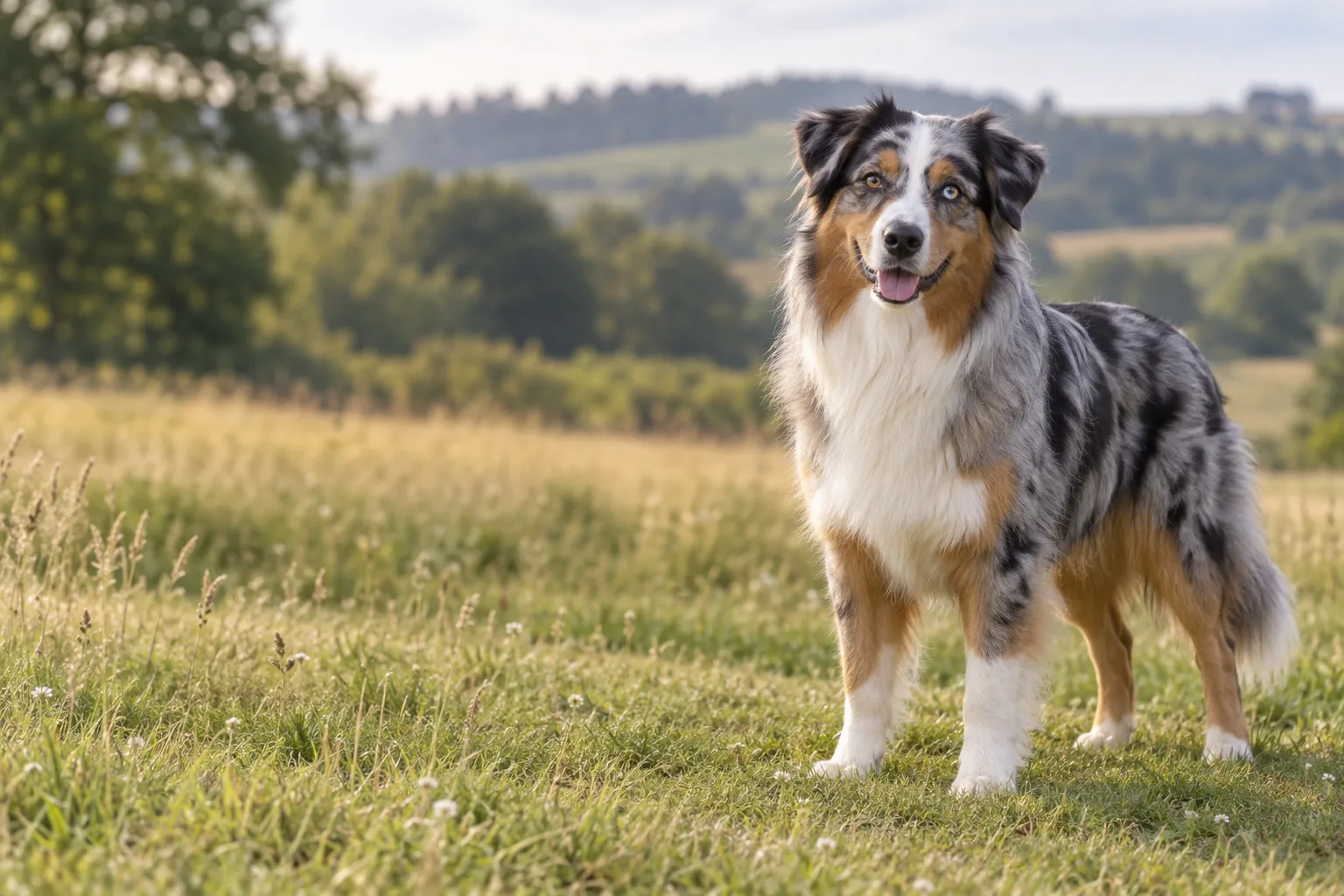
Ask most people where the Australian Shepherd comes from and the answer arrives before you have finished the question. Australia, obviously. It is right there in the name. We would like to begin the archive's entry on this breed by gently taking that answer off the table, because the true story is stranger, and a good deal more interesting.
The Australian Shepherd is an American breed. It took its shape on the ranges of the western United States, among stockmen who needed a dog that could work sheep and cattle across rough, open country all day and still be sensible in the yard at night. Almost everything about how the breed looks and behaves follows from that job. What comes below is a longer account than the short story on the breed page. It draws on published breed histories and the records of the breed clubs, and where a popular tale cannot be supported, we say so.
An American dog with an Australian name
So why the name? The most widely repeated explanation is also the best supported. In the nineteenth century, sheep were brought into the American West from Australia, and shepherds, many of them Basque, travelled with the flocks. Their dogs came too. Americans who saw these dogs arriving with Australian sheep began calling them Australian shepherds, and the label stuck long after anyone stopped thinking about where the flocks had sailed from.
That is about as far as the paper trail goes with any confidence. There is no single founding dog, no foundation kennel and no studbook from those years. The dogs were bred by working people for working results, and the records were kept in memory and conversation rather than in registers. Breed historians generally agree that the Aussie's ancestry is a mixture: herding dogs from the British Isles that travelled west with settlers, the dogs that arrived with the Basque shepherds, and the stockdogs already working on the ranches. Exactly which dogs contributed what has never been settled, and anyone who tells you otherwise is telling a tidier story than the evidence allows.
Before the name settled, these dogs were known by a scatter of others depending on the region and who was talking. Some accounts mention names that pointed to Spain or to New Mexico, or simply to the dog's look, such as bobtail. It is a useful reminder that the Australian Shepherd began as a type of farm dog, recognised by what it did, well before it was a breed with a standard.
One common confusion is worth clearing up here. Australia does have its own herding breeds, the Australian Cattle Dog and the Australian Kelpie among them, and they are separate dogs with their own histories. The Australian Shepherd is not a cousin bred down under and shipped over. If you meet someone who insists otherwise, you have met the myth in person.
Rodeo, film and a breed club
For decades the dogs stayed what they had always been, useful animals on ranches, valued by the people who depended on them and largely unknown outside those circles. The change came in the middle of the twentieth century, and it came through spectacle.
Rodeo was booming across the western states, and stock dogs were part of the show. One name that turns up again and again in the breed's history is Jay Sisler, a rodeo performer whose Australian Shepherds performed trick routines in front of crowds. Audiences who had never seen a ranch dog at work suddenly saw one leaping, weaving and following commands with an eagerness that was hard to ignore. Dogs from his act also appeared in films made by Disney. Many people who later went looking for one of these dogs had first met the breed on a screen or in an arena.
Popularity brought organisation. The Australian Shepherd Club of America was founded in 1957 in Arizona, and it began registering the dogs and drawing up standards for them. This matters more than it might sound. Until then, an Aussie was whatever a good stockman said it was. A registry meant that pedigrees could be recorded, that a breed type could be described and argued over, and that breeders in different states could work towards a shared idea of the dog. It is the point at which a regional working type began turning into a breed in the modern sense.
Recognition by the wider kennel club world took longer. In the United States, the American Kennel Club admitted the Australian Shepherd in the early 1990s and placed it in the Herding Group. Across the Atlantic, the breed arrived in Britain much later still, and The Kennel Club now lists it in the Pastoral Group alongside the other herding breeds. If you are trying to date a particular British dog's line, it is worth remembering that the breed's presence here is comparatively recent, and that many British Aussies trace back to imported American stock.
We should also be straight about something the reader might expect to find here. The record does not describe a war that scattered the breed or a near disappearance that had to be rescued by a handful of survivors. The breed's real risk was quieter. When a working dog becomes fashionable, the pressure shifts from what it can do to how it looks, and the traits that made it valuable can thin out. The Aussie's story is partly the story of how far a rural working type could travel through registries, show rings and living rooms while keeping a good share of its original mind.
What the work built into the dog
A dog that spends its days moving stock over uneven ground needs a particular body. The Australian Shepherd is medium in size, athletic and balanced, with the stamina to keep going and the agility to turn sharply. Its weather-resistant double coat suits outdoor work in changing conditions. None of this was designed to be pretty. It is what a working dog looks like when its owners kept the animals that could do the job.
Then there is the colour. The breed is famous for the merle coat, which produces mottled patches of blue or red, alongside solid black and red, often with white and tan markings. Blue eyes, or eyes of two different colours, appear in the breed and are associated with merle. Many people think of these as the breed's signature. Some Aussies are also born with a naturally short tail, the so-called natural bobtail, a genetic trait and one of the reasons for the old name. Britain does not permit routine docking of pet dogs, so a bobtailed Aussie here is one born that way.
The look comes with responsibilities, and any honest breed history should say so. Breeding two merle dogs together can produce puppies with serious hearing and sight problems, which is why responsible breeders avoid that pairing. Many Australian Shepherds also carry a gene variant known as MDR1, which can make them sensitive to certain drugs. A simple test exists, and it is worth asking your vet about it if you share your life with one.
Temperament is the part that surprises people most. A stockdog cannot wait to be told what to do at every moment, because a shepherd may be a long way off. It has to read the animals, judge the situation and act. That independence, combined with an intense focus on its handler, gives the Australian Shepherd its reputation as a quick, intelligent and sometimes overwhelming companion. The herding instinct does not vanish when the sheep do. It turns up as circling, nudging and the occasional nip at the heels of children, joggers and the household cat.
What this history means for living with one today
If you are weighing up an Aussie in the UK or the US, the history is the most practical guide you have. This is a dog bred to work for hours on real tasks, and it will look for one if you do not supply it. That does not necessarily mean a farm. It means enough daily exercise, and enough to think about, that the dog is not left to invent its own occupation. Agility, obedience, tracking, herding trials and simple trick training all give the breed a job, and its history in rodeo shows how quickly it takes to performing.
Climate and setting differ between the two countries, but the needs are the same. A British garden and a wet walk on the fells will do the same work as an American backyard and a trail, provided the dog is actually taken. The double coat sheds and needs regular brushing wherever you live. And because so many British Aussies descend from American lines, it is sensible to ask breeders about health testing, including the merle pairing and MDR1 questions mentioned above.
Perhaps the most useful lesson from the breed's past is the one about names. The Australian Shepherd was never an Australian dog, and it was not a lapdog dressed up for the show ring either. It is a working dog from the American West that became famous because people could see it doing something clever. Choose one because you want a partner for that kind of life, and it will repay you handsomely. Choose one for the coat alone, and you may find the breed's history arriving in your sitting room, one herded family member at a time.
We have gone well beyond the short version here, but a breed history is always a little unfinished, and we will update this account as better sources come to light. For a look at the breed in another form, the archive plate for the Australian Shepherd is an original digital engraving, drawn for this collection. You will find it on the breed's page.
See it in the archive: The Australian Shepherd archive plate