
Breed Histories · 26 September 2026
The History of the Beagle, the Hound Bred to Hunt on Foot
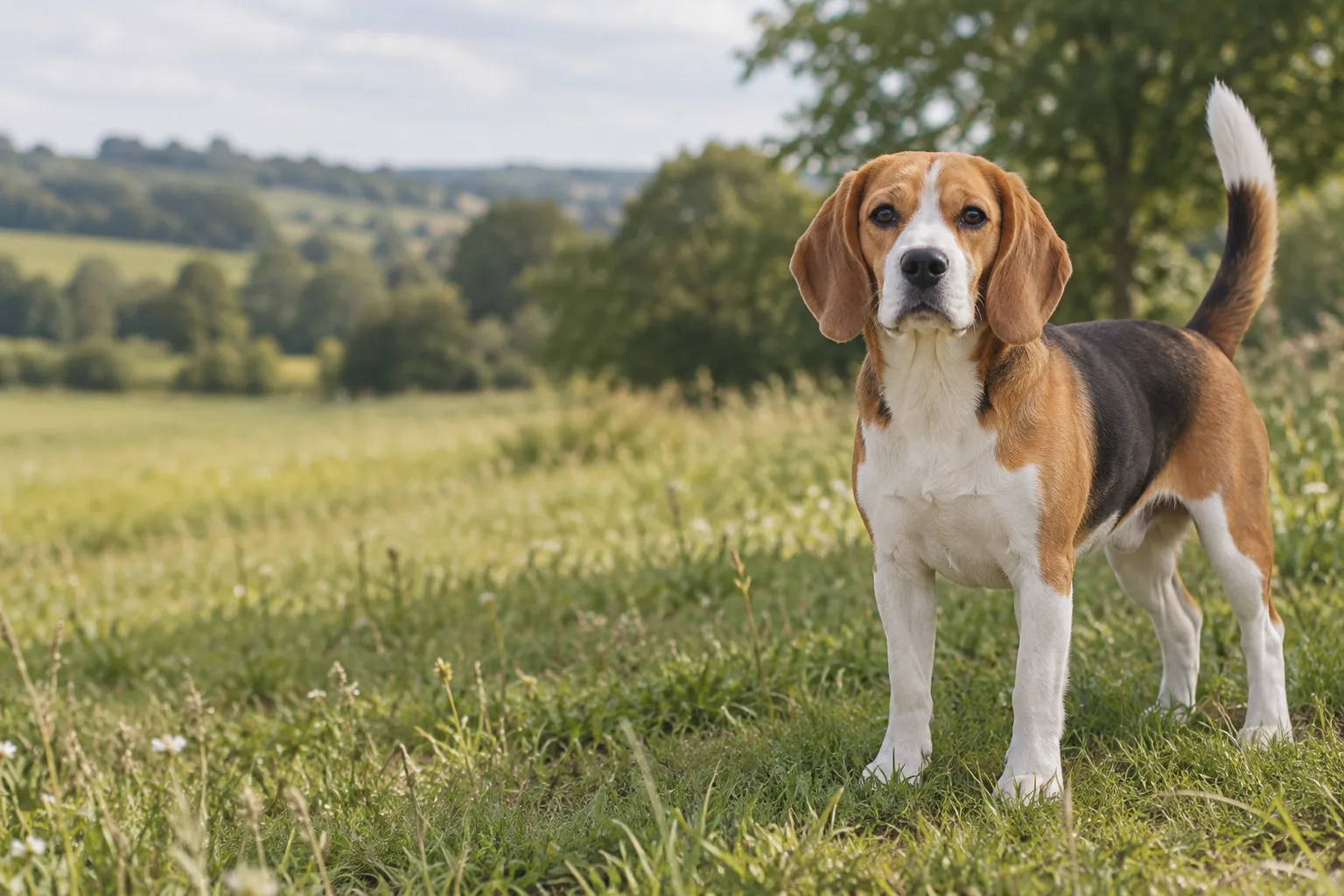
Why does a Beagle stop dead in the middle of a walk, nose down, deaf to everything you say? Because for several centuries that was the whole point of the dog. Everything else about the breed follows from it.
I keep the archive's breed histories, and I will say at the start that the Beagle's early story is a hazy one. Nobody wrote down a birth date for the breed. What we have is a trail of references, a few well documented packs, and a set of kennel club records that begin in the nineteenth century. Where the evidence runs out, I will say so, and I will name a few popular stories as stories.
A small hound with a job
The Beagle belongs to the scent hounds, the dogs that hunt by following a trail on the ground rather than by sight or speed. In Britain, small hounds used to follow hare and rabbit are described in hunting writing over many centuries. Breed histories generally trace the Beagle back to these small hounds, and to older British types such as the Talbot hound and the Southern hound, which are usually credited as ancestors of English scent hounds in general. Some accounts also point to the ancient Greek writer Xenophon and his description of hunting hare on foot with hounds. That shows the sport is very old. It does not prove that the Beagle is.
The origin of the name is unsettled too. Suggestions include an old word for small, or a French phrase meaning an open throat, referring to the dog's voice. Both are plausible and neither is proven, so I would not trust anyone who states one as fact.
What matters is the work. Beagling, hunting hare with a pack of small hounds followed on foot, was a sport that did not need a horse. The hounds were expected to do three things well. They had to find a scent and hold it through a field, a hedge and a ditch. They had to stay together as a pack. And they had to give tongue, which is to say bark and bay clearly, so the people following on foot could tell where the hare had gone. A dog that ran too fast spoiled the day, because the followers could not keep up. A dog that gave up on a cold line was no use either.
Now look at a Beagle with that job in mind. A compact, sturdy body, not too tall, with enough leg to cover rough ground and enough depth of chest for stamina. A broad muzzle and large nostrils, which suit a nose held low. Long, soft ears that hang close to the face. A tail carried up, and a white tip is common, which is useful when a hound is working through long grass and you want to see where it is. The colours vary, with the tricolour of black, tan and white being the one most people picture. None of this was designed for a catalogue. It is the shape of a dog that had to hunt all day and be forgiven for its voice.
Pocket dogs, packs and a Victorian clergyman
You will find it repeated that Henry VIII and Elizabeth I kept tiny Beagles small enough to sit in a pocket or a saddlebag, and that Elizabeth called them her singing Beagles. Small hounds of this kind did exist, and they are usually called pocket Beagles in breed histories. I would treat the detail of the tales with some care, since much of it was written down long after the fact. The Elizabethan pocket Beagle is a real part of the breed's folklore. It is not a well documented ancestor of the dog on your sofa. The small hounds of that type died out.
The story gets firmer in the nineteenth century. Breed histories consistently name the Reverend Phillip Honeywood, who kept a pack of Beagles in Essex in the 1830s, as a key figure in the modern Beagle's foundation. His pack was admired for its hunting and its uniform type, and it is often described as the source of much of the later breed. Other hunting men worked with different lines, and packs varied a good deal from one part of the country to another. The idea of a single, tidy Beagle standard is a later one.
That tidying came with the Kennel Club. The Kennel Club in the UK was founded in 1873, and Beagles were shown and registered from those early years. In 1890 the Beagle Club was formed to write a standard and look after the breed, and the Association of Masters of Harriers and Beagles followed the next year, to look after the packs themselves. It is worth noticing the split. There were the show Beagles, judged on type, and the pack Beagles, judged by whether they could hunt. Many of the working packs continued in the same way for a long time, and the two worlds still overlap.
The Kennel Club standard today describes a sturdy, compact hound with a merry expression, and gives a height range of about 33 to 40 cm. The Beagle sits in the Hound Group.
Crossing the Atlantic
Beagle type dogs were in North America before the modern breed was formalised, but the American Beagle we know owes a great deal to imports from England in the second half of the nineteenth century. American histories, including those from the AKC and the National Beagle Club, credit General Richard Rowett of Illinois with bringing over English Beagles around 1870 and building a foundation of good hunting stock. Other breeders imported hounds too, and in time the American dog and the English dog developed slightly different tastes in type.
The American Kennel Club recognised the Beagle in 1885, and the National Beagle Club followed in 1888. American breeders came to divide the breed by height, into a 13 inch and a 15 inch variety, which suited the way Beagles were used there. In the US the Beagle became a favourite for hunting rabbit, a job it did as cheerfully as it did the British hare. A hound that could do that, and then settle in the house at night, was on its way to becoming a family dog.
By the middle of the twentieth century it had arrived. Charles M. Schulz's comic strip Peanuts began in October 1950, and its Beagle, Snoopy, became one of the most recognisable dogs in the world. I would not claim that a cartoon made the breed popular on its own. Beagles were already widely registered in the US, and were among the most popular breeds there for a number of years. But a dog with a strong personality on the page did the Beagle no harm, and many people now meet the breed as Snoopy before they meet a real one.
I was asked to look for wars and near losses in the Beagle's story, and I have looked. I cannot support a claim that the breed came close to disappearing in either world war, in the way that a few rarer British breeds did. I have seen it written, but not from a source I would put my name to, so I am leaving it out. What is safe to say is that the hunting packs that had sustained the breed in Britain went through the same upheavals as the rest of country sport in the twentieth century, and that the Beagle survived them with its numbers and its reputation intact.
Two later chapters are easy to verify. Beagles have long been used in scientific research, partly because of their size and even temper, which is an uncomfortable part of the breed's modern history and one we would rather name than skip. And in 1984 the United States Department of Agriculture began its Beagle Brigade, using the breed's nose at airports to find fruit, plants and meat in passengers' bags. It is a very tidy modern version of the old job: a small, friendly hound with its nose down, working a scent for its handler.
What that history means for living with one
This is where the old work turns up in your kitchen.
The nose is in charge. A Beagle was bred to follow a scent for hours, and it will do exactly that on a park path, in the garden, or along the skirting board towards the bin. A recall that works beautifully at home can fall apart the moment a good smell appears. Many owners in both the UK and the US use long lines and secure fencing for that reason. It is not disobedience. It is the dog doing the job it was made for, very well.
The voice is part of the package. A pack hound that gives tongue to tell its followers where it is will use that voice. Expect baying, particularly if a Beagle is left bored or alone. Neighbours in a terrace or a flat will notice, so it is worth thinking about before you fall for the face.
It likes company. Beagles were worked in packs and many are happiest with people or other dogs around. A dog that spent its history hunting alongside others tends not to enjoy long, empty days.
It likes its food. A working hound eating on a hunting day needed the fuel. A house Beagle with the same appetite and a sofa needs its portions watching. Weight is a common concern with the breed, and it is worth asking your vet what suits your own dog.
It needs proper exercise, and something for the nose. The stamina that carried a hound across a day's hunting has not gone anywhere. Long walks help, and so does anything that lets the dog sniff and search, such as scattering food in the grass or hiding it around a room. That gives the old job somewhere to go.
None of this makes the Beagle a difficult dog. It makes it a specific one. The owners who enjoy the breed most tend to be those who understand it was made to follow its nose and to be part of a pack, and who arrange a life around that rather than against it.
That is the short version of a long, partly unrecorded history: a small hare hound, a few good Victorian packs, a kennel club standard, a trip across the Atlantic and a place on the family sofa. If you would like to see the breed as we drew it, the Beagle archive plate is an original digital engraving, made for the collection. You will find it on the Beagle's page, alongside the breed's own dog picture, and I hope it does the old hound justice.
See it in the archive: The Beagle archive plate