
Breed Histories · 26 September 2026
The History of the Border Collie
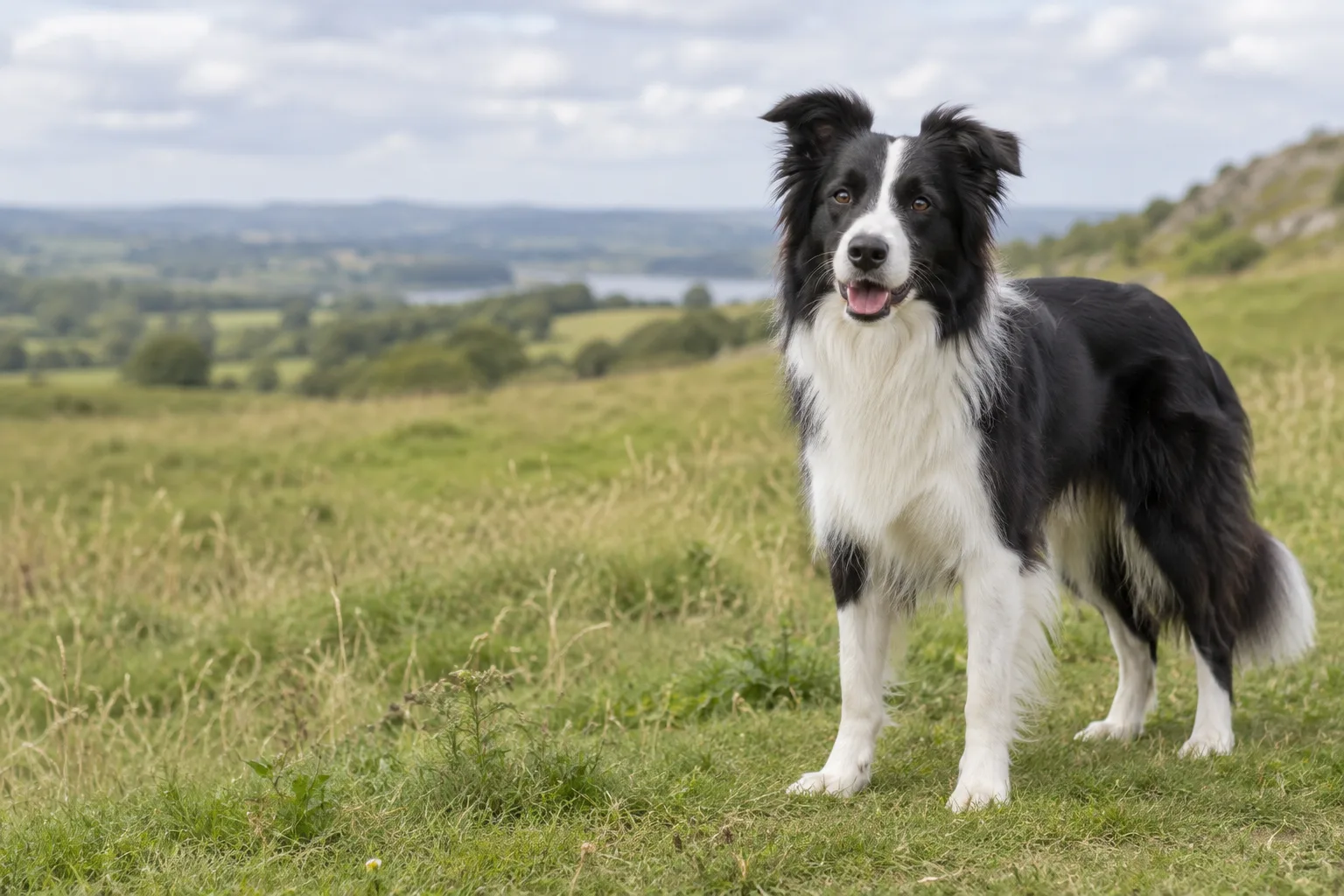
Ask ten people what a Border Collie is and you will get ten answers. The cleverest dog in the room. The agility star. The neighbour's dog that rounds up the postman. Ask the archive and the answer is shorter: a working sheepdog, and almost everything else about the breed follows from that.
The short summary on the breed page gives you the outline. This is the longer story. Where the record is solid, we say so. Where a popular tale runs ahead of the evidence, we say that too.
Hill dogs of the border country
The breed takes its name from the border country between England and Scotland, the hill farms of Northumberland and the Scottish Borders and the ground around them. Sheep had been farmed there for centuries, and shepherds kept dogs of the collie type to move them. Nobody wrote a standard for these dogs. A dog was judged on what it did on the hill, and that single test mattered more than anything else.
Even the word "collie" has no settled origin. One suggestion links it to a word for black or coal-coloured, another to a Scots name for a type of hill sheep. Both are plausible, and neither is proven, so we leave the question open.
You will also hear that Roman legions or Norse settlers brought the ancestors of the breed. It is a tidy story and a good one for a winter evening. We have not found records that support it, so we treat it as a story and not as history.
What we can say is this. By the nineteenth century, shepherds across the north were breeding from dogs that worked well, and only from those. That is why the working Border Collie has always come in a wide range of colours and coats. Appearance was never the point. A dog could have a white blaze, a merle coat, one blue eye or a rough jacket, and none of it mattered as long as it could bring a flock down off the fell and through a gate.
There is a second collie story that runs alongside this one, and it is worth keeping apart. In Victorian Britain the show collie, the rough-coated dog that most people now picture when they hear "Lassie", became fashionable. Queen Victoria's fondness for collies at Balmoral is often credited with helping that fashion along. That dog was bred more and more for the ring. The border sheepdog stayed on the hill. The two share a name and some distant ancestry, but they went in different directions.
Bala, Old Hemp and a name
The sheepdog trial gave the working collie a public stage. The first recorded trial was held at Bala, in Wales, in 1873. It was organised by a landowner, R. J. Lloyd Price, and won by James Thomson, a Scotsman living in Wales, with a dog called Tweed. The idea spread quickly. Shepherds who had always known which of their neighbours kept the best dog could now put it to a test in front of a crowd, with the sheep as the judges.
The next turning point is a single dog. Old Hemp was born in Northumberland in 1893, bred by Adam Telfer, and he died in 1901. He is remembered for a quiet, steady way of working, very different from the loud, fast style many dogs used at the time. Sheep seemed to trust him. He was used heavily at stud, and many working Border Collie pedigrees are traced back to him. Ask a sheepdog breeder about the foundation of the breed and his is usually the first name you hear.
We would be careful about the finer detail of his life, because much of what is repeated about Old Hemp is handed down and not documented. The parts that hold up are his birth in Northumberland, his breeder, his working style and his influence on the dogs that followed.
Organisation came next. The International Sheep Dog Society was founded in 1906 to run trials and, in time, to register working dogs. Then in 1915 the society's secretary, James Reid, used the name "Border Collie" in the register to separate these working dogs from the show collies. The name stuck. It is a good reminder that the breed was defined by its job first and by its name second, and that the name arrived only when someone needed a way to tell two kinds of collie apart.
The job, the dog and the two registers
To understand why a Border Collie looks and behaves the way it does, look at what a trial asks of it. The dog goes out in a wide arc to the far side of the sheep, comes in behind them without alarming them (the lift), brings them back to the handler (the fetch), takes them away in a straight line (the drive), separates chosen animals from the group (the shed), and finally puts them in a pen. All of this can happen hundreds of yards from the handler, guided by voice and whistle.
That work produced the famous "eye". A Border Collie fixes its gaze on the sheep, drops low, and stalks. It does not chase and bite as a wolf would. It controls the flock by stare and position. Take away the sheep and the behaviour does not vanish. It turns up in other places, such as a dog that crouches and stares at a ball, a child on a bicycle or a passing car.
The look follows the work too. A working Border Collie is medium sized and lean, with a moderate coat, either smooth or rough, that copes with wet hills without dragging in the bracken. The body is built for stamina, not for show. It is a dog that trots for miles and turns on a sixpence. The character follows the same logic: a dog that must work far from the handler has to make its own decisions, so it is alert, intense and independent, and it is also very keen to please the person it works for. Think of a good midfielder, always watching the whole pitch and reacting before the play arrives.
Then came recognition, and with it a real tension. The Kennel Club in Britain recognised the Border Collie as a breed in 1976, and the American Kennel Club recognised it in 1995, placing it in the Herding Group. Many sheepdog breeders were uneasy about this. Their worry was simple and it was reasonable: once a dog is judged by its appearance in a ring, appearance can start to matter more than ability, and the thing that made the breed could slowly be bred out. The International Sheep Dog Society kept its own register for working dogs, and that split still exists. Today you can find a Border Collie from working lines, bred for the hill, and one from show or pet lines, and they are not always the same kind of dog to live with.
People sometimes ask about wars or a near-loss, because so many breed histories have one. We have found no supported record of either shaping this breed, so we have not invented one. The pressures on the Border Collie have been quieter. Farms changed, fewer of them needed a dog, and a breed famous for its brains became fashionable in homes that had no sheep.
What that history means at home
If you are thinking of living with a Border Collie, in a UK terrace or a US suburb, the history is not trivia. It is the instruction manual.
First, the dog needs work. A walk round the block is not a job. Owners of these dogs tend to find that mental work tires them as much as physical exercise: training games, scent work, agility, flyball, obedience and herding classes. Border Collies are common in agility rings on both sides of the Atlantic, and there is a reason for that. It gives the eye, the speed and the listening somewhere to go.
Second, expect herding where you did not plan for it. A dog with no sheep may try to gather children, other pets, joggers and cars. This is not naughtiness. It is the breed doing the only thing it was ever bred to do, so it helps to channel it early and firmly, and to keep it kind.
Third, the famous intelligence is real, though it is easy to oversell. A Border Collie named Rico, studied in Germany and reported in the journal Science in 2004, was shown to know some two hundred words. In the United States, a Border Collie called Chaser, trained by her owner John Pilley, a retired psychology professor, was reported to have learned the names of over a thousand objects. Both stories tell you the same thing: these dogs want to learn, and they will learn whatever you teach them, including habits you did not mean to teach. Bored, a Border Collie invents its own games.
Fourth, sound. Many of the breed are sensitive to noise, which makes sense in a dog that once listened for a whistle across a valley. Bonfire Night in Britain and the Fourth of July in America can be hard nights for a dog like this, so plan a quiet room and a calm evening.
Finally, ask about health and about the working or show background of the parents. The Kennel Club, the AKC and the breed clubs all publish guidance on which health tests suit the breed. A responsible breeder will explain the tests done and what the lines were bred for.
The Border Collie's story is a story of a job done so well that the dog became the job. That is why the breed can look so effortless on a hillside and so demanding on a sofa.
Our archive plate for the Border Collie is an original digital engraving, drawn to sit alongside this history. You will find it on the breed's page here on the site, and it is worth a look once you have read the story behind the dog.
See it in the archive: The Border Collie archive plate