
Breed Histories · 26 September 2026
The History of the Border Terrier
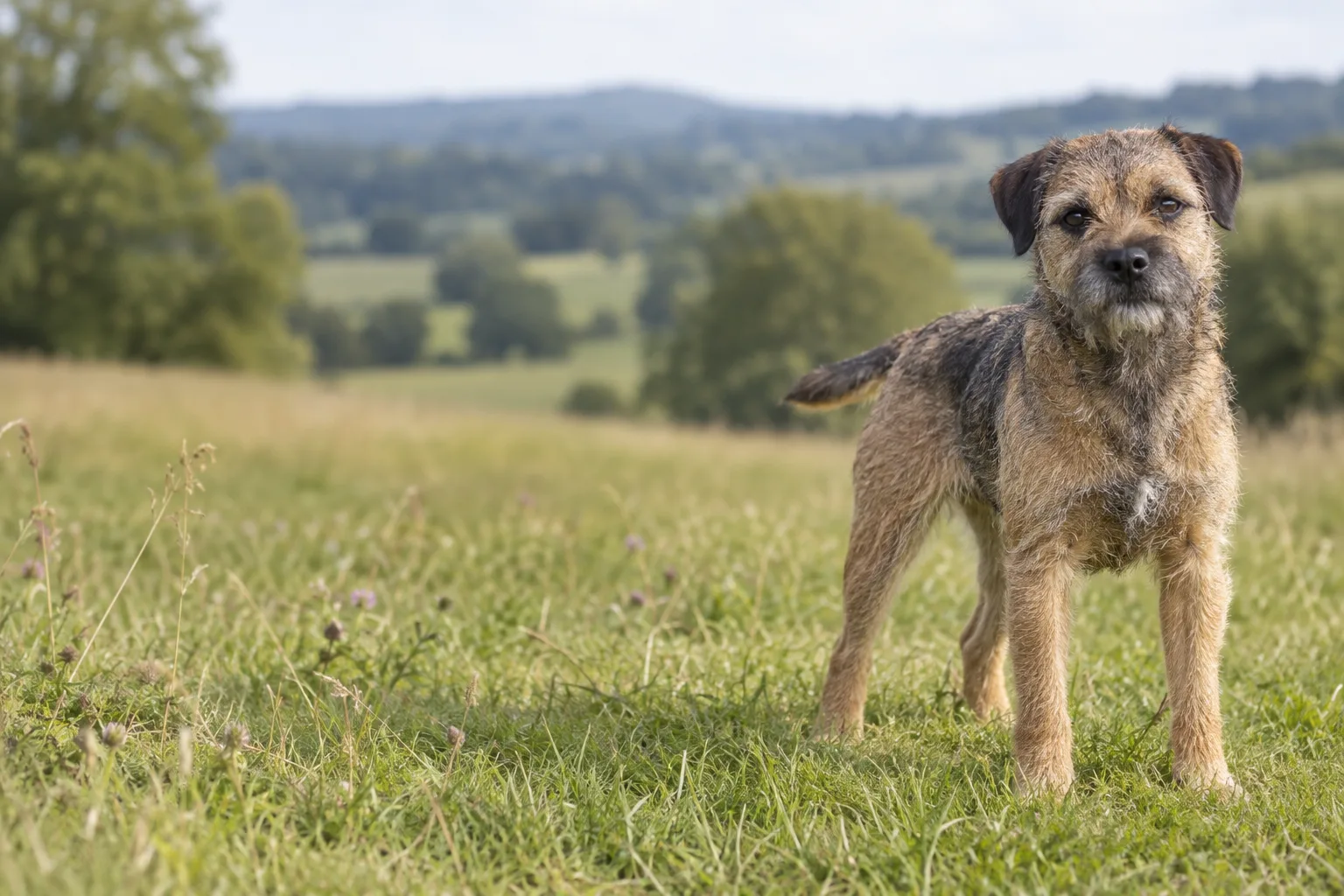
Why does a Border Terrier look so unfussy? No topknot, no sculpted coat, a face that owes something to an otter. The answer is a job, and it was a hard one. Most of what you can see in the breed today, and a good deal of what you will meet on your sofa, comes from that work.
This is the archive's longer account of the breed than the short summary on its page. I have kept to what breed clubs, the Kennel Club, the AKC and published breed histories agree on. Where the record thins out, I say so.
A border country and a practical problem
The Border Terrier belongs to the hill country on either side of the English and Scottish border, above all the Cheviot Hills and the valleys of Northumberland. It is not gentle land. It is open, wet and rough, and in the days this breed took shape it was farmed largely by people raising sheep on the hills.
Foxes were the problem. A fox that took lambs cost a hill farmer real money, and the answer in that country was the hunt, run on foot and on horseback with hounds. Hounds can find a fox and drive it. They cannot follow it underground. A fox that reached a rocky earth in the hillside was safe from the pack, and the hunt was stuck.
That gap is where the terrier came in. The dog had to do three things at once, and each one pulled against the others.
- Keep up with the hunt over long, rough ground, and horses cover a lot of it.
- Be small enough to get into an earth or a gap between rocks.
- Be tough and steady enough to face a fox there, without being so fierce that dog and quarry ended in a serious fight.
Most terrier breeds were built around a version of this brief. What makes the Border distinctive is how it balanced the three.
Many names before one
Before it was the Border Terrier, the type was known by the valleys it came from. Breed histories record names such as the Coquetdale Terrier and the Redesdale Terrier, and Reedwater turns up as well. Nobody was standardising anything. Farmers and hunt servants kept the dogs that worked, bred from them, and swapped puppies with neighbours. Names followed the dales, and dogs in one valley looked a little different from those in the next.
Breed histories tend to agree that these local terriers were being kept in that country by the 1700s, and that people wrote about them before any breed club existed. I would be cautious beyond that. You will sometimes read that the breed is ancient, or that it descends from something specific and noble. I have not found a source that supports those claims, so I treat them as stories. What can be said is that the type came out of working dogs kept for a purpose, and that the purpose did most of the selecting.
People who kept these dogs asked simple questions. Can it go to ground? Can it stay out all day? Will it come home sound? A dog that could not manage a full day's work on the hills did not have many puppies. Looks were secondary, though they were not accidental, as the next part shows.
How the job made the dog
Look at a Border Terrier with the work in mind and the design makes sense.
The size. The dog is small, but not tiny. A terrier that has to go into an earth needs a narrow frame, yet it also has to run for miles behind horses and hounds. The Kennel Club and AKC standards both describe a moderate, lean, working build, and the standard has long been read as asking for a chest narrow enough to be spanned by a pair of hands. That detail is about getting through tight spaces.
The legs. Border Terriers are noticeably longer in the leg than many other terriers. This is the answer to the horse. A dog with very short legs would have been left behind. The breed's history is partly a story of legs long enough to keep up with the hunt and a body slim enough to go underground afterwards.
The head. The breed is often described as having an otter-like head, broad in the skull with a short, strong muzzle. It is one of the first things people remember about the face, and it is also practical. A short muzzle with a strong jaw gives a working terrier a solid grip without a long, easily injured nose.
The coat and skin. The Border wears a harsh, dense outer coat over a soft undercoat, and the skin is described as thick and loose. On a wet hillside, and in a hole in cold rock, that combination sheds water and protects the dog. It is also why the breed is traditionally hand stripped rather than clipped, which keeps the coat's weather-resisting texture. If you have ever seen one come in from the rain and shake off most of it, that is the work still showing.
The temperament. The standards describe the Border as a dog with a good temper. That was not sentimentality. A terrier that spent its working life alongside hounds, horses and people, sometimes in a full pack, could not afford to pick fights with its own side. The breed is remembered as being game and hardy in the field yet reasonably easygoing in company. I would call this the least obvious inheritance and possibly the most useful one.
From hill dog to registered breed
The move from a regional type to a recognised breed is where the record becomes clearer, and where some names appear. Breed histories often mention Jacob Robson of Hexham, in Northumberland, as one of the early breeders and hunt figures connected to these terriers. A dog called Grip is also often named among the early dogs associated with him. I would point out that this is the level of detail the sources support, and I have not filled in dates or pedigrees beyond it.
The turning point came in 1920. That year the Border Terrier Club was formed, and the Kennel Club recognised the breed under the name we use now. It is a good example of a name being fixed after the fact. The dogs had existed for generations under other names, and the new name simply reflected the country they came from.
The AKC followed in 1930, recognising the Border Terrier in the United States as part of the Terrier Group. So, in the wider world, the breed's history as a registered dog is quite short compared with its history as a working one. A few decades of registration sit on top of a much longer period of practical breeding.
You might expect the wars to feature strongly here, since so many breeds saw their numbers fall during them. I have looked, and I cannot find a solid, sourced account of wartime losses for the Border Terrier specifically. I would rather leave the gap than repeat a dramatic story that nobody can back up. If you know of a well documented source, I would like to hear of it.
One more point about the breed's development. Because it was recognised relatively late and stayed tied to working ability, the Border has been described as one of the terriers that changed least between its field days and its show days. Some breeds drifted a long way from their original purpose once they entered the ring. Enthusiasts of the Border have generally tried to hold it close to the working type, and the standards still describe a dog fit to do the job rather than one made for display.
What the history means at home
The interesting question is what all this tells you about the dog beside you now, whether you live in the UK or the US. Here is how I read it. These are readings of the history, not guarantees, and every dog is an individual.
It may want to dig and to chase. A dog bred to go to ground after quarry did not lose that in a few generations. Many owners describe digging, and a strong reaction to small animals moving in a garden or on a walk. A secure fence and a lead near livestock or wildlife are sensible, not fussy. The breed was made to follow a scent and a line into the earth, and some will try to prove it.
It was built for a day out. Those long legs and that stamina were meant for the hills. A Border Terrier does not need to be an athlete, but a dog bred to follow the hunt all day is usually happiest with real walks and something to think about, not a short trip round the block. Boredom in a working type tends to find its own entertainment, and your furniture may not like it.
It is usually sociable. That old need to get along with the hunt is often given as the reason the breed is described as good with people and, with sensible introductions, with other dogs. I would not promise it for any individual, but it is a recurring theme in how the breed is described by clubs and owners.
It needs the right coat care. The harsh coat is part of the design. Ask a breeder or a breed club about hand stripping and how the coat should feel before you decide how to groom.
Do your health homework. Like any breed, the Border has conditions that appear in it more than in some others, and breed clubs and the Kennel Club publish guidance on the health testing and screening they recommend. That is the place to start, before you meet a litter, and it is a better source than any single article.
There is a comfort in knowing why the dog is the way it is. When a Border Terrier lifts its head at a rustle in the hedge, or settles by the fire looking entirely pleased with itself, you are seeing a working past that was built one careful choice at a time, on a hillside, by people who needed a dog to do a job.
The archive's plate for the breed is an original digital engraving, drawn to sit alongside a history like this one. If you would like to see how the dog looks when it is drawn line by line, you will find it on the Border Terrier page, beside the breed's photograph.
See it in the archive: The Border Terrier archive plate