
Breed Histories · 26 September 2026
The History of the Boxer, From Boar Hunter to Family Dog
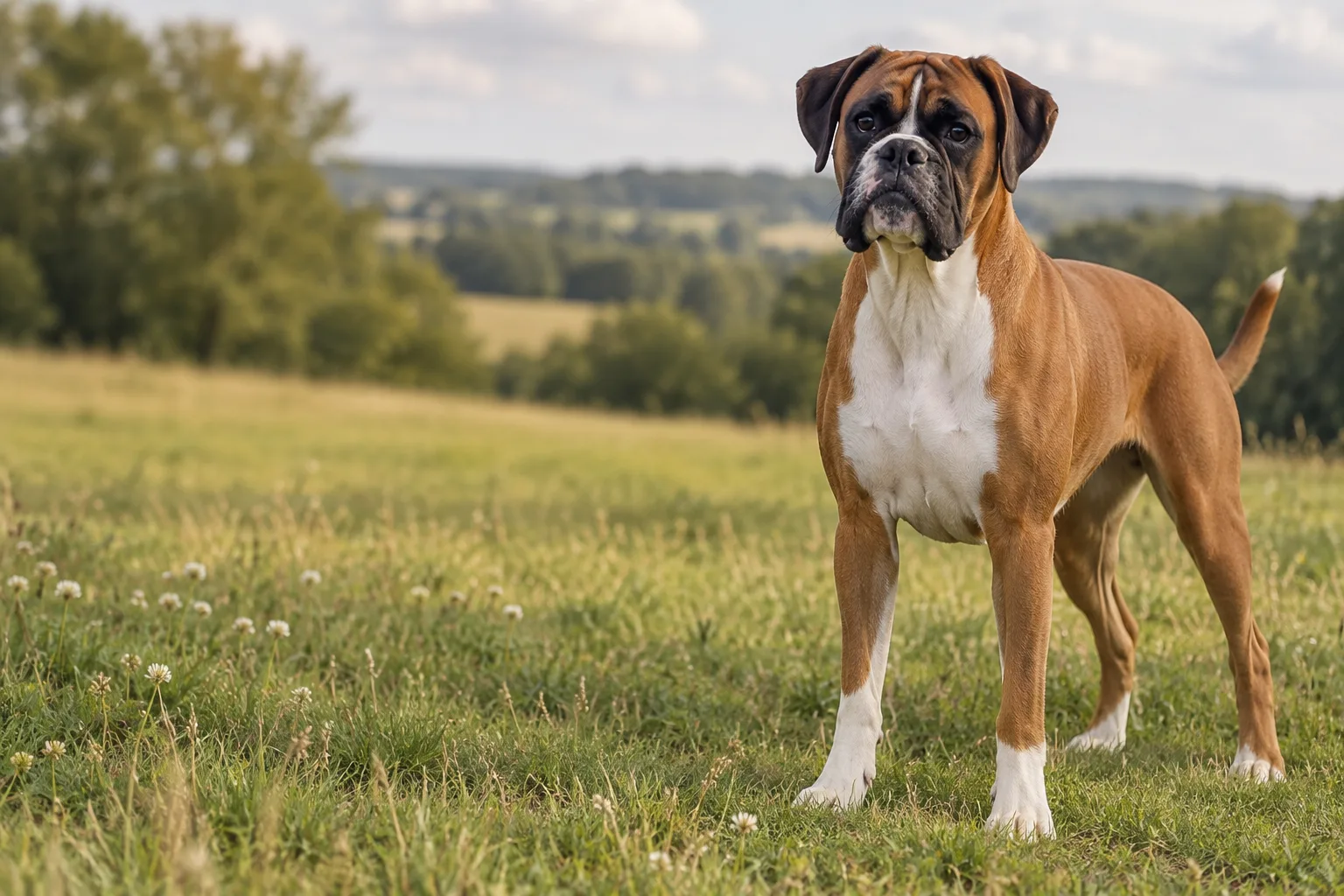
Why does a dog with such a serious jaw behave like an overgrown puppy? Anyone who has lived with a Boxer will tell you the two things sit together quite happily. The history of the breed explains both, and it is a more practical story than the legends around the name would suggest.
We keep the archive, so we are careful about what we say. Where the record is firm, we give it. Where it is argued over, we say so. Boxer history has its share of tidy tales, and a few of them do not survive a look at the sources.
A hunting dog before it was a Boxer
The Boxer descends from the Bullenbeisser, a German catch dog. The name is usually translated as "bull biter", and the job was exactly what it sounds like. Hunters kept these dogs to seize and hold large, powerful quarry, such as wild boar, bear and stag, until the huntsmen could come up. It was not a dog for tracking or fetching. It had to get hold, stay hold and survive the encounter.
That job accounts for a great deal of the modern shape. A broad, deep muzzle with a strong bite gives a firm grip. The muzzle is short, and the nose is set back, so the dog can keep hold of a struggling animal and still breathe. The body is compact, muscular and quick rather than heavy. A dog that had to dodge tusks needed a light, springy frame, and the Boxer has kept one.
Two regional types are often named in the histories: the Brabanter, from the Brabant region, and the Danziger. The Brabanter is the one most closely tied to the Boxer's ancestry. As large-scale hunting of that kind declined across Europe, the demand for the dog declined with it. The old type did not vanish in a single stroke. It was absorbed into a new breed, one that was built to work with people rather than only for them.
English Bulldogs are widely reported to have been part of the mix, though the details of who crossed what, and how often, are not well documented. We would rather say that plainly than invent a pedigree. What is clear is that by the late nineteenth century, breeders in Germany were shaping a smaller, more manageable dog from these catch dog roots.
Munich, and the making of a breed
The turning point is a place and a date: Munich, in the 1890s. Breed histories, including those given by the American Kennel Club, credit a small group of enthusiasts there with setting the type. Names that recur are Friedrich Roberth, Georg Alt and Elard König. Alt owned a female of Bullenbeisser type called Flora, who was bred to a dog known as Lechner's Box. One of their offspring, Flock St. Salvator, whelped in 1894, became the first Boxer entered in the German stud book, in 1904.
The breed's first club, the Deutscher Boxer Club, followed in Munich in 1895, and a first written standard came in 1902. That sequence matters. A club and a standard are what turn a local type into a breed. From that point breeders had something to aim at, and judges had something to measure against. The Boxer of today is recognisably the product of those first few years of careful selection.
The name itself is another matter. The most popular explanation is that Boxers spar with their front paws, rather like a prizefighter. Boxers do use their paws a great deal, and it is a charming habit to watch. But the origin of the word is not settled. Some writers suggest it grew out of an older German word or nickname, and we have not found a source that closes the question. If someone tells you the name is definitely about boxing, treat it as a good story rather than a fact.
The breeders of that time also wanted more than a good hunting dog. Boxers were taken up for other work in Germany, including police and military duties. That direction of travel is important for understanding temperament. A dog asked to be brave, alert and responsive to a handler, and then to be trusted around a household, needs a particular balance. The Boxer's reputation for loyalty and watchfulness comes from that selection.
War, travel and the road to Britain and America
The First World War took Boxers into service as messenger dogs, pack carriers and guards, as many working breeds were. Soldiers who met the dogs abroad, or who served alongside them, came home with an affection for them. That is a common route by which a breed leaves its country of origin, and the Boxer was no exception.
In the United States, the American Kennel Club registered its first Boxer in 1904, and the first American champion followed in 1915. Numbers stayed small for years. The great growth came after the Second World War, when service personnel returning from Germany brought dogs and, more often, a taste for them. The Boxer Club of America was founded in 1935, and by the middle of the twentieth century the breed had a firm hold on American homes and show rings.
One named dog stands out from that period. Bang Away of Sirrah Crest won Best in Show at the Westminster Kennel Club in 1951, and is often remembered as a dog that made the breed famous with the American public. A Best in Show win at Westminster does more for a breed's profile than any amount of description, and the Boxer's rise in popularity followed.
The story in Britain is quieter but no less real. Boxers had a foothold in the country in the interwar years, with breeders and a breed club establishing standards of their own. The years around the Second World War strained every kennel in Europe, and the Boxer in Germany was not spared the upheaval. Dogs were lost, lines were broken, and rebuilding depended on the animals and the breeders that survived. We would be inventing detail if we gave you exact figures, so we will simply say that the postwar generations owe a great deal to the small number of people who kept their lines going through it.
How the working past shows up in the dog today
Every trait people mention when they talk about Boxers has a line back to the work.
The energy. A dog bred to chase, seize and hold big game was never meant to lie about all day. Boxers need proper daily exercise and something to think about. A bored Boxer will find its own job, and you may not like the choice.
The slow growing up. Breeders and owners often describe Boxers as playful well into adulthood, and many say they stay puppyish for years. That clownish streak is part of the charm, but it also means training needs patience and a sense of humour. Start early and keep it kind, since a strong dog that has not learnt manners is a lot to handle.
The watchfulness. Alert, protective and loyal are the words you will read in nearly every breed description, and they fit the guard and service work the dog was given. Most Boxers are affectionate with their own people, including children, but a dog of this strength and this much enthusiasm needs supervision around small ones, if only because of the bounce.
The face. The short muzzle that helped a hunting dog hold on also means the breed can struggle in heat and during hard exercise. On a warm day in either country, walk early or late, keep water close, and take breathing seriously. Fawn and brindle are the familiar colours, with white markings. White Boxers do appear in litters, and breed standards limit how much white a show dog may carry, so if you are interested in one, ask the breeder and your vet about the practical considerations rather than relying on hearsay.
The health. Boxers are prone to certain heart conditions, and breed clubs and kennel clubs encourage screening. A responsible breeder will talk about the health checks done on the parents without being pushed. Lifespan is commonly given as around ten to twelve years. If a seller is vague about health, that tells you what you need to know.
Then there is the matter of tails and ears. Traditionally, Boxers were shown with cropped ears and docked tails, and the standard in the United States still describes the dog that way, though practice varies and many owners choose to leave both natural. In the UK, docking was banned in England in 2007 under the Animal Welfare Act 2006, with an exemption for certain working dogs, and cropping ears is illegal. So a British Boxer is far more likely to look natural, with a long, expressive tail that can clear a coffee table in a single happy sweep. Both looks are the same breed, only shaped by different laws and habits.
What we would want you to take from it
The Boxer's story is a short one by the standards of old breeds. It runs from a hunting dog that gripped boar and stag, through a handful of Munich enthusiasts in the 1890s, into two wars and out the other side into the show ring and the family kitchen. The job changed, but the dog did not forget it. The courage, the springy athleticism and the constant need to be with its people are all still there.
If you live with a Boxer, you already know this. If you are thinking of one, take the history seriously. It is not a dog for a quiet, empty house. It is a dog for people who want a companion with plenty of life in it, and who will meet that life with exercise, training and a good deal of laughter.
We have drawn the breed as an original digital engraving, and you will find that plate on the Boxer page of the archive, alongside the shorter summary of the breed. It is our way of giving this dog the same care that the people in this story gave it.
See it in the archive: The Boxer archive plate