
Breed Histories · 26 September 2026
The History of the Bull Terrier
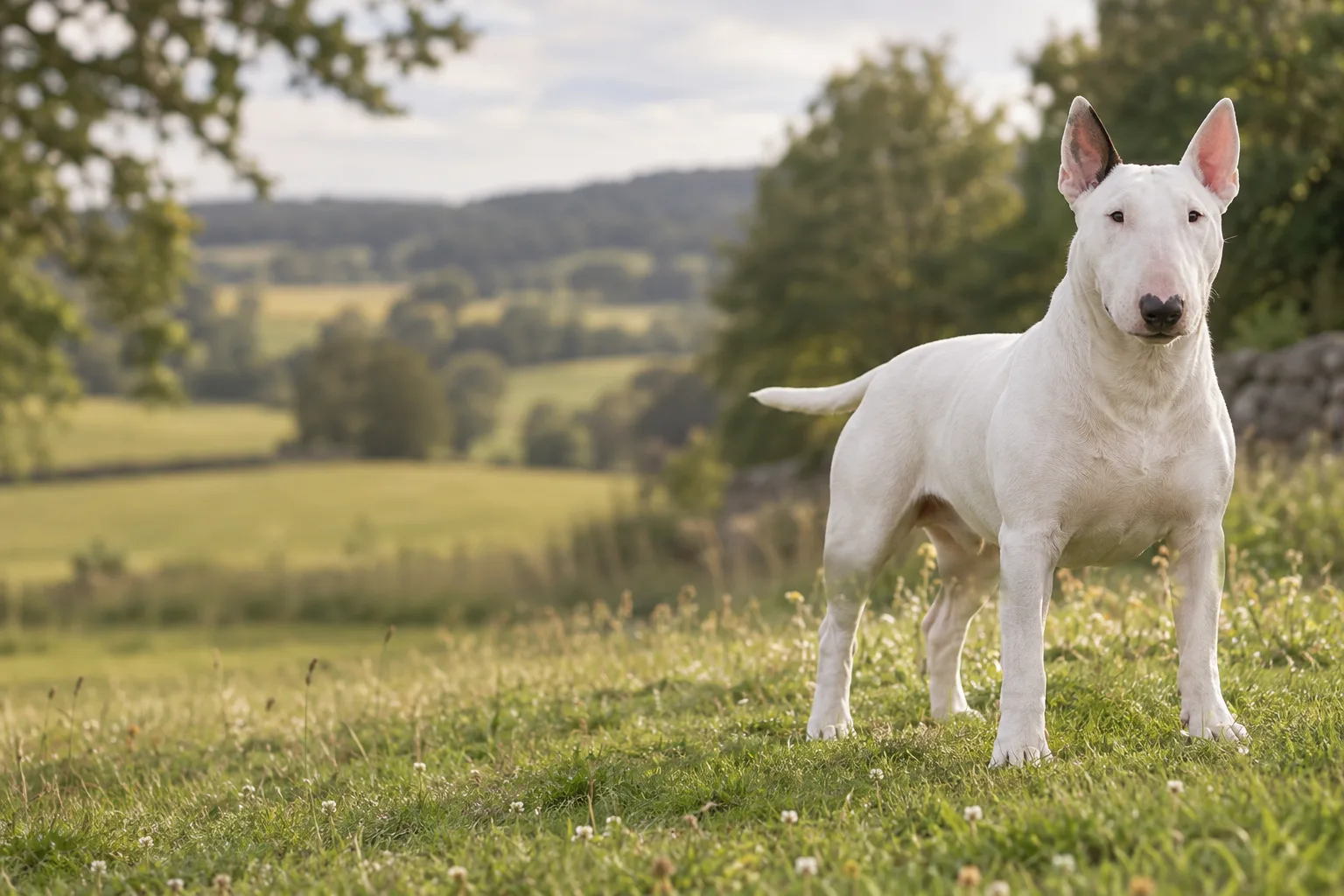
Why does a dog with a face like an upturned boat and the manners of a toddler exist at all? Nobody sets out to design that. The Bull Terrier is the result of a working past, one sharp-minded Victorian breeder, and a great many decisions made by people who liked the look of a white dog. It is worth taking apart, piece by piece.
We are the archive, so a word first on how we handle a breed like this. Breed history is full of tidy stories that get repeated until they sound like fact. Where a claim rests on the Kennel Club, the American Kennel Club, the breed clubs or published breed histories, we say it plainly. Where it is only folklore, we say that too.
The bull-and-terrier years
The Bull Terrier does not start with a show ring. It starts with the sort of dog that Britain's working and sporting men wanted in the early nineteenth century: a compact, muscular, hard-headed animal with a bulldog's grip and a terrier's speed and nerve.
The Old English Bulldog of that period was bred for bull baiting, a cruel spectacle that Parliament outlawed in 1835 under the Cruelty to Animals Act. The law did not end the appetite for dogs that could take punishment. Dog fighting and rat pits carried on out of sight, and the breeders who supplied them crossed bulldogs with terriers to get something quicker on its feet than a pure bulldog and gamer than a pure terrier. These dogs were called bull-and-terriers, and they came in every colour and shape imaginable. There was no breed standard, no registry and no agreement about what the ideal dog should look like.
Those dogs are the raw material. They give the Bull Terrier the things that a first-time owner notices in the first week: the grip, the stubbornness, the sheer physical confidence. The breed did not lose those traits when it became respectable. It kept them and was given a new coat of paint.
James Hinks and the white dog
The man most closely tied to the modern Bull Terrier is James Hinks of Birmingham. In the middle of the nineteenth century he set about refining the bull-and-terrier into a cleaner, more elegant dog, and he chose white as his signature. Breed histories generally describe his cross as the Old English Bulldog with the now extinct white English Terrier. Some accounts add the Dalmatian, and others the Pointer or Whippet, in the mix. Those extra ingredients are argued over, and it is safest to treat them as a matter of debate rather than settled fact.
What is not in dispute is that Hinks wanted a dog that could stand out on a show bench. He wanted it upright, longer in the leg than the old bull-and-terrier, and finished in a sharp, gleaming white. His dogs were sometimes called White Cavaliers. Hinks and his family are also credited with a white bitch named Puss, born around 1860, who is often cited as one of the foundation dogs of the type. She turns up again and again in breed histories, and she is a good example of why named dogs matter to us: a single animal can end up standing for a whole idea of what a breed should be.
Timing helps to explain why the idea landed. Organised dog showing in Britain began in the 1859 and 1860 shows, and it grew quickly through the 1860s. A handsome, clean white dog with a history of pit work behind it was just what a new class of dog-show enthusiast wanted to put in front of a judge. The bull-and-terrier's rough reputation was polished up. The Kennel Club was founded in 1873, and the Bull Terrier had entered the world of pedigrees and standards well before the end of that decade.
Across the Atlantic, the American Kennel Club registered the breed in 1885, which places it among the earlier breeds admitted to its stud book. The Bull Terrier Club in Britain followed in 1887, giving the breed its own body to argue about type. Arguing about type is what breed clubs do best, and the Bull Terrier gave them plenty to argue about.
The head, the colours and the little ones
If you look at an early Bull Terrier and a modern one side by side, the difference is in the head. The Victorian dogs had a more ordinary terrier profile, with a muzzle that dipped in a little below the eyes. Over the following decades, breeders selected for a long, deeply filled, downward-curving face, so that the skull from the top of the head to the tip of the nose forms one continuous curve. The standard calls it egg-shaped, and it is unique in the dog world. The small, triangular, deep-set eyes give the breed its unmistakable expression, half mischief and half quiet calculation.
That head was a breeders' project, not something a working dog needed. It is a good reminder that the Bull Terrier of today owes as much to fashion in the show ring as to the pit. The breed became a shape first and a job second.
Colour is the other turning point. For a long time the white dog was the Bull Terrier, and coloured dogs were regarded as something less. Coloured puppies still turned up, and breeders who liked them brought in brindle and other colours deliberately. The Kennel Club recognised the coloured variety in the 1930s, and the breed today has two varieties, white and coloured, both judged against the same standard. It is a slightly awkward fact that white Bull Terriers, especially those with white heads, can be prone to deafness. Responsible breeders test for it, and any owner of a white Bull Terrier should ask about hearing when choosing a puppy.
Size is the third part of the story. Miniature Bull Terriers had been kept and bred in Britain for a long time, but they were a smaller version of the same dog rather than a separate breed. The Kennel Club took the miniatures under the same breed banner in the 1930s, while the AKC gave them their own recognition much later, in 1991. They keep the same head, the same character and the same appetite for trouble, only in a smaller, more portable package.
Dogs people remember
Bull Terriers have a habit of turning up in the culture at large. Bill Sikes's dog Bull's-eye in Charles Dickens's Oliver Twist (1838) is a bull-and-terrier type, published years before Hinks did his best work. It is the sort of dog that the book's readers would have recognised at once, and Bull's-eye's unpleasant owner colours the way the type was seen for a long time afterwards.
The twentieth century did a good deal to repair that image. General George S. Patton is often pictured with his Bull Terrier, Willie, and the story is a favourite of the breed's admirers, though we would treat the finer details as anecdote rather than record. In the US, the breed became familiar to a much wider public through advertising. A dog known as Spuds MacKenzie fronted a beer campaign in the late 1980s, and a Bull Terrier with a painted eye patch became the face of a US retail chain. Both made people smile, and both put the breed in front of people who had never met one. Neither, it must be said, prepared anybody for the reality of owning one.
We should also put down one popular myth. Bull Terriers are sometimes described as the original gladiator or as a breed that was made solely for fighting. That is a gross simplification. The bull-and-terrier stock in the background did work in the pits, but the Bull Terrier as we know it was shaped by show-ring breeders in the nineteenth century and after, and it has spent far longer as a companion than it ever spent in a pit.
What the history means for living with one
Every point above has a consequence in a house, and it is worth spelling them out.
They are strong for their size. That bulldog heritage is real. A well-built adult Bull Terrier is dense, muscular and difficult to hold if it decides to leave. Sturdy leads and a secure garden are not optional extras.
They are clowns, and they are stubborn. The terrier half of the inheritance means independence. A Bull Terrier can be affectionate to the point of clinging, and then take a stubborn stand over a pair of slippers. Short, cheerful, consistent training tends to work better than long sessions, and a bored Bull Terrier will find its own entertainment.
Early socialisation matters. Because of the breed's past, some individuals can be intolerant of other dogs, and any owner should meet that head on with early and careful introductions. This is not a trait shared equally by all dogs, but it is common enough to plan for.
They want company. This was a dog bred to work near people, and then to sit in the parlour with them. Left alone all day, it may take apart the sofa.
The legal position is a separate question, and it differs by country. In the UK, the Bull Terrier is not one of the breeds named in the Dangerous Dogs Act 1991, though every dog owner is still responsible for their dog's behaviour under UK law. In the US, rules are set by states, cities and sometimes landlords and insurers, and can change from place to place. If you are moving with a Bull Terrier, or thinking of getting one, check the local position before you commit.
None of this is a reason to avoid the breed. It is a reason to choose it knowingly. People who live with Bull Terriers tend to describe them as loyal, funny and slightly ridiculous, which is a fair summary of a dog that started in a rough trade and ended up on a sofa.
The archive plate for the Bull Terrier is an original digital engraving, and it is the natural place to end. Look at how the line of the head runs, from the top of the skull down to the nose in one unbroken curve, and you are looking at a century and a half of Birmingham breeders' choices in a single stroke. You will find it on the Bull Terrier breed page.
See it in the archive: The Bull Terrier archive plate