
Breed Histories · 26 September 2026
The History of the Cairn Terrier
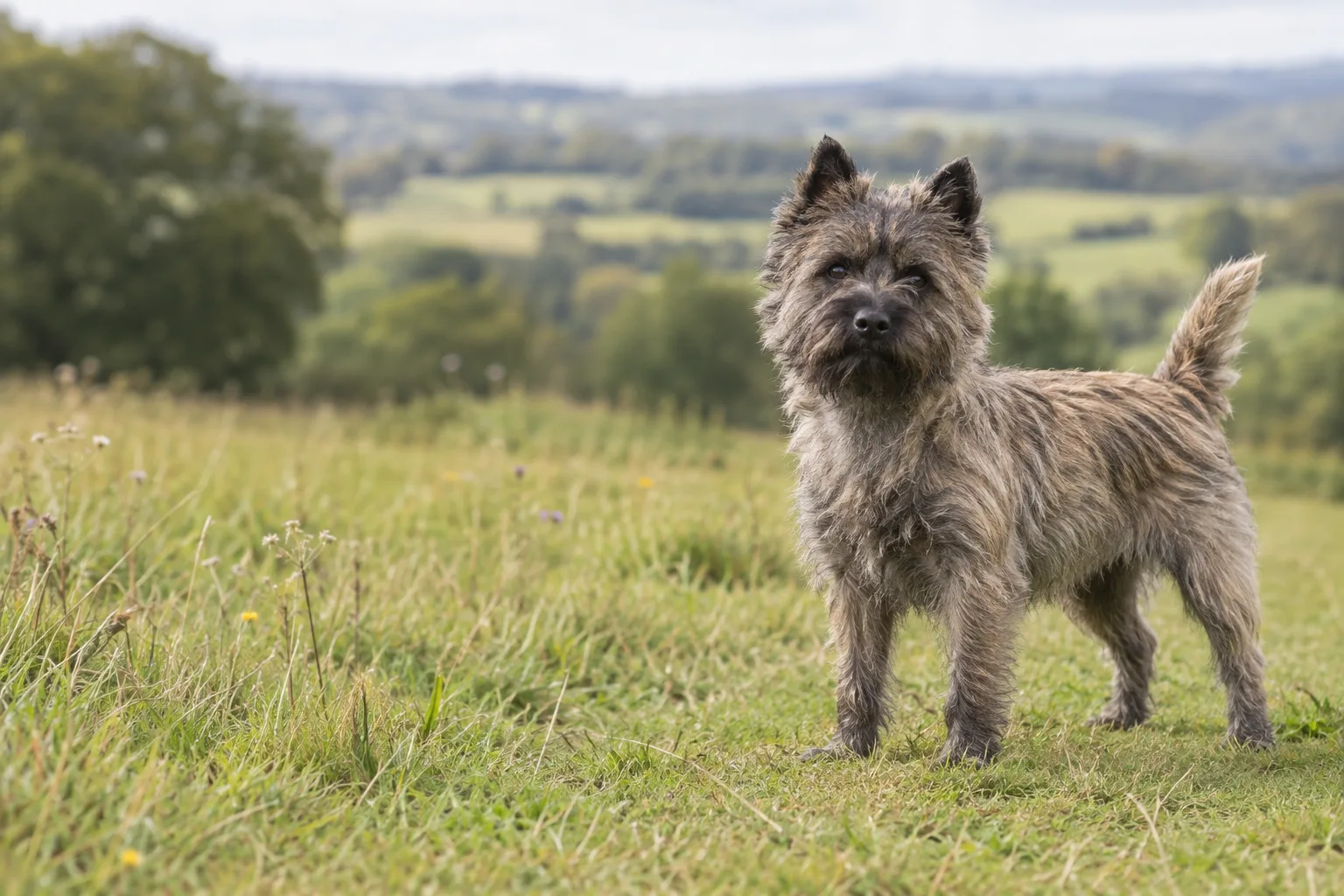
Why is a small dog named after a heap of stones?
Because that heap of stones was the whole point of the dog. Before the Cairn Terrier was a show ring exhibitor, a film star or a lap companion, it was a working terrier in the Scottish Highlands and the Isle of Skye. Its job was to go into the cairns and find what was hiding there. Almost everything you see in a Cairn today, from the shaggy coat to the busy, cheerful stubbornness, traces back to that one task.
We keep the archive's breed pages short on purpose. This is the longer version. Where the sources agree, I have said so plainly. Where a popular story cannot be properly supported, I have said that too, because breed history is full of tidy tales that grew in the telling.
A working dog among the stones
A cairn is a pile of stones. In the Highlands and islands, cairns were built as markers and memorials, and stone also collected in heaps where land was cleared, along dykes and on rocky hillsides. Those piles made ideal cover for foxes and other animals that farmers and shepherds regarded as pests. The animals could slip deep into the gaps, well out of reach of a man or a larger dog.
The answer was a small, hardy terrier with the nerve to follow. The Kennel Club and the American Kennel Club both describe the Cairn as a breed developed in Scotland for this kind of work, bolting quarry from among rocks and stone heaps. That is the core of the story and it is well supported. The dog had to be small enough to squeeze between stones, strong enough to keep its footing on rough ground, and bold enough to go in when it would rather have stayed out. It also needed a voice, because a keeper standing outside had to know where the dog was and what was going on beneath the rocks.
The Cairn did not arrive as a single tidy breed. Its ancestors were the working terriers of the western Highlands and the islands, valued for what they could do rather than for how they looked. Farmers and keepers bred from the dogs that got the job done. Nobody was writing a standard. Appearance followed function, and that is exactly why the modern Cairn still looks the way it does.
Look at the dog and you can read the job:
- A hard, weather-resistant outer coat over a soft undercoat, for wet, windy hillsides and for scraping against stone.
- A compact body on short, strong legs, so it can turn in a tight space.
- A broad head with strong jaws, and a fox-like, alert expression.
- Big feet for digging, and a tail carried cheerfully, which also gave a handle of sorts when a dog needed pulling out of a hole.
Even the coat colours make sense. Cairns come in shades such as cream, wheaten, red, sandy, grey and brindle, and the breed standards are happy with dark points on the ears and muzzle. A dog in the colours of the hillside was harder to lose sight of against the heather than a bright white one might be, and the working people who bred them were not choosy about colour. They cared about the work.
Skye, a shared ancestry and a name change
The early history is where the tidy stories start to wobble. Before the Cairn had its own name, dogs of this kind were lumped together with other Scottish working terriers. A common account is that short-haired terriers from the Isle of Skye were shown as Skye Terriers, and that people who knew the difference objected. The Skye Terrier we recognise today, long-coated and low to the ground, was a different type from these hardy little workers, and the two did not fit comfortably under one name.
The solution was a new name that described the work. The breed became the Cairn Terrier, and the Kennel Club recognised it in the early years of the twentieth century, around 1910. A breed club followed. The name is one of the more sensible in dog history. It tells you what the dog did and where.
There is also a well-repeated link between the Cairn and the West Highland White Terrier. Both breeds come from the same broad pool of Scottish working terriers, and the accounts we have suggest that light-coloured puppies turned up in Cairn litters in the early days. Over time the white dogs were developed as their own breed, while the Cairn standard kept the darker, weathered colours. I would treat the fine detail of who bred what, and when, with caution. Individual kennel stories vary, and some of them were written long after the events. What holds up is the shared ancestry, not any single dramatic moment of separation.
One myth is worth naming. You will sometimes read that the Cairn is the oldest of all terrier breeds, or that it can be traced in an unbroken line back many centuries under its present name. The breed's ancestry as a Scottish working terrier is old. The name and the pedigree breed are not. Written breeding records, a standard and a formal register came with the Kennel Club era. Before that, we have a type of dog, not a documented breed.
Across the Atlantic, and onto the silver screen
The Cairn crossed to America not long after it was recognised in Britain. The American Kennel Club admitted the breed in 1913, and the Cairn became part of the AKC's terrier group. From there it spread the way a small, tough, easy-to-house dog would: through breeders, enthusiasts and, eventually, a very famous film.
That film is The Wizard of Oz, released in 1939. Dorothy's dog, Toto, was played by a Cairn Terrier called Terry. Terry was a female dog, which surprises people who assume Toto must have been a male. She worked with her trainer for the film and appeared in several others. Her name was later changed to Toto, in tribute to the part that made her famous. It is one of the best-documented dog stories in cinema, and it did the Cairn's reputation a great deal of good, on both sides of the water.
It is worth being careful about what Toto proves, though. Fame did not change what the breed is. A dog who could run across a film set and hit her mark for a trainer was still a terrier, alert, quick and full of purpose. The film simply showed a wide audience what owners already knew: this is a small dog with a big personality.
What about the wars? Like most British breeds, the Cairn came through the two world wars in a country under strain, with food short and kennels reduced. I have not found a specific, well-sourced Cairn story for those years that I am happy to repeat as fact, so I am not going to invent one. The safe statement is a plain one. Breeding was disrupted across the whole pedigree dog world in those decades, and the Cairn, as a compact, robust and adaptable dog, kept its place. If a breed club or published history gives you a firm number for a particular year, go with that rather than any round figure you read online.
What the history means for living with one
This is the part that matters if you share your home with a Cairn, or you are thinking about it. The dog was bred to work alone, out of sight, making its own decisions among the rocks. Many owners say they see that in the everyday dog.
Expect a dog that:
- Digs. A terrier that digs is a terrier doing what it was made to do. Give it a patch of its own, or a sandpit, rather than fighting the instinct across the whole garden.
- Chases. Small moving things are irresistible. Secure fencing and a lead near roads and livestock are sensible, and recall needs steady, patient work.
- Uses its voice. Cairns tend to be alert and alarm-prone. The dog that once called from a cairn now reports on the postman.
- Thinks for itself. Independence is a feature of the breed, not a training failure. Short, varied, reward-based sessions usually suit terriers better than long drills.
- Is happy to be busy. This is a small dog, but it is not a couch ornament. Walks, games and something to sniff and dig keep it content.
The coat carries its history too. That harsh outer layer was made for the weather, and it is usually maintained by hand stripping or regular grooming, not by clipping it down, though your breeder or a groomer who knows the breed will advise on what suits your dog. Brushing regularly keeps the coat weatherproof and stops tangles. Most owners find a Cairn gets muddy easily and dries quickly, which is a fair trade.
Cairns are generally described by breed clubs as sturdy little dogs, and many live into their teens. As with any breed, health varies between lines. The Kennel Club and the breed clubs publish current advice on health testing and on choosing a breeder, and that is where I would send anyone looking for a puppy, rather than trusting a summary written here.
The UK and US experiences of the breed are close cousins. The Kennel Club and the AKC both place the Cairn in the terrier group, both describe the same small, shaggy, independent, game little dog, and both draw on the same Scottish origin. Owners on each side of the Atlantic tend to describe the same qualities: a bold, cheerful dog with plenty to say and no idea how small it is.
That, in the end, is the whole history in a sentence. A dog was needed to follow quarry into the stones, and the breed that came out of that need never forgot the job. It still carries the cairn in its name and the hillside in its coat.
We have drawn the Cairn Terrier as an original digital engraving for the archive, and the plate for this breed sits alongside its page. If this history has made you look at a Cairn a little differently, the plate is the place to see it as we see it.
See it in the archive: The Cairn Terrier archive plate