
Breed Histories · 26 September 2026
The History of the Cavalier King Charles Spaniel
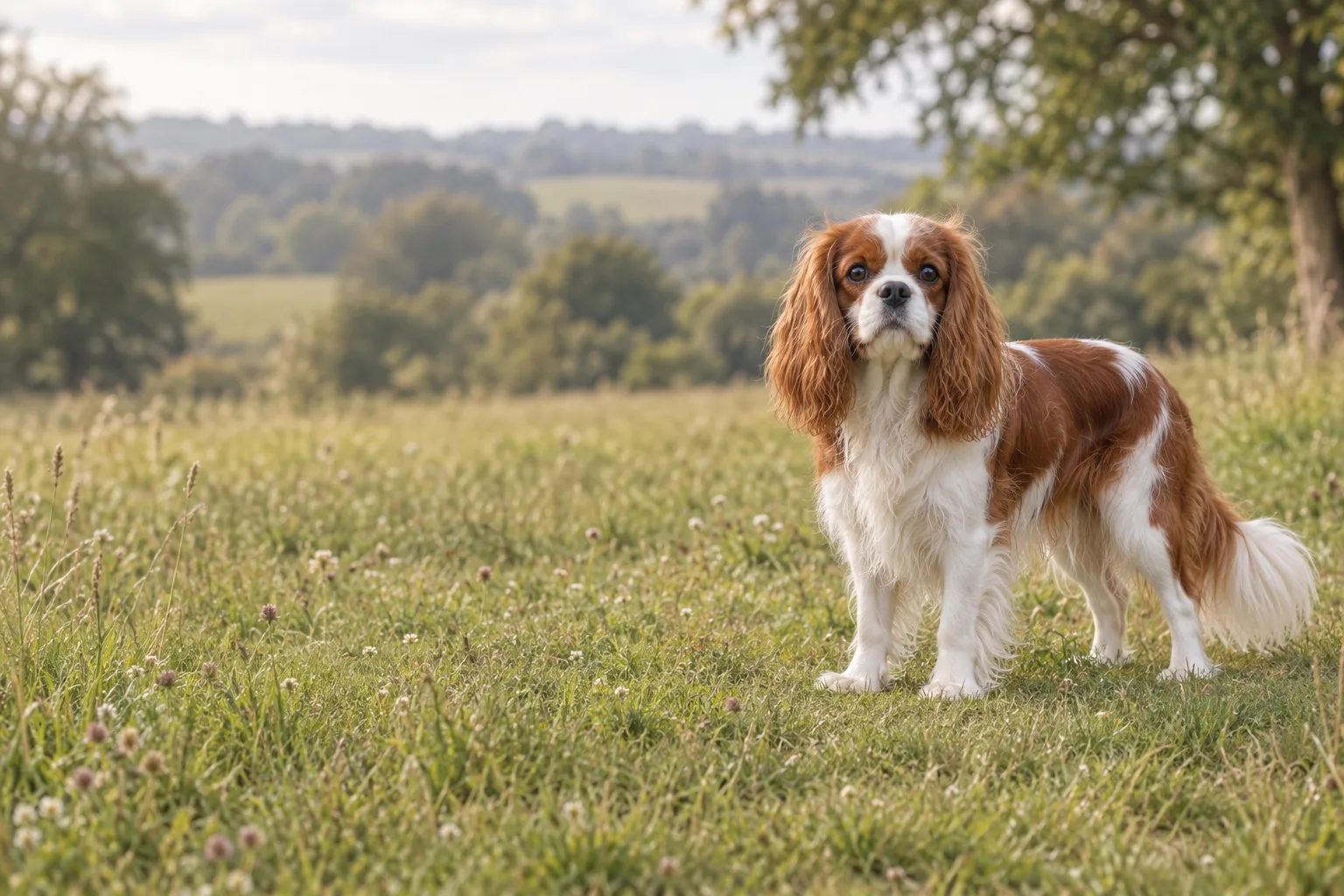
Most breeds in the archive were built to do something you can measure: pull a cart, flush a bird, hold a flock. The Cavalier King Charles Spaniel was built for something harder to put a number on. It was bred to be good company, and it has spent several centuries doing exactly that.
That sounds gentle, and it is. But the breed's story is not a soft one. It has a royal name that was borrowed, a type that very nearly vanished, and a revival that began with a rather eccentric offer of prize money. Here is what we can support, and what we have left out because nobody can prove it.
Small spaniels at court
Long before anyone wrote a breed standard, small spaniel-type dogs turned up in European painting. They sit in the corners of portraits by some of the great names: Titian in the sixteenth century, Van Dyck in the seventeenth, and later British portraitists such as Gainsborough. The dogs in those pictures are not identical to the Cavalier we know, and it would be a stretch to say they are the same breed. What they show is a fashion. Wealthy households liked a small, silky, feathered spaniel that could sit on a lap, and painters liked to include one.
The name comes from Charles II, who reigned from 1660 and was famously devoted to his little spaniels. Samuel Pepys, in his diary in the early 1660s, complained that the king seemed more interested in playing with his dogs than in the business of the council. That is about as close to a contemporary witness as this breed gets, and it is a good one. The word "Cavalier" points back to the royalist supporters of the Stuart kings, and it was attached to the modern breed much later, in the twentieth century. Nobody at the court of Charles II called these dogs Cavaliers.
Two popular stories deserve a plain label. One says Charles II issued a decree that his spaniels could go anywhere, including Parliament. It is repeated everywhere, and we have not found a source that supports it, so we treat it as legend. The other says these dogs were kept as lap warmers whose real job was to draw fleas away from their owners. It is a lovely tale and an unprovable one. The job we can defend is simpler: they were companions, and they were prized for it.
Blenheim, and the type that drifted away
The red and white colouring we call Blenheim has its own history. It is linked to the Churchill family, and to John Churchill, the first Duke of Marlborough, who won the Battle of Blenheim in 1704. His family kept red and white spaniels at the palace that was built in the battle's honour, and the colour took its name from the place. The little chestnut mark on the crown of the head, often called the lozenge or Blenheim spot, is a feature of the type. You will often be told it is the thumbprint of the Duchess, pressed onto her dog's head while she waited anxiously for news of the battle. We name that as a myth. The spot is a marking, not a fingerprint, and the story is a charming way of remembering the colour.
These spaniels were not only lap dogs. Small spaniels of this kind were also kept in country households and, in some hands, used on game in a modest way. That working memory is still there. Ask anyone who has watched a Cavalier suddenly stop being a sofa ornament and become a nose on legs across a field.
Then fashion changed. In the nineteenth century the spaniel that took hold in Britain, the King Charles Spaniel, which today is known as the English Toy Spaniel in the US and by its longer name in the UK, was bred with a much shorter face, a high domed skull and a very short nose. It is widely thought that flat faced toy breeds such as the Pug had a hand in that shift, though the exact crosses are not well documented. The Kennel Club was founded in 1873, and shows and registers helped to fix the new look. The longer nosed, flatter skulled spaniel of the old paintings did not disappear entirely, but it became rare, and it was no longer what the show ring rewarded.
An American's prize and a breed made again
The turning point came in 1926, and it came from across the Atlantic. Roswell Eldridge, an American, went to Crufts and could not find the spaniels he knew from the old pictures. He offered a prize of twenty five pounds, a serious sum then, for the best dog and the best bitch of the old type at Crufts. His wording described the dogs of Charles II's time: a longer face, no pronounced dome to the skull, and the spot in the centre of the head. He funded the classes for several years, and they gave breeders a reason to search for the old shape.
In 1928 a club was formed to look after the revived breed, and it was at this point that "Cavalier" was added to the name to tell the two types apart. A standard was drawn up, and a dog named Ann's Son, bred by Mrs Amice Pitt, is remembered as a model for it. The people behind this work were breeders picking through what survived of the old type, not inventing a dog from nothing, and the result was a small spaniel that looked much more like the one in the portraits than the flatter faced dogs then in the ring.
The Kennel Club recognised the Cavalier King Charles Spaniel as a breed in its own right in 1945. The Second World War was hard on all pedigree dog breeding in Britain, when feeding dogs was difficult and breeding stock was thin, and it is fair to say that the breed's numbers were small as it moved into recognition. The rebuilding afterwards was slow and careful, and that early narrowness in the gene pool matters later in this story.
In America, the Cavalier King Charles Spaniel Club, USA was founded in 1954, and the breed gained ground steadily over the following decades. The American Kennel Club recognised it in 1995 and placed it in the Toy Group. That is worth knowing if you are in the US and wondering why the breed can seem newer there. In the UK it has a full century of organised history behind it. In the US, official recognition is much more recent, even though the dogs and their admirers arrived far earlier.
The breed also has four accepted colours, which is a good way to recognise one at a glance: Blenheim (chestnut and white), tricolour (black, white and tan), ruby (a solid rich red) and black and tan. Every one of them was part of the revival.
What that history means for living with one
A breed made for company will want yours. Cavaliers are typically sociable, gentle and eager to be near their people, which is exactly what the job was. It also means many of them dislike being left for long stretches. If your working day keeps you away for many hours, plan for that honestly before you bring one home, not after.
The spaniel in them is real. Expect a good nose, a fondness for a walk and a tendency to follow a scent or a bird without consulting you first. A secure lead near roads and a sensible recall routine are not optional extras. Think of it as a restaurant regular who will happily sit in your booth all evening, but who will also bolt to the kitchen door the moment it opens.
The long, silky coat with its feathering on ears, chest, legs and tail needs regular brushing. Ears that hang close to the head need checking and keeping clean. None of this is difficult, but it is a routine, and it is easier to keep up when you start it in puppyhood.
The other part of the story that owners in both countries need to know is health. The revival began with a small number of dogs, and the breed today is known for inherited conditions. The best known is mitral valve disease, a heart condition that is common in the breed and can appear earlier than in many other dogs. Another is syringomyelia, a painful condition of the spinal cord and brain linked to skull shape. Neither is a myth or a rumour. Breed clubs and kennel clubs in both countries recognise them, and health screening schemes exist. The sensible response is not to avoid the breed but to ask questions: ask any breeder what heart testing the parents have had and what the results were, ask about screening for syringomyelia, and be wary of anyone who dismisses the question. Your own vet can tell you what checks suit an individual dog.
That is the shape of the history, and it is a hopeful one. A breed that had almost been lost to fashion was rebuilt because one person wanted the old dogs back and others took up the search. What lives on the sofa beside you is the product of that choice.
If you would like to see this breed as we draw it, the archive plate for the Cavalier King Charles Spaniel is an original digital engraving, and you will find it on the breed's page in the archive.
See it in the archive: The Cavalier King Charles Spaniel archive plate