
Breed Histories · 26 September 2026
The History of the Cockapoo, Told Honestly
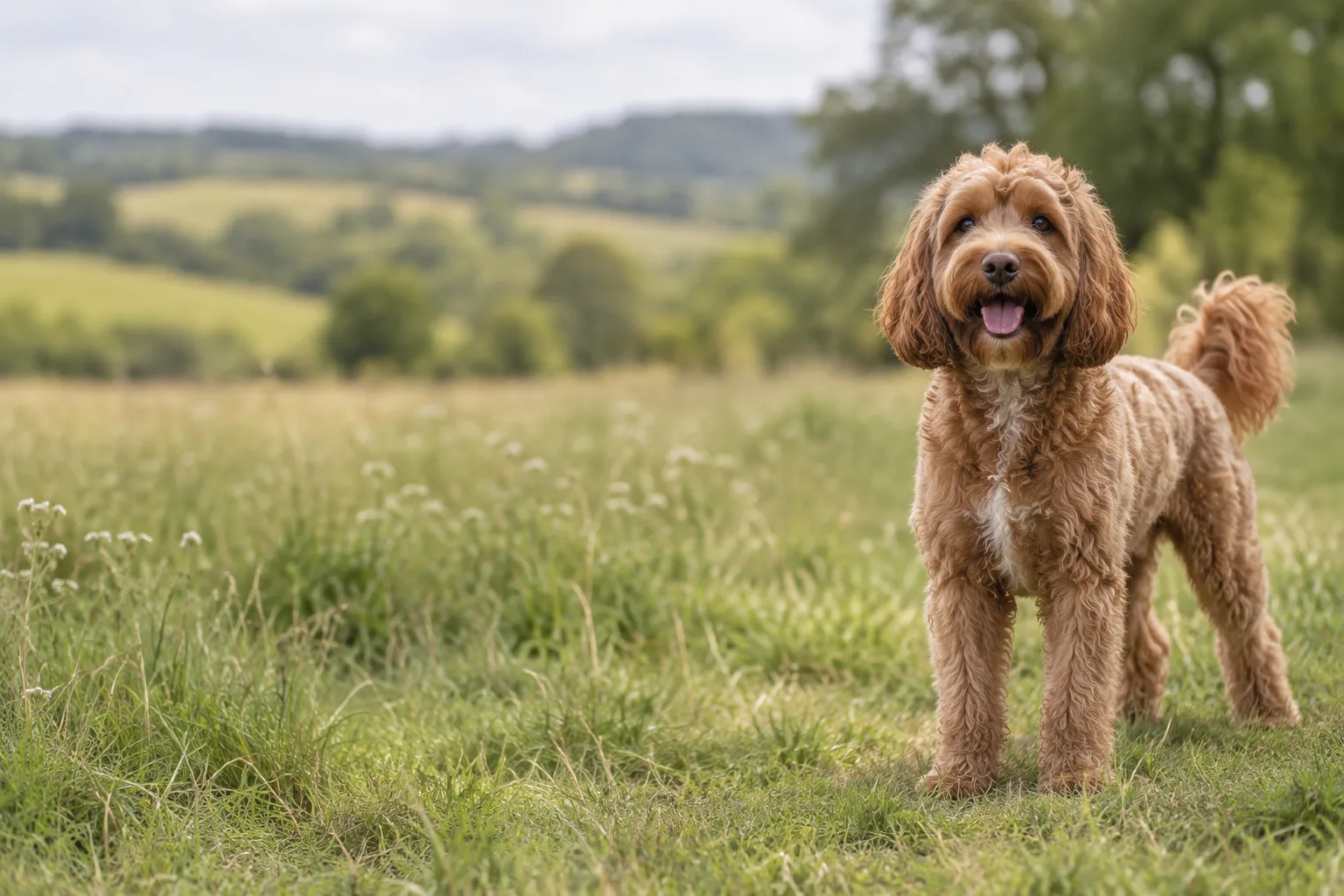
Most of the dogs in this archive come with a long paper trail: a stud book, a founding club, a standard argued over for a century. The Cockapoo comes with almost none of that, and I think that makes its story worth telling more carefully, not less.
So this is a history in two halves. The first is what we can stand behind: the two parent breeds, the work they were built for, and the way the cross came to be loved. The second is what I'm leaving out, because it is repeated everywhere and I can't support it.
Two working parents
A Cockapoo is a Cocker Spaniel crossed with a Poodle. Everything about the dog makes more sense once you know what each side was originally for.
The Cocker Spaniel is a gundog. The name is generally traced to the woodcock, the bird these small spaniels were sent in after. The job was close, busy, nose-down work in thick cover: pushing into brambles and undergrowth, flushing birds into the air for the gun, and then bringing them back. That work asks for a particular dog. It has to be small enough to get in, keen enough to keep going, and sociable enough to work in step with a person all day. It is where the Cocker's soft, eager, tail-wagging temperament comes from, and it is also why so many Cockers are happiest with a task and a person to do it with.
The Poodle has a reputation as a show-ring ornament, which is a strange thing to have happened to a water dog. The breed's roots are in retrieving game from water, and the word itself is usually linked to a German term for splashing about. The famous clip started as a working compromise: leave the coat on the chest and joints for warmth, take it off elsewhere so the dog can swim freely. What you are looking at in a show Poodle is a practical haircut that became a fashion. Behind it sits an intelligent, quick-learning dog that likes to be busy and likes to be with people.
Put those two side by side and you can see why someone thought the cross was a good idea. Both are dogs made to work alongside a person. Both are quick to learn. Both are, at heart, people dogs.
How the cross took hold
Here I have to be straight with you. The Cockapoo does not have a single documented founding moment that I can point to with confidence. The account you will see most often places the deliberate cross in the United States in the middle of the twentieth century, with the 1950s the decade usually named. From there, breeders on both sides of the Atlantic took it up, and in Britain the dog became a familiar sight in the decades that followed, especially from the 1990s onwards when crossbreeds of this kind became fashionable family choices.
You will also find named dogs credited as the first Cockapoo, and stories about a chance mating that produced a litter people fell for. Some of these may well be true. I have not found one that I can tie to a Kennel Club record, an AKC record, a breed club history or a published account I trust enough to repeat as fact, so I'm not going to. If a dog's name is going to appear in this archive, it will be because the record backs it.
What I can say is how the appeal was framed. The Poodle side was associated with a coat that sheds little and suits some people with allergies, and the Cocker side with warmth and an easy nature. Put together, the promise was a small, cheerful, low-mess family dog. That promise is worth looking at closely, and I'll come back to it below, because it is where owners most often get caught out.
Why there is no kennel club standard
A Cockapoo is not a recognised breed with The Kennel Club in the UK or the American Kennel Club in the US. That is not an oversight or a snub. Both bodies register pedigree breeds, meaning dogs that breed true to a written standard over many generations. A cross between two established breeds is, by definition, not that. Its parents are recognised. It is not.
The practical result is that the things a pedigree history usually gives you are missing here. There is no official standard of size, coat or colour. There is no shared foundation stock everyone can trace back to. And there is no wartime story of a breed pulled back from the edge of extinction by a handful of devoted breeders, which is a plot I have written for several other dogs in this series. The Cockapoo was never in danger of disappearing. If anything, its story runs the other way: it has been very popular, very quickly.
Breed clubs and enthusiast groups for the cross do exist, and they matter, because they are where owners share health information and where people try to encourage good breeding practice. But a club is not a registry with the force of a kennel club standard behind it, and it is worth knowing which one you are dealing with.
That has a consequence I find quite interesting. Because the cross is not fixed, two Cockapoos can look very different. Some come from a Poodle and a Cocker Spaniel directly. Others are the product of Cockapoo to Cockapoo matings over several generations. The coat can be tight and curly, loose and wavy, or almost straight. The size follows the type of Poodle used, and the Poodle comes in more than one size, so a Cockapoo can be anything from quite small to a sturdy medium dog. If you see two of them side by side and they look like different dogs, they may simply be different mixes of the same two inheritances.
What the history means for living with one
This is the part I care about most, because history is only worth telling if it helps you understand the dog on your sofa.
First, the work. Both parents were bred to work closely with a person, and that shows. A Cockapoo tends to want company, and many struggle when left alone for long stretches. If your days are empty of people, a dog descended from two people-dogs is worth thinking twice about. Plan for training, for exercise and for something to do with its head. A bored spaniel-Poodle cross is clever enough to invent its own entertainment, and you will not enjoy the results.
Second, the nose and the water. The Cocker side means a strong scenting instinct and an appetite for bounding off after smells. The Poodle side brings a fondness for retrieving and, often, for water and mud. Neither instinct is a fault. Both are the reason the ancestors were valued. Recall training early is kinder than a lifetime of apologising in a field.
Third, the coat, and here I'll return to the promise I mentioned earlier. It is often said that Cockapoos do not shed and are good for allergy sufferers. I would treat that with caution. Coats vary from dog to dog in this cross precisely because it is not fixed, and no coat makes a dog allergy-proof. What you can rely on is that a curlier, Poodle-type coat needs regular brushing and regular trims, because a coat that doesn't shed freely tends to mat instead. Budget time and money for grooming as a fixed part of ownership, not a treat.
Fourth, health. Because the cross is not held to a single standard, the sensible approach is to look at the health of both parents, and to ask what checks they have had. Questions about what each parent breed is prone to are exactly the ones to put to a breeder, and a good one will welcome them. I won't list conditions here as though I were a vet; your own vet and the parent breeds' clubs are the right sources.
Last, the honest summary. The Cockapoo has a short history, a crowded set of stories, and a lot of very happy owners. It is a modern dog made from two old working breeds, and it carries their habits with it: keen, affectionate, quick, and happiest when it is part of the day's work, even if that work is now a walk, a sofa and a great many biscuits.
If you love the breed, or you're thinking of welcoming one, the archive plate for the Cockapoo is an original digital engraving, made for this collection. You'll find it on the Cockapoo page of the site, and it is the best place to carry on from here.
See it in the archive: The Cockapoo archive plate