
Breed Histories · 26 September 2026
The History of the Dalmatian and the Job It Was Bred For
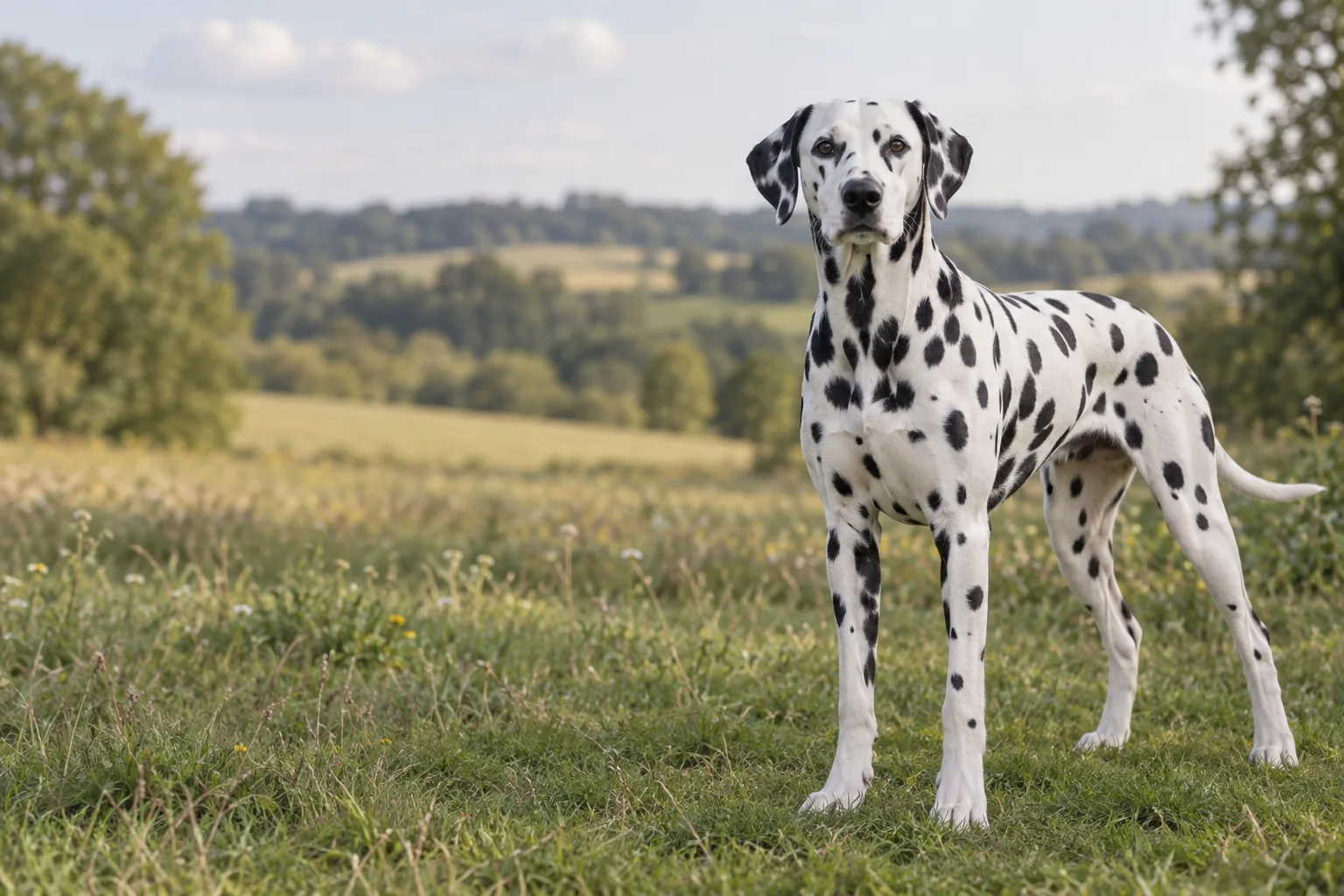
Few dogs are recognised as quickly as the Dalmatian. The white coat, the black or liver spots, the long clean lines. Ask people where the breed comes from, though, and the answers get vague very fast. We have spent time with the breed clubs and the published histories, and the honest answer is more interesting than the tidy one. It is also a good deal less certain.
This is our history of the Dalmatian: what we can support, what we cannot, and what it all means if you share a house with one.
A name that points to a place, not a proof
The breed carries the name of Dalmatia, the historic coastal region of what is now Croatia. That much is settled. What is not settled is whether the spotted dog was truly born there.
Older books like to hand the Dalmatian a grand ancestry: temple dogs of ancient Egypt, companions of wandering travellers, hunting hounds of the classical world. We have left all of that out. Spotted dogs turn up in art from many places and many centuries, and a spotted dog in a picture is not the same thing as a breed. Breed clubs themselves are candid that the true origin is unknown, and that the ancient stories are more folklore than record.
What the record does offer is the Dalmatian connection. Croatian sources point to church paintings and to a chronicle written in the early 1700s by a bishop of Đakovo, which describes a dog of the Dalmatian type. That is the kind of evidence we trust: a dated, named source, tied to a real place. It shows spotted dogs of this type were known in the region by then. It does not show that the breed began there, and we would rather say so than pretend.
Some writers also suggest that pointer-type dogs and old spotted hounds went into the mix as the breed took shape in Britain. It is a reasonable idea, and you will see it repeated. We treat it as a theory, not a fact.
The job that made the dog
The Dalmatian we recognise was shaped in Britain, and above all by one job. In the eighteenth and nineteenth centuries it became the coach dog, also called the carriage dog. Its work was to trot beside, or beneath, a horse-drawn carriage, often for many miles at a steady pace.
The practical reasons are easy to picture. A carriage horse could be nervous, and roads were no place to leave a valuable team at an inn. A dog that had grown up with the horses, and that stayed calm around them, could keep watch and deter thieves while the passengers were elsewhere. It could also clear the road ahead of stray dogs. There was a fashion side to it as well. A well-matched, well-marked dog at the wheel was a sign of a smart turnout, and owners took an interest in the pattern of the spots.
Now look at the dog with that job in mind, because the job explains most of it.
- The build. A lean, muscular dog with a deep chest and clean, straight legs is a dog made for covering ground without tiring. The breed standard still describes a dog capable of great endurance, and that line is not decoration.
- The manner. A dog that guards horses and stands quietly by a carriage learns to be watchful and steady. The reserve many Dalmatians show with strangers is often traced to this work.
- The bond with horses. Breed histories regularly mention Dalmatians and stables together, and some owners still find their dogs settle happily around horses.
Here is the part that surprises new owners. Nothing about that job was gentle or short. If you ask for a dog that can run beside a carriage, you are asking for a dog that needs to run.
Firehouses, showrings and the breed on paper
When motor vehicles began to replace horses, the coach dog lost its purpose in Britain. The breed did not vanish, but it moved from the road into the showring and the home. In the 1880s the first breed standard was drawn up in Britain, and a Dalmatian club followed in 1890. The Kennel Club records the breed today in its Utility Group.
Across the Atlantic the breed found a second career. In American cities the horse-drawn fire engine needed the same qualities as the carriage: calm dogs that stayed with the horses and helped clear the way. The Dalmatian and the firehouse became a pairing that outlived the horses altogether, and the image is still with us. The AKC recognised the breed in 1888, and the Dalmatian Club of America was founded in 1905. The AKC places the breed in its Non-Sporting Group, one of those categories that tells you the breed was made for something specific and then outlived it.
We have not found solid support for a story of the breed nearly disappearing in either country, and so we have not told one. Numbers rose and fell with fashion, and the change in transport certainly removed the dog's original work. But a near-loss in the dramatic sense is not something we can source, and we will not write one to make the history feel more exciting than it is.
Named dogs are equally thin on the ground in the reliable record, so we will not pretend otherwise. The most famous Dalmatians of all are fictional. In 1956 Dodie Smith published The Hundred and One Dalmatians, with Pongo and Missis at its heart, and the Disney film of 1961 made the breed a household name. It was a wonderful thing for the breed's fame. It was also, as breed clubs have warned ever since, a mixed blessing.
The spots, the puppies and the things nobody warns you about
Dalmatian puppies are born white. The spots come through in the first weeks and keep developing, and the finished pattern is not visible for some time. It is one of the small delights of the breed and it surprises people who assumed the puppies were born marked.
Behind the pattern sit two genuine health matters that every serious breed club discusses, so we will too.
The first is hearing. Deafness is well documented in Dalmatians, in one ear or both, and it is linked to the pigment genes that give the breed its white coat. Responsible breeders have their puppies hearing tested, and the breed clubs encourage it. A deaf Dalmatian can lead a full life with an owner who understands what that involves, but you should know about it before you choose a puppy, not after.
The second is uric acid. Dalmatians handle uric acid differently from most dogs, which makes them prone to forming urinary stones. It is a trait of the whole breed, and it is a real reason to talk to your vet about diet and water. A long-running project began in the 1970s to breed in a gene from a pointer to correct the fault, and dogs descended from it have since been accepted by kennel clubs, including the AKC and the Kennel Club, in the early 2010s. Views within the breed communities have differed on how it should be used, and we would not want to flatten that debate. If the subject matters to you, read what the national breed club says rather than relying on us.
What the history means for living with one
So what does all of this add up to on a wet Tuesday in the UK, or a hot afternoon in the US?
A dog bred to run for miles does not settle for a fifteen-minute wander round the block. Most Dalmatians need serious daily exercise, and they tend to do best with owners who enjoy walking, running or cycling, and who will keep at it in poor weather. Bored Dalmatians are inventive, and the results are seldom convenient.
A dog bred to watch over horses and property can be reserved with strangers, and it needs good early socialisation to grow up confident. It is often sensitive, too. Harsh training tends to go badly, and calm, consistent, reward-based work suits the breed's intelligence much better.
And a dog made famous by a film is a dog people buy on impulse. Rescue organisations on both sides of the Atlantic have long reported that Dalmatian numbers in rescue rose after each wave of screen popularity, once the puppies turned out to be a great deal of dog. That is the lasting lesson of the breed's modern history. The Dalmatian is not difficult, but it is specific. It suits the household that has read up first.
Look at the whole story and you will see a consistent line. A dog whose origins remain a mystery was shaped by a single demanding job into an athletic, watchful, affectionate and often headstrong companion. Its looks are famous. Its history is the better guide to how to live with it.
The archive plate for this breed is an original digital engraving, drawn to sit alongside history like this. If you would like to see the Dalmatian as we drew it, the plate is waiting on the breed page.
See it in the archive: The Dalmatian archive plate