
Breed Histories · 26 September 2026
The History of the Dobermann
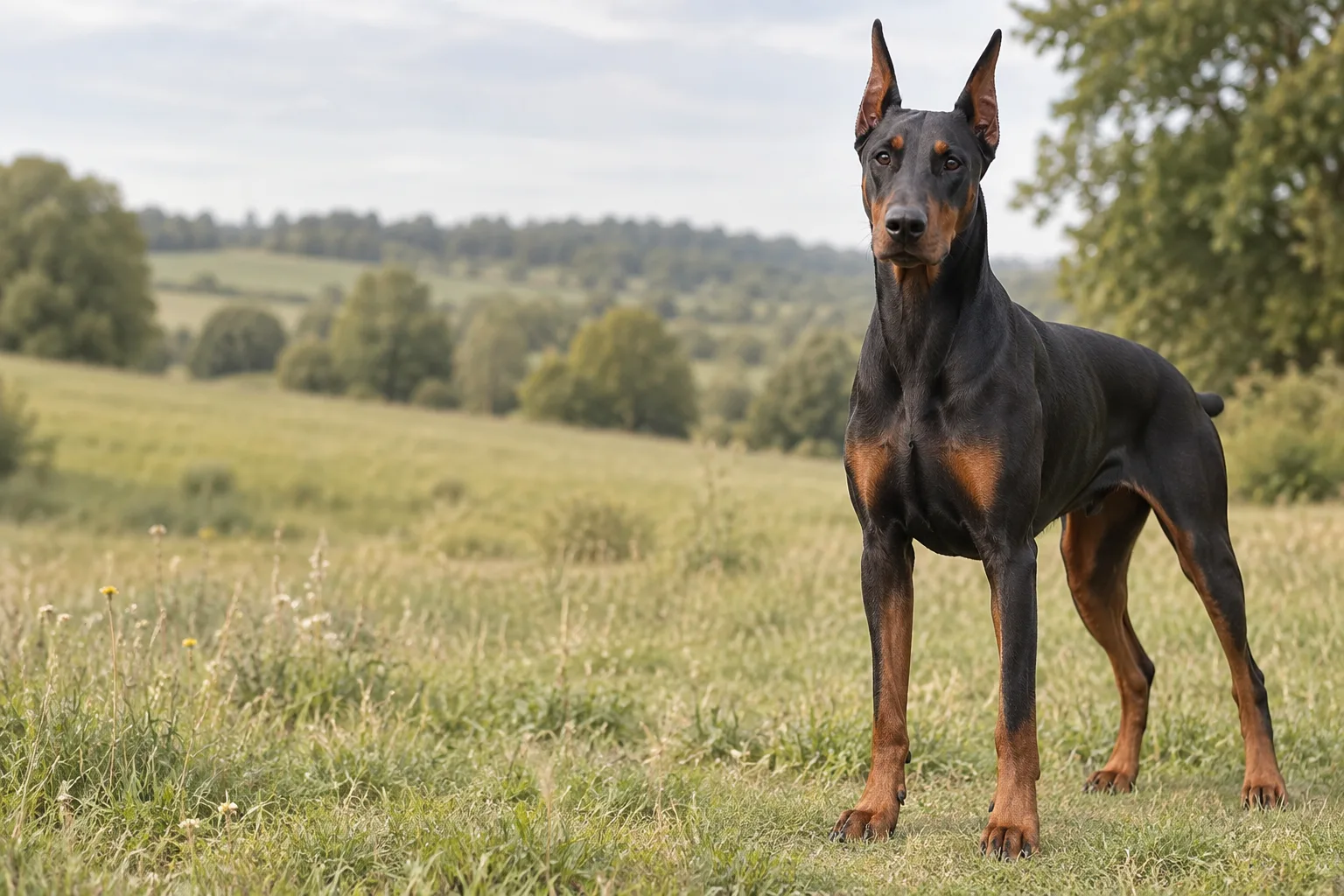
Most breeds have a fuzzy beginning, lost somewhere between farms and folklore. The Dobermann is unusual. We can name the man, the town and the decade. What we cannot do, and what a lot of breed articles quietly pretend to do, is say exactly which dogs he used.
Here at the archive we like to keep those two things apart. So this is the Dobermann's story as far as it can be supported, with the gaps left as gaps.
A tax collector in Apolda
The breed takes its name from Karl Friedrich Louis Dobermann, who lived in Apolda, in Thuringia, Germany, in the second half of the nineteenth century. He is usually described as a tax collector, and the accounts of his life add that he also had charge of the local dog pound. That second detail matters, because it put a great many dogs of different types in front of a man who knew exactly what he wanted from one.
What he wanted was protection. Collecting money from people who did not always want to hand it over was not a job for the timid, and he was often carrying cash. The story goes that he set out to breed a dog with the nerve to stand beside him, the stamina to keep up with a working day, and enough intelligence to read a situation instead of simply reacting to it.
Breed histories place this work from around the 1860s and 1870s onwards. Louis Dobermann did not live to see the result recognised. He died in 1894, and the dogs that carried his name went on without him.
What went into the mix, and what is only rumour
Ask where the Dobermann came from and you will hear a confident list of ingredients. The Rottweiler, the old German Pinscher, the Black and Tan Terrier, the Weimaraner, sometimes the Greyhound for speed. You can find that list repeated in a great many places.
Here is the honest position. Louis Dobermann did not leave a tidy stud book. The crossings behind his dogs were not recorded in the way a modern breeder would record them, so the list above is informed inference, not documentation. Some of those names are plausible on looks and temperament alone. Others are repeated mainly because someone else has repeated them.
What we can say is that the early dogs were bred for a job, and the job did the shaping. A guard that spends its day beside a person needs to be quick, athletic and close to its handler. It needs a coat that is easy to keep, a body that is lean without being frail, and a head that stays clear when things get tense. Look at a Dobermann now and you are looking at that brief, refined over more than a century.
The famous black and tan colouring is part of the same story. It is a striking pattern, but it also belongs to the working pinscher types of the region, so it is likely to have come with the foundation stock as much as by design.
From one man's dog to a recognised breed
The breed's next chapter belongs to the people who took up Louis Dobermann's work after his death. Chief among them was Otto Göller, a breeder who is credited with steering the dogs toward a consistent type and who helped found a breed club in Apolda in 1899. The breed was recognised in Germany soon after, around 1900, and it was known there as the Dobermann Pinscher.
We have deliberately not filled this section with a parade of early dogs by name. The first generations were registered in a young and patchy system, and we would rather leave a name out than attach the wrong dog to the wrong date. The breed club stud books are the place to look if you want the pedigrees, and we would point any serious enthusiast there.
Two things are worth noticing about this period. First, the breed was built for a working life, and its early admirers valued it for that. Police and guard work were natural homes for it. Second, the name itself moved. In Germany the word Pinscher was dropped from the breed's name in 1949, which is why the German and British breed is simply the Dobermann. In the United States the breed is still the Doberman Pinscher, and the spelling loses its second n. It is the same dog under two spellings, and that difference tells you a little about how the breed travelled.
Across the Atlantic, and into uniform
The breed reached America in the early twentieth century, and the American Kennel Club recognised it in 1908. The Doberman Pinscher Club of America followed in 1921 and became the breed's main voice there. From that point the American Dobermann developed alongside the British one, with the two countries valuing slightly different things and, in some respects, drifting apart in look.
Then came the war that gave the breed its most famous chapter. During the Second World War the United States Marine Corps used war dogs in the Pacific, and the Dobermann became closely associated with them. The dogs worked as sentries and scouts, and on Guam in 1944 they served in the recapture of the island. One dog, Kurt, is often told of in the stories of that campaign, credited with warning his handler's unit of danger before he was killed. We would describe that as the widely repeated account, not one we have traced to a primary record, so we hold it with a little care.
What is on firmer ground is the memorial. On Guam there is a war dog cemetery and a statue called Always Faithful, honouring the Marine Corps war dogs that died in that battle. A Dobermann is the figure people remember. It is a fitting picture of what the breed was made for: a dog that stays close to its person and works in earnest.
The war also did something to the breed's reputation that lasted. It cemented the image of the Dobermann as a serious, fearless dog. That image is only half right, and living with one shows you the other half.
What the history means for living with one
A dog bred to stay beside one person all day has a particular kind of loyalty. Owners tend to describe it the same way: the Dobermann wants to be where you are. It follows you from room to room, leans against your legs and reads your mood. That is the guard's job description turned into home life. It is not aloofness or aggression. It is attachment, and it needs an owner who is around.
The same history explains the energy. This was a working dog with stamina, and it does better with proper exercise and something to think about than with a quick walk round the block. A bored Dobermann is inventive in ways you will not enjoy. Training suits it well, because the intelligence that made it a useful guard also makes it quick to learn. It responds to calm, consistent, reward based teaching. It does not respond well to harshness, however tough its reputation makes it look.
Then there are the things the story does not fix. A few points from the modern standards and the usual breed guidance:
- The coat is short and easy to keep, but a lean, thin skinned dog feels the cold, so many owners in Britain give theirs a coat in winter.
- The recognised colours in the UK and the US include black and tan and red and tan, with blue and fawn also seen, so check the standard of the club you follow.
- Ears and tails look different depending on where you are. In the UK, cropping is not permitted and docking of pet dogs is banned, so British Dobermanns are seen with natural ears and tails. In the US, cropping and docking remain lawful and the AKC standard describes the traditional look. Neither is better or worse as a companion, but it explains why a dog from one country can look so different from one in the other.
- The breed is known to be prone to heart disease, particularly dilated cardiomyopathy, and to a bleeding disorder called von Willebrand's disease. Responsible breeders screen for both, and it is worth asking to see the results before you commit.
None of that is meant to put anyone off. It is what a good history is for. Knowing that this dog was made to be close to its person, to work and to think tells you what to give it: company, exercise, patient training and a decent vet.
Where the story leaves us
A tax collector in a small German town wanted a dog he could rely on. From that practical need came a breed that police forces, armies and families have all taken to, and a look that is still recognised at a glance. The mythology has grown around it, some of it charming and some of it unsupported. We would rather give you the plain version, with the uncertain parts marked.
If you want to see the breed as we see it, the archive has an original digital engraving plate of the Dobermann. It is drawn in the old manner, in fine line, and it is our way of putting the dog on the page as a natural historian might have done. You will find it on the Dobermann page, and we hope it does the breed justice.
See it in the archive: The Dobermann archive plate