
Breed Histories · 26 September 2026
The History of the English Bulldog
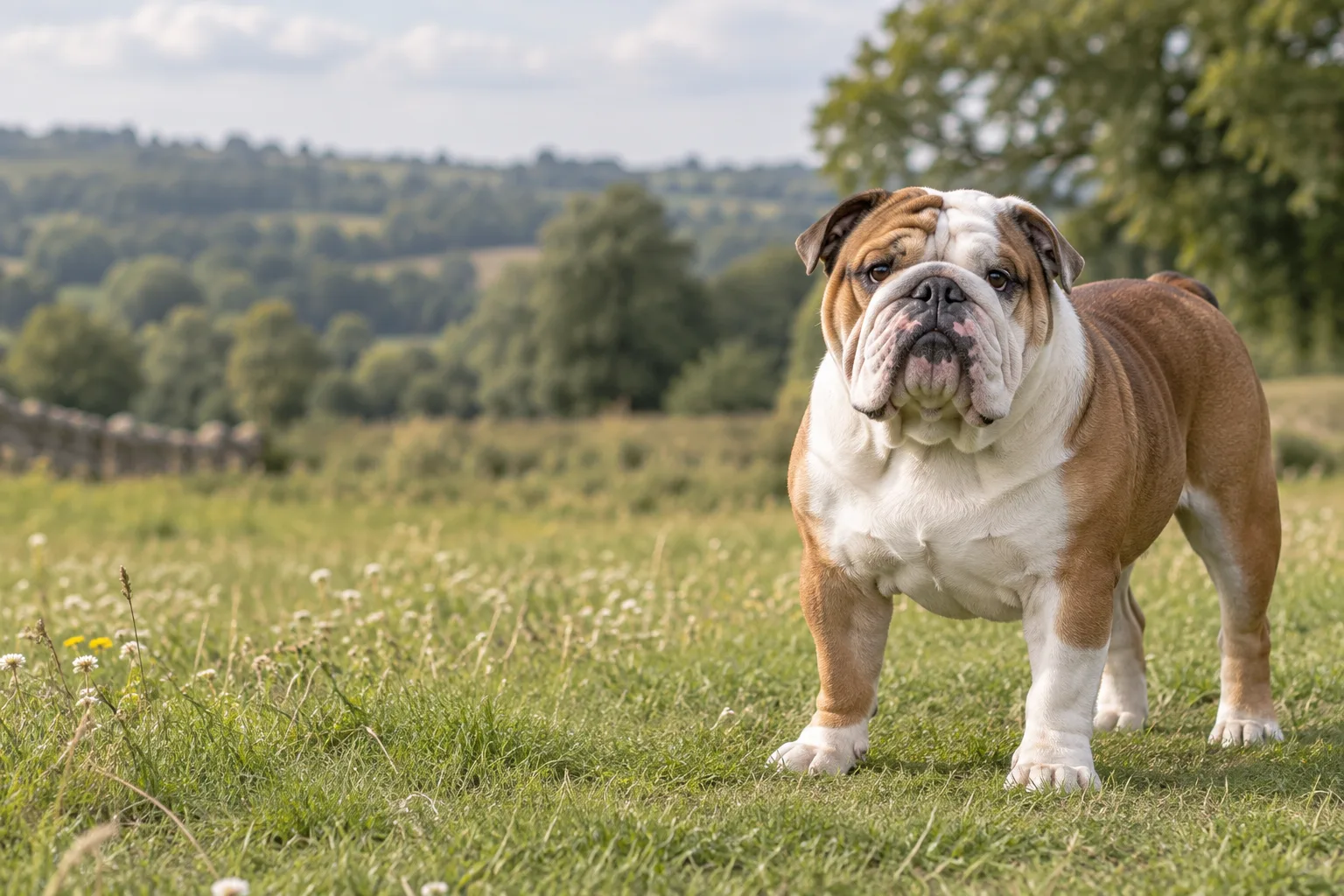
Why does a dog with such a soft, wrinkled face carry the name of one of England's fiercest old sports? The answer runs through a butcher's yard, an Act of Parliament, a handful of Victorian dog fanciers and a good deal of argument. We think it is one of the most interesting stories in the archive, and one of the most awkward, so we will tell it plainly.
A note on how we work. Where a date or a name comes from a breed club, a kennel club or a published breed history, we give it. Where a story is only a story, we say so. The Bulldog has attracted more tall tales than most breeds.
The work the Bulldog was bred for
The Bulldog's name tells you the job. From the medieval period into the early nineteenth century, bull-baiting was a popular spectacle in English towns. A bull was tethered, and dogs were set on it. The dog's task was to seize the bull by the nose and hold on. The dogs that did this were called bulldogs, and the earliest surviving uses of the word date from the sixteenth and seventeenth centuries. One often cited example is a letter of 1631 asking for two good bulldogs.
There was a second reason the sport lasted so long. It was widely believed that a baited bull made better meat, and in some towns baiting before slaughter was treated almost as a custom of the trade. That is why butchers turn up again and again in the early story of the breed.
You will often read that the sport began at Stamford, in Lincolnshire, in 1209, when a nobleman watching two bulls fight saw a butcher's dog seize one of them and was so pleased that he gave land for a bull-baiting. It is a lovely tale. We treat it as tradition, not as a proven origin. What the records do support is simpler: by the seventeenth century the bulldog was a recognised working type, valued for courage and grip, and it was kept and bred for that purpose.
That job explains almost everything about the shape of the dog. A dog that must hold a bull's nose wants a broad, powerful jaw, set so that it can keep hold and still breathe. The lower jaw juts out and the nose is set back, so the dog can grip without cutting off its own air. The body is low and heavy, which makes it hard for a bull to toss a dog high. The loose skin and wrinkles around the head are usually explained as a way of letting blood run away from the eyes and nostrils. That last explanation is commonly repeated in breed writing, but it is an explanation, not a measured fact, so we would hold it lightly.
The old working Bulldog was also not quite the dog you know. Paintings and descriptions from the period show a lighter, longer-legged, more athletic animal than the modern show Bulldog. It was a working dog first, and its looks were a by-product of its work.
1835 and the near loss of the breed
The turning point is a date you can check. In 1835 Parliament passed a Cruelty to Animals Act that outlawed bull-baiting, along with bear-baiting and the staging of dog fights. The Bulldog's reason for existing was gone almost overnight.
Breed histories describe what followed as a real danger to the breed. There was no longer a job for a dog bred for nothing else, and the sport did not disappear at once, since illegal baiting and fighting carried on in places. Some of the dogs' fighting qualities went into crosses with terriers, which is how the tale of the Bull Terrier begins. Bulldogs themselves became fewer.
Here we should name a myth that is repeated as if it were fact: that the Bulldog was saved by one person or one moment. It was not. What the sources show is a slow rescue by many hands. A number of enthusiasts, mostly in the Midlands and the north of England, kept the dogs and began to show them, at a time when dog shows were themselves new. The dog that had been bred to be savage was being valued for its steadiness with people, and breeders began to select for exactly that.
It came at a price. To make the breed suitable for the show ring and the parlour, breeders moved it towards the heavier, shorter-faced, lower-slung dog that we recognise today. Some of the athletic build of the working dog was traded away.
Show rings, clubs and a named dog
The Bulldog appeared at the very early dog shows of the 1860s, and it soon had its own devoted following. The Bulldog Club, formed in the 1870s and later incorporated in 1875, is often described as the oldest breed club in the world. It matters because it produced a written standard, a description of what a Bulldog should be, which gave breeders something to work towards other than each other's opinions. The Kennel Club itself was founded in 1873, so the breed's club and the national body grew up at more or less the same time.
A named dog sits at the centre of that story. Old King Dick is the name most often given in breed histories as the dog on whom the early Bulldog ideal was modelled. The accounts we have differ in detail, and we would not lean on the exact words attributed to anyone who described him, but the name endures because the standard drawn up in that era is generally said to have been shaped around a dog of his type.
Today the Kennel Club places the Bulldog in its Utility Group. In the United States, the American Kennel Club recognised the breed in 1886, and the Bulldog sits in its Non-Sporting Group. The breed's American parent club was founded in 1890. The AKC and most American owners simply call the breed the Bulldog, and "English Bulldog" is what people often say to tell it apart from the French Bulldog and the American Bulldog. In Britain it is just the Bulldog, and we use both names in the archive because that is how people search for it.
The breed went to America with English emigrants and, later, with breeders and importers. The American Bulldog, a taller, more athletic dog, was revived in the American South in the twentieth century, and we treat it as a separate breed with its own history. The same goes for the various modern attempts to recreate the old working type. They are interesting, but they are new breeds, not the original dog returning.
A national emblem, and a mascot
By the late nineteenth century the Bulldog had turned into something more than a dog. Its stubborn, unmoving stance made it a natural picture of British character, and cartoonists and writers used it that way for generations, notably in the Second World War, when the bulldog was invoked again and again as a symbol of resistance. It is often said that Winston Churchill was likened to one. The comparison was certainly made in the popular press. We would only say that it was a comparison and not a fact about his dogs or his tastes.
In America the Bulldog found a second life as a mascot. Yale University's Handsome Dan, first introduced in 1889, is generally cited as one of the first live college mascots in the country, and the Bulldog has been a school and team emblem ever since. The United States Marine Corps adopted the breed too, and its long line of Bulldog mascots is a matter of Corps tradition. You may also read that German soldiers in the First World War called the Marines "devil dogs" because they fought like Bulldogs. That is a popular legend, and we have not seen it supported by a reliable primary source, so we leave it in the pile of stories that are better than the evidence.
Whatever the truth of each tale, the point stands. The dog that was bred to hang on to a bull became, within a couple of generations, a byword for loyalty and gentle stubbornness. That is a remarkable change in temperament, and it did not happen by accident. It happened because people chose, again and again, to keep the calm dogs.
What this history means for living with one now
Here is the part of the story that matters most to anyone bringing a Bulldog home in Britain or the United States. The features that were once useful are the source of the breed's best-known health worries.
The short, flat face that suited a nose-grip can make it hard for the dog to breathe, cool itself or exercise in warm weather. Bulldogs are one of the flat-faced (brachycephalic) breeds the Kennel Club has placed under its highest level of health monitoring through its Breed Watch scheme. Since 2019 the Kennel Club has also supported a respiratory function grading scheme, run with the University of Cambridge, for Bulldogs and some other flat-faced breeds, to help breeders identify dogs with better breathing. Research from the Royal Veterinary College, using data from veterinary practices, has also linked the breed's extreme shape to a range of health problems. We are not vets and we will not give you percentages, but the direction of that research is clear enough.
The heavy head and narrow hips that came from decades of showing are also why many Bulldog litters are delivered by caesarean, and why breeders often need veterinary help. Skin folds need cleaning, and some dogs have trouble with their eyes and joints as well. None of this makes the Bulldog a bad choice. It does mean that a good breeder, an honest conversation with a vet and a realistic view of summer heat are part of owning one.
The character, on the other hand, is exactly what the Victorian fanciers were aiming for. Well-bred Bulldogs tend to be calm, affectionate, sociable and rather comic, happiest close to their people and content with short walks. They are dogs that sit on your feet. It is a gentle end to a violent beginning, and it deserves to be kept safe by breeding for health as well as for looks.
If you want to see the breed as we have drawn it, the archive plate for the Bulldog is an original digital engraving, and you will find it on the Bulldog page of the site. It is our way of remembering a dog whose story is older, stranger and more human than its sleepy face lets on.
See it in the archive: The English Bulldog archive plate