
Breed Histories · 26 September 2026
The History of the English Springer Spaniel
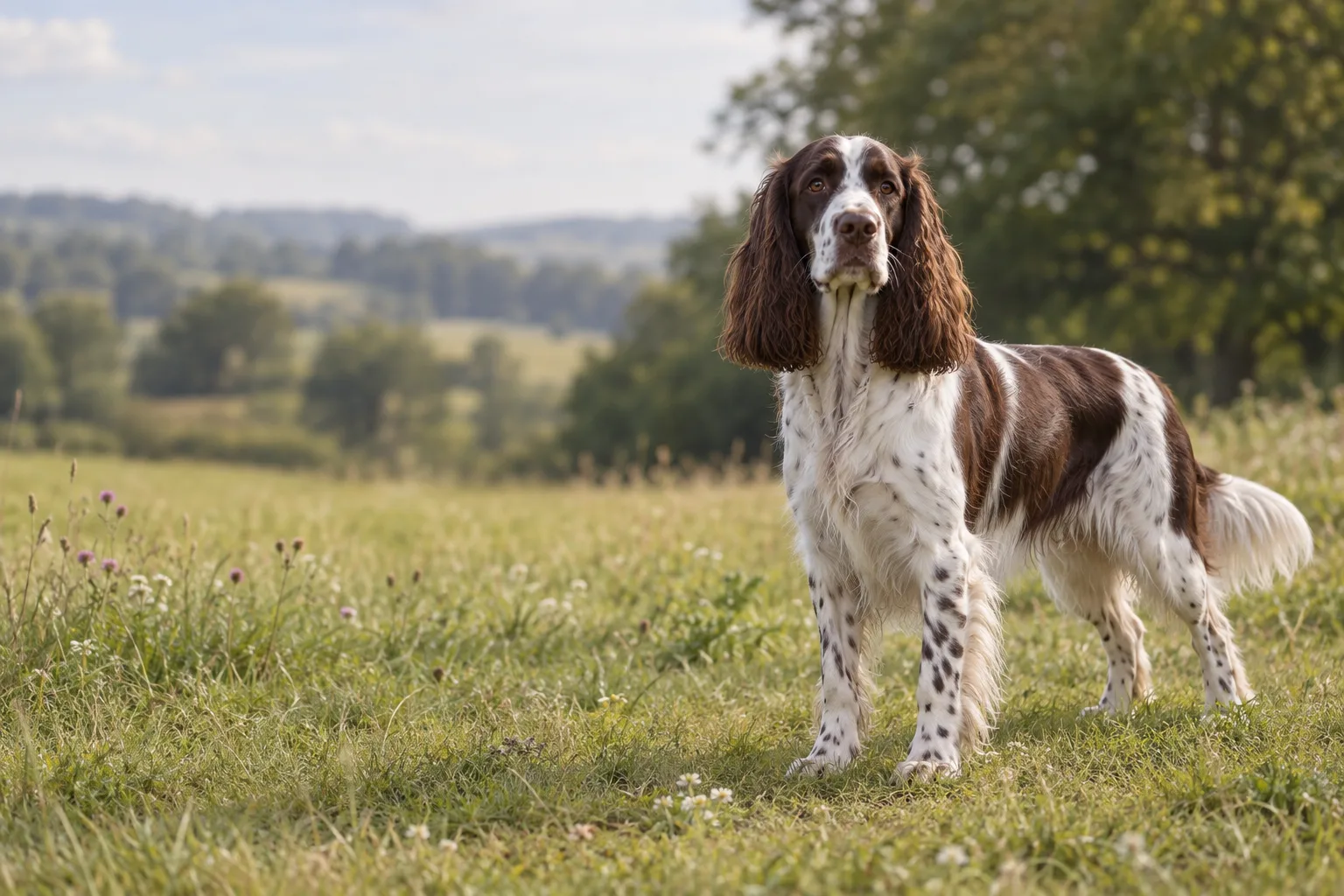
Why does a Springer never seem to switch off? Ask anyone who has lived with one and you will hear the same thing: the nose goes down, the tail goes, and the dog is gone into the hedge before you have finished your sentence. That is not bad manners. It is a job description, and the archive has been reading up on where it came from.
A note on how I have written this. Every date below is one I can stand behind from the Kennel Club, the American Kennel Club, or the published histories of the breed. Where the record goes quiet, I say so. Breed history is full of tidy stories, and a tidy story is often the first thing to check.
A dog named for what it did
The word "spaniel" is old, and nobody has settled where it comes from. The popular tale is that it means "dog of Spain", and you will see that repeated everywhere. It is a plausible guess, but it is a guess, and I would not put it on a plate as fact.
What we can say is that spaniels were being written about in England long before there was a kennel club. In the sixteenth century the physician John Caius described the dogs of Britain, and he sorted the spaniels by the work they did, into those for the land and those for the water. That habit of naming a dog by its job runs through the whole story. It is why we have a Springer at all.
The name says it plainly. A Springer springs game. The dog works close to the gun, quarters the ground, finds birds or rabbits hiding in cover and flushes them into the air or out into the open. Then, when the bird has been shot, it fetches. For centuries this was done with spaniels of no fixed pattern. What mattered was whether the dog could do the work, not what its ears looked like.
The old sporting writers used "springer" and "cocker" as working words. The cocker was the smaller spaniel, associated with woodcock. The springer was the larger one, used to spring the game. In the early days, dogs from the same litter could turn out as either, and size was often the deciding factor. That matters, because it tells you these were not two ancient, separate bloodlines. They were two jobs, sorted by size, that slowly hardened into two breeds.
From working spaniel to recognised breed
You will also meet the name "Norfolk Spaniel" in older books. It was used for the liver and white land spaniels associated with the Norfolk estates, and it faded from use as the modern Springer took shape. I have found no need to tell a romantic story about it. It is simply an earlier label for dogs that are recognisably part of the same family.
The turning point was organisation. The Kennel Club in Britain recognised the Cocker Spaniel as a breed in its own right in 1892. The English Springer Spaniel followed in 1902. That date is worth remembering, because it is when a working type, sorted by size and by habit, was given a name and a register.
Just before that, another change had begun. Spaniel field trials started in Britain in the closing years of the nineteenth century, and they gave breeders something better than opinion to argue about. A dog either found and flushed game cleanly, or it did not. Those trials pushed the breeders who took them seriously to value drive, nose, steadiness and the willingness to work with a handler, and to value them over a pretty head.
I would like to give you the names of the early foundation dogs here. The archive has come across several, and they turn up in old pedigrees. But the names differ from source to source, and I am not willing to print one I cannot check twice. If you own a Springer with a long working pedigree, your own breed club will have the registers. That is the right place to trace them.
What the job did to the dog
Look at a Springer and you can read the work on the body. The legs are long enough to get through rough cover and stay in the field all day. The chest gives lungs and stamina. The coat is dense but not heavy, with feathering on the ears, legs and chest. The ears hang long, and that is a reminder of a dog that has spent its life with its head in undergrowth.
The classic colours are liver and white, or black and white, and some carry tan markings, which people call tricolour. The white has a practical side. A dog moving through thick cover is easier for the handler to see, and easier for the gun to tell from game. I offer that as a reasonable reading of how the breed developed, not as a documented reason, because I do not have a source that says breeders chose it for that purpose.
The character comes from the same place. A dog that has to hunt close, stay keen for hours, and then hand back what it has found needs two things that pull against each other. It needs drive, and it needs to want to please. Springers tend to have both, which is why the breed has such a reputation for cheerful, busy, affectionate company. It is also why an under-exercised one can turn its energy on your sofa.
The tail tells its own story. Working spaniels in Britain have traditionally had their tails docked, to prevent injury in thick cover. In England, docking for ordinary pet dogs is not permitted, and only certain working dogs are exempt. If you meet a Springer with a natural tail, that is now the normal sight for a family dog. Rules elsewhere differ, so check your own country's position.
Crossing the Atlantic
The Springer went to North America, and the American Kennel Club recognised the English Springer Spaniel in 1910. In 1924 an English Springer Spaniel Field Trial Association was formed in the United States, and that is the point where the working side of the breed there began to organise itself properly, with its own trials and its own standards of performance.
Something happened on both sides of the Atlantic over the twentieth century that owners still feel today. The breed divided, gently but noticeably, into dogs bred mainly for the show ring and dogs bred mainly for the field. In Britain, the Kennel Club's gundog rules aim to keep the two connected, by asking show winners to prove some working ability before they can call themselves full champions. In the United States, the difference between field lines and show lines is also widely discussed by breeders and owners.
The plain result is that two Springers can look and behave quite differently. A field-bred dog is often leaner, faster, and more intense. A show-bred dog is often heavier in coat and bone, and usually a little calmer indoors. Both are Springers, and neither is a fault. But if you are choosing a puppy, ask which kind you are looking at, and how the parents live.
The breed has also had its moments in public. A Springer won Best in Show at the Westminster Kennel Club in 1971, and another did so in 2000. Millie, the Springer who lived at the White House with the George H. W. Bush family, even had a book published under her name. The breed is also used in detection work, where a nose that never tires is worth a great deal. I mention these because they show a breed that has moved well beyond the shooting field without forgetting where it came from.
You may be wondering about the dramatic parts of the story: war, or a near-loss of the breed. I looked, and I could not find a source for either. Some breeds did come close to disappearing in the twentieth century. The Springer's record, from what I can support, is one of steady popularity in the field and the show ring. I would rather tell you that plainly than invent a rescue.
What all this means at your door
If the history is the reason for the dog, then living with one comes down to giving the history somewhere to go.
- Give it a job. A long walk is good. A walk with something to find or fetch is better. Springers were bred to think while they work, and games that use the nose tire them more than plain running.
- Teach a calm off switch. A dog bred to work all day does not always know how to stop. Practise settling on a mat, in short sessions, from a young age.
- Expect water and mud. Many Springers love both. A dog with hanging ears and a full coat will need regular brushing, and ears that are checked and kept clean after wet outings.
- Do not leave it bored. A bored Springer is clever enough to invent its own work, and you will not enjoy the results.
- Ask about the lines. Field or show, the answer will shape your first year together.
For owners in the UK, the Kennel Club's breed pages and the Springer breed clubs are the natural next stop. In the US, the AKC and the English Springer Spaniel Field Trial Association hold the equivalent records. Use them to check anything I have said here. I would sooner you did.
The archive plate for this breed is an original digital engraving, drawn to sit beside the story you have just read. It is on the English Springer Spaniel page, and it is my favourite way to remember a dog that was made by its work and still wants to be out doing it.
See it in the archive: The English Springer Spaniel archive plate