
Breed Histories · 26 September 2026
The History of the Golden Retriever
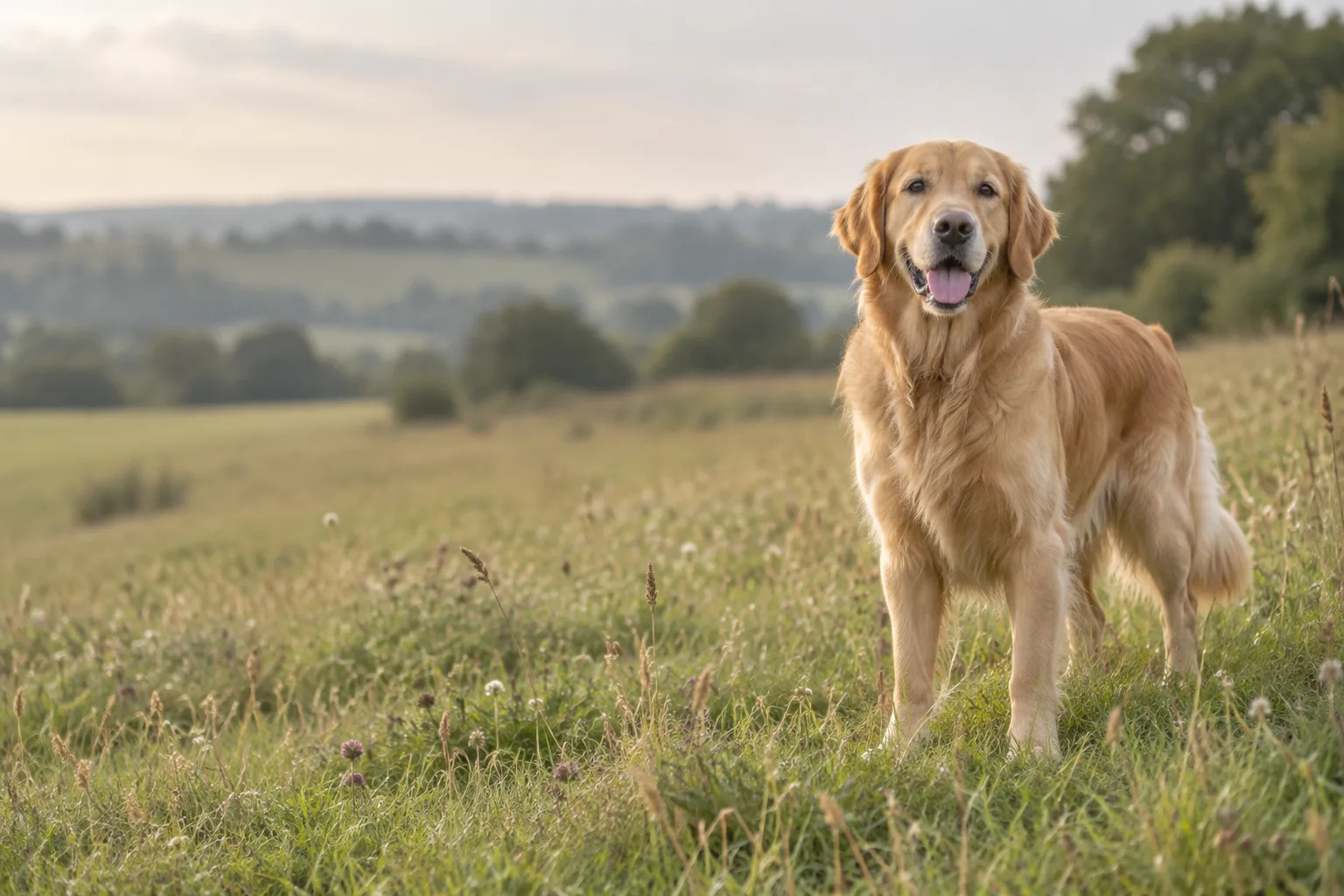
Ask most people where the Golden Retriever comes from and you will hear a story about Russian circus dogs. It is a lovely tale. It is also a myth, and the real history is better. It has a Highland estate, a careful landowner with a notebook, a yellow puppy bought in a seaside town, and a working job that explains almost everything about the dog asleep on your sofa.
We keep the archive for breeds like this one, so we have gone to the accounts that hold up: the published breed histories, the breed clubs, The Kennel Club and the American Kennel Club. Where a popular claim cannot be supported, we say so.
A problem on the Scottish hills
The story starts in the second half of the nineteenth century, and it starts with a change in how people shot game. As breech-loading guns became common, more birds were brought down, and they fell further away, into water, heather, bracken and rough ground. A shooting party needed a dog that could mark where a bird fell, go out and find it, and bring it back to hand without damaging it. That last part matters. A "soft mouth" was not a nicety. A bird chewed to pieces was a bird wasted.
Retrievers of several kinds were already doing this work. Curly-coated and wavy-coated black retrievers were popular, and water spaniels were valued around rivers and lochs. What one man wanted was a dog with a particular set of gifts: strong in cold water, steady on the hill, willing to work closely with people, and calm enough to wait quietly at a peg for hours.
That man was Dudley Marjoribanks, later the first Baron Tweedmouth. He bought the Guisachan estate near Glen Affric in Inverness-shire in the 1850s, and it was there that the dogs we now call Golden Retrievers took shape. Tweedmouth kept breeding records, and those records are the reason this breed has a far clearer origin than most.
Nous, Belle and the first golden litters
According to Tweedmouth's records, the line begins with a yellow retriever named Nous. He was a wavy-coated dog, the only yellow puppy in an otherwise black litter, and Tweedmouth acquired him in the mid 1860s. Nous was then mated to a Tweed Water Spaniel called Belle in 1868. That litter produced the puppies Cowslip, Crocus, Primrose and Ada, and it is the foundation on which the breed was built.
The Tweed Water Spaniel is worth a pause, because you will not meet one today. It was a local type from the Borders, curly-coated and clever in water, and it faded away as a distinct breed. In a real sense a little of it survives in every Golden Retriever, which is one of the more quietly moving facts in dog history.
Tweedmouth did not stop there. Over the following years he brought in other blood to fix what he wanted. The records point to further yellow and wavy-coated retrievers, and to an Irish Setter cross, and the accounts also mention a Bloodhound cross, chosen for scenting ability. His aim was not to invent a fashionable colour. It was to get a dependable, biddable, weatherproof working retriever, and he kept selecting for it, generation after generation, at his own kennels on his own hills.
Those notes were kept privately for a long time. They only came into the open in the twentieth century, when Tweedmouth's records were published through a relative's family papers. Until then, the breed's beginnings had drifted into legend.
The Russian circus myth
The legend went like this. A trainer had bought a troupe of performing dogs from a Russian circus, saw how clever they were, and used them to found the breed. It was widely repeated, and it appeared in early writing about the breed in the early twentieth century. It is romantic, and it gave the dog an exotic pedigree.
But it does not match the Guisachan records. Those show a home-bred line, built up from known dogs with known parents, on a Scottish estate. The circus story is best treated as the sort of tale that grows around a popular dog when the paperwork is hard to find. We include it here only so you can recognise it, and put it down.
It is a good example of why breed history needs sources. When a story sounds too good, it usually deserves a second look. In this case the true account is not duller. It has a named dog, a named mother, a named litter and a landowner who wrote down what he was doing.
From estate dog to recognised breed
After Tweedmouth's time, the dogs spread. Friends, relatives and other sportsmen took puppies from Guisachan and from lines descended from them. Yellow and golden retrievers began to be shown, at first mixed into classes with other retrievers. That shared classification lasted for years.
In 1911, The Kennel Club recognised the breed, at first under the name "Retriever (Golden or Yellow)". That same year the Golden Retriever Club was formed to look after it. The name we use now, Golden Retriever, was adopted by The Kennel Club in 1920. It is a small change on paper, but it reflects a truth about the breed. By then, the golden coat was the thing people recognised across a field.
The breed crossed the Atlantic too. The American Kennel Club recognised the Golden Retriever in 1925, and the Golden Retriever Club of America was founded in 1938. In North America the breed built its reputation partly on field work, then on obedience and showing, and in time on being one of the most popular family dogs in the country.
The twentieth century was not kind to every breed. Two world wars disrupted breeding, food supplies and kennels across Britain, and small, careful lines such as those of a developing breed felt it. We would rather say plainly that the details vary from kennel to kennel and are not something we can list with confidence here, than invent numbers. What the breed clubs' histories agree on is that the breed came through, carried by breeders who kept dogs and records going through hard years.
How the job shaped the dog
Here is where the history becomes practical, because a dog's look and temperament are the shape of its old work.
The coat. A retriever has to work in cold, wet weather and swim. The Golden's coat has a water-resistant outer layer over a dense undercoat, with feathering on the legs, chest and tail. It sheds. It sheds a great deal, and the same dense coat that kept a dog warm in a Highland burn is what you are finding on your jumper.
The mouth. The soft mouth, prized by shooting men, is why so many Goldens carry things gently and seem to want to carry everything. A sock, a slipper, a tennis ball, your car keys. This is not a bad habit. It is the job, looking for an outlet.
The temperament. A gundog that waits quietly, watches its handler and works to instruction has to be biddable and steady with people, and to be calm around other dogs at a shoot. Those traits are the reason the breed is so often described as friendly and eager to please. The point about history is that this temperament was not an accident of fashion. It was selected for, on purpose, because the job demanded it.
The energy. A dog built to spend a day on the hill does not turn into a couch ornament just because you have a garden and a sofa. Many owners are surprised by how much exercise and mental work a healthy adult Golden needs. Give it a job, and it is happier: fetch, scent games, swimming, training, and time with you.
What this means for living with one today
If you are in the UK, you will find that Golden Retrievers turn up in many kinds of working roles beyond the shooting field, from assistance work to search and therapy work. The same qualities that made them good retrievers, willingness to cooperate, a gentle mouth and a steady head, make them useful for other jobs. In the US, the picture is similar, and the breed has a long association with family life and public roles alike. Gerald Ford's dog Liberty, for instance, brought a Golden into the White House in the 1970s.
The old job also explains a few things worth knowing before you bring one home:
- They need daily exercise and something to do with their minds, not just a walk round the block.
- They tend to mouth and carry objects, so expect to be handed things, and to lose the occasional shoe.
- They usually love water, so a muddy stream may be more tempting than a clean path.
- The coat needs regular brushing, and you will still find hair everywhere.
- They are people dogs. Left alone for very long stretches, many become bored and unhappy.
Health deserves an honest word too. Like many popular breeds, Golden Retrievers can be affected by inherited conditions, and the breed clubs and kennel clubs on both sides of the Atlantic encourage health testing of breeding dogs. If you are looking for a puppy, ask a breeder what health checks have been done on the parents, and ask to see the results. It is a fair question, and a good breeder will expect it.
There is a lot of pleasure in knowing what your dog was made for. The next time yours hands you a soggy tennis ball with an expectant face, you are looking at a Victorian gamekeeper's problem, solved. The patient landowner who kept his notes, the yellow puppy in a black litter, the Tweed Water Spaniel that is gone but not lost: it is all still there in the dog at your feet.
If you would like to see the breed as we see it, look for the Golden Retriever archive plate on the breed page. It is an original digital engraving, made for the archive, and it is the picture we would point you to first.
See it in the archive: The Golden Retriever archive plate