
Breed Histories · 26 September 2026
The History of the Great Dane: A Boar Hunter Turned Companion
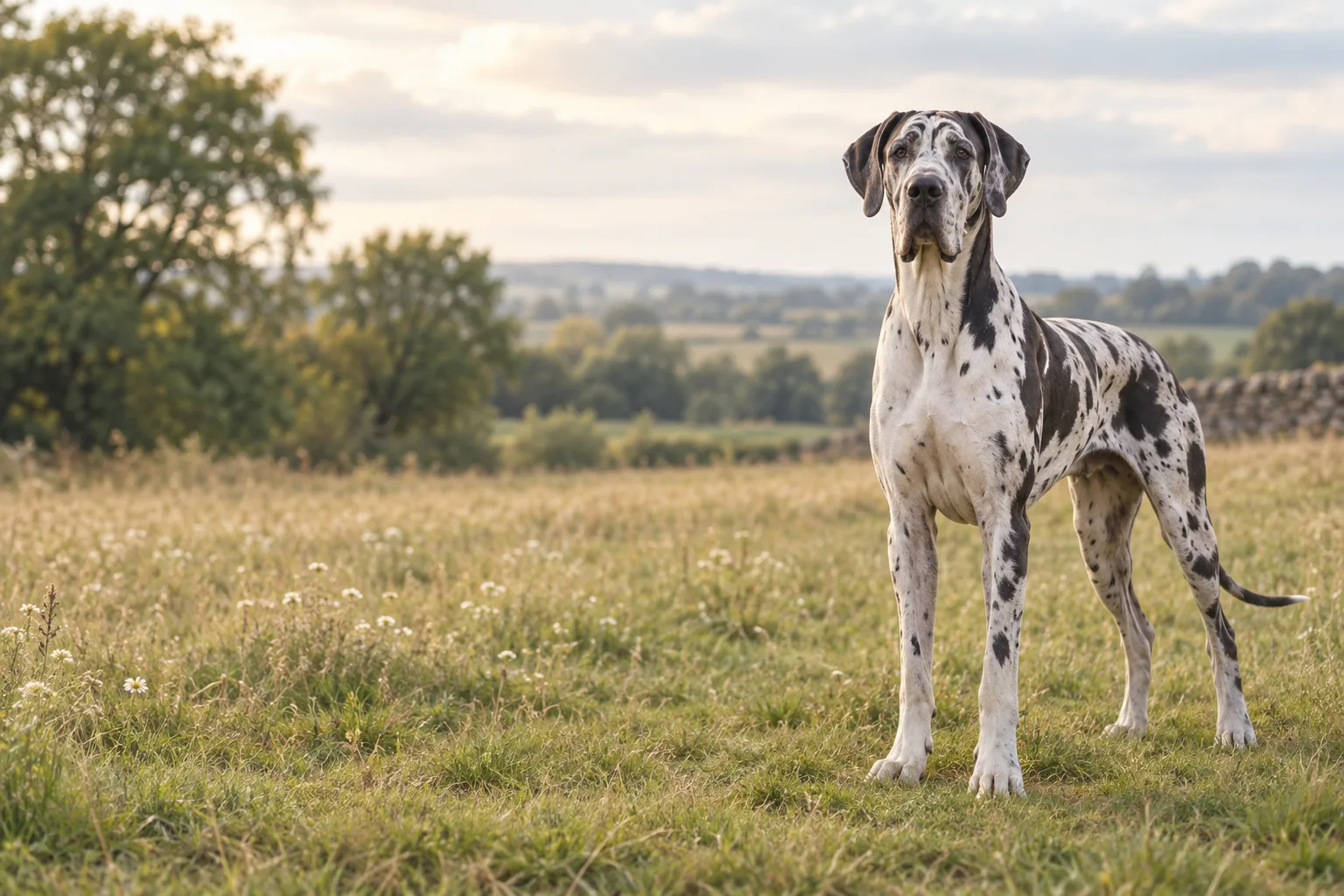
Ask most people where the Great Dane comes from and they will say Denmark. It is a reasonable guess. It is also wrong, and the story of how the breed got its name is a good place to start, because it shows how much of the Great Dane's history has been tidied up over the years.
We keep the archive for people who like to know where their dogs came from. So here is the longer version of the Great Dane, told as carefully as we can, with the myths named as myths.
Not Danish at all
The breed's home country is Germany. There it is the Deutsche Dogge, the German mastiff, and Germans have never called it anything else. The English name is generally traced to the eighteenth-century French naturalist Buffon, who wrote about a large dog he called the grand danois. Breed historians usually treat that label as a slip, or at best a loose piece of labelling, because no strong Danish line of the breed has ever been shown to exist. The name stuck in English anyway, and it stuck in the United States too.
Germany had other names for the same sort of dog before the modern breed was fixed. You will meet Ulmer Dogge, after the city of Ulm, and Hatzrüde and Saupacker, which point at the dog's work rather than a place. Each of these was a working description before it was ever a breed name. That matters, because it tells you what the dog was for.
The job that built the dog
The ancestors of the Great Dane were big, fast, courageous hunting dogs kept by the German nobility to pursue wild boar. A boar is not a gentle quarry. It is heavy, quick, armed with tusks and willing to turn. The dog that hunted it had to be tall enough to seize a large animal, strong enough to hold it, quick enough to catch it in the first place, and brave enough to go in when the sensible thing would be to stay out.
That list of demands explains almost everything about how a Great Dane looks today.
- The height. A tall dog reaches a big animal at the head and shoulder, where the hold matters. Height was a working advantage before it was ever a show-ring virtue.
- The length of leg and the deep chest. A dog that has to run down a boar needs stride and lung room. The Dane's deep, tucked-up build, more greyhound than bulldog for such a large animal, carries the memory of pursuit.
- The clean, powerful head. The head is long and chiselled rather than heavy and wrinkled, because a hunting dog has to breathe, grip and see.
- The cropped and natural ears. Cropping is a whole other subject with its own history, mostly about protecting the ears of a dog that fought. It is now banned in the UK and in much of Europe, and we do not pretend the practice is anything to admire.
The temperament followed the build. A boar hound could not be a nervous dog. Yet it also had to live close to people, in and around the household of its owner, and had to be steady when the hunt was over. That combination of courage in the field and calm in the house is the thing owners of the breed talk about most, and it was selected for long before anyone wrote a breed standard.
As boar hunting changed and the great estates altered how they kept dogs, the big hunting hound drifted from the forest to the household. The dogs that guarded the house and kept the family company were the same dogs, just given a different working day.
From hunting dog to a breed with a standard
The Great Dane as a defined breed is a nineteenth-century development. Breed histories place a key moment in Germany in 1880, when German breeders and judges met in Berlin and agreed that the many local names should go, and that the dog should be treated as one breed called the Deutsche Dogge. That is often described as the breed being declared Germany's national dog. A German breed club followed, and with it a written standard that gave breeders a common picture to aim for.
We would rather you knew the outline than a precise date we cannot back up, so treat the exact sequence as the standard account rather than a document we have in front of us. The point is that the Great Dane became a breed through a group of people deciding, on paper, what it should be. Before that, it was a type of working dog. After it, it was a breed with a shared standard.
The breed then travelled. It was shown in Britain during the Victorian era, when dog shows were becoming a national pastime, and it was recognised by the Kennel Club, where today it sits in the Working Group. In America it was registered by the American Kennel Club in the later nineteenth century and is grouped there in the Working Group as well. Both registries use the name Great Dane, even though the country of origin remains Germany.
Colour became part of the story as it did with so many breeds. The standards recognise fawn, brindle, blue, black and harlequin, and the mantle pattern, black with a white chest and collar, is also seen. Harlequin, white with torn black patches, is the colour most people picture when they think of the breed, and it is also the one that carries a genetic warning. Breeders have long known that two harlequins bred together can produce white puppies with a higher risk of deafness. Responsible breeders plan colour pairings with that in mind, and it is well worth asking about if you are looking for a puppy.
The dog in the public imagination
Great Danes have a public life that few breeds match, and much of it is about size. Guinness World Records has recognised Great Danes as the tallest living dog on several occasions, and the titles have tended to pass from one giant to another over the years. We will not list heights here from memory, because the figures are the sort of thing that is easily misremembered, and the record-holder changes. If you want the current one, check the record-keepers directly.
The other famous Dane is a cartoon. The Scooby-Doo franchise, which began on American television in 1969, made a Great Dane into one of the best-known dogs in the world. It is worth saying plainly that the cartoon dog is not much like the real thing. He is a coward, and the real breed's history is the opposite of that. Still, it did a great deal to make the shape of the Great Dane familiar to children on both sides of the Atlantic.
The breed has also picked up the nickname "Apollo of dogs" in some German writing, a nod to the elegance breeders wanted alongside the power. We mention it as a nickname, not as fact about the breed's origin.
What we cannot give you is a tidy account of how the breed fared through the twentieth-century wars. Many European breeds were hit hard by the two World Wars, when food was short, kennels closed and breeding was interrupted, and it is reasonable to think a very large breed felt that more than most, since a giant dog is expensive to feed. But we have not seen a source that gives numbers for the Great Dane specifically, so we are not going to put figures on it. If you know of one, the breed clubs are the best place to look.
What all this means if you live with one
Knowing the history is not just trivia. It is a fairly good manual.
They are athletes in a sofa's clothing. The dog that ran boar needs proper exercise, but the breed is not usually described as a demanding one. Owners tend to describe a dog that is calm indoors and happy with steady walks, rather than one that needs hours of running. Growing puppies are a separate case. A fast-growing giant breed puppy should not be over-exercised on hard ground, and your vet or breed club can tell you what is right for each stage.
They want to be with you. A dog built to live in the household of its owner is unhappy shut away. A Great Dane left alone for long hours is not being independent, it is being asked to do something the breed was never selected to do.
They are big in every sense. Everything costs more: food, bedding, vet bills, a car large enough to carry one. A dog that stands as tall as your kitchen worktop will clear a coffee table with a tail. Think about that before the puppy arrives, and think about it in the UK's smaller homes as much as in a large American house.
They have health risks that come with the frame. Vets and breed clubs are consistent about the main ones. A deep chest brings a risk of bloat, in which the stomach twists, and that is an emergency to be treated as one. Large hearts can develop disease. Big joints take strain. Lifespans in giant breeds are commonly shorter than in smaller dogs, and it is kinder to know that before you commit than to discover it after. Ask breeders about health testing, and ask your vet what signs to watch for.
They are gentle, and they still need training. A boar hound's courage has become, in the modern dog, something closer to quiet confidence. But a gentle giant that jumps up, leans on strangers or pulls on the lead is still a very large problem. Start early, keep it kind, and teach the manners you will want in a dog of seventy kilos, not seven.
The Great Dane's history is a story of a dog whose job was dangerous and whose home life was close. It was bred to be brave in the forest and gentle at the fireside, and most of the good Danes you meet today are still trying to do both.
We have drawn the Great Dane as an original digital engraving for the archive, and it sits on the breed's page alongside the dog's own picture. If this history has made you look at the breed differently, that is the place to see it.
See it in the archive: The Great Dane archive plate