
Breed Histories · 26 September 2026
The History of the Greyhound
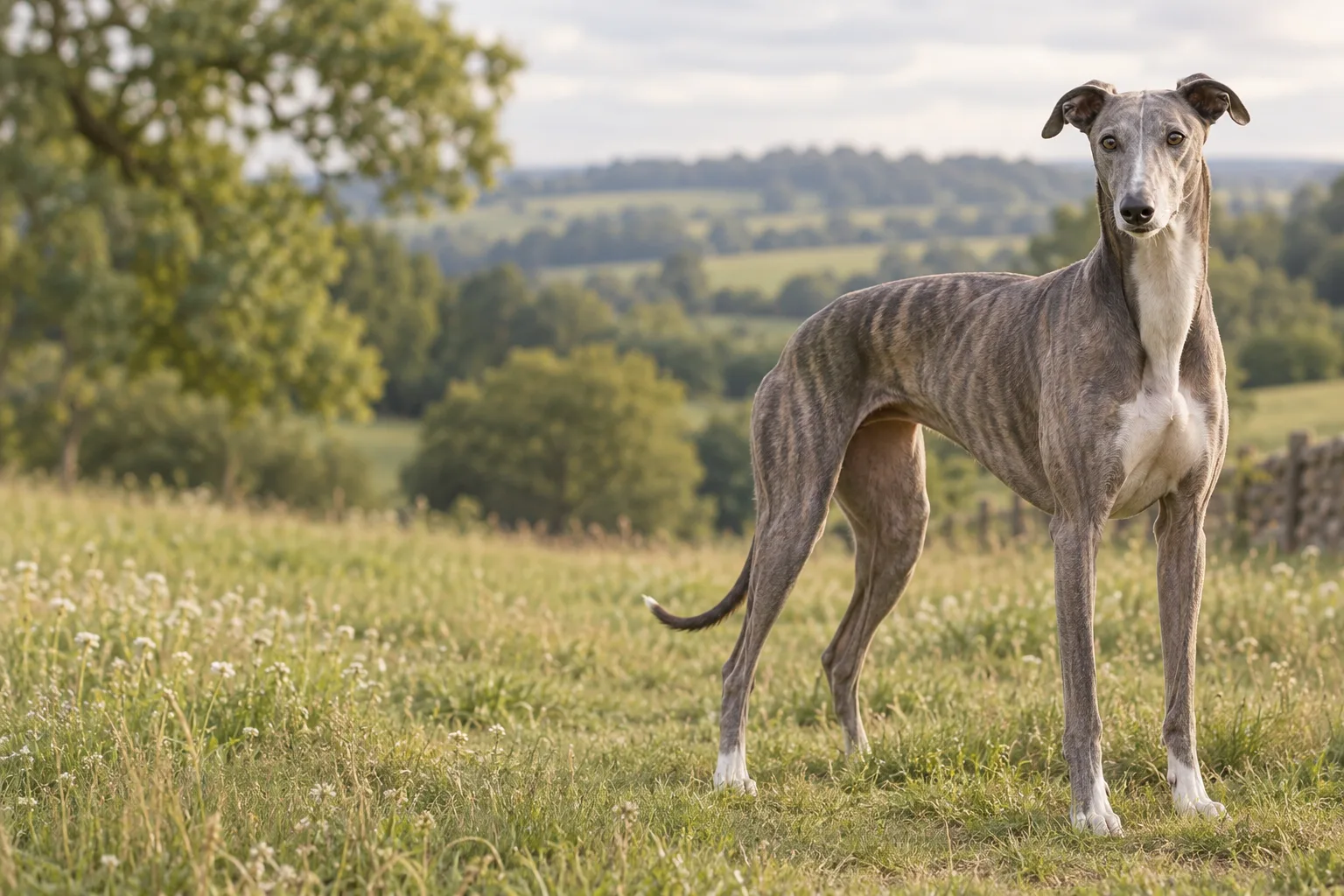
Why does a dog that can outrun almost anything on four legs spend most of its day asleep on a sofa?
The answer sits in the archive, and it is a good deal older than the racing track. As the archive, we like to begin with the job, because in every breed the job comes first and the looks follow. The Greyhound is the clearest case we know.
A dog built for one purpose
The Greyhound is a sighthound. That word describes how it hunts: it spots quarry across open ground, gives chase by sight, and wins by speed rather than by scent or stamina. Everything you see in the breed comes from that. The deep chest holds a big heart and lungs. The long, flexible spine works like a spring, and the narrow waist and tucked-up belly leave the back legs room to swing forward beneath the body. The head is long and lean, with eyes set to watch the horizon.
Put those parts together and you have a dog made for the sprint. It is not a marathon dog, and that matters later when we come to living with one.
Where the breed first appeared is harder to say than many pages admit. You will often read that the Greyhound is the dog of the pharaohs, and that it can be seen unchanged on Egyptian tombs. We would call that a popular story rather than a settled fact. Slim, long-legged hunting dogs do appear in very old art from Egypt and the wider region, and they tell us that people valued speed in a hunting dog for a very long time. What they do not give us is an unbroken, documented line to the dogs sitting in British homes today. The breed as we would recognise it is best traced through Britain and Ireland, where the written record is stronger.
The name itself is another thing we handle with care. The "hound" half is plain enough. The "grey" half has been argued over for centuries, and it certainly does not mean the colour, since Greyhounds come in many. We would rather tell you the origin is uncertain than hand you a neat explanation that nobody can support.
The hunt, the law and the lady with the book
In medieval Britain the Greyhound was bound up with rank and land. A law known as the Forest Laws of Canute, usually dated to the eleventh century, is often quoted as saying that only a freeman could keep a Greyhound. Historians debate whether those laws were really written in Canute's day or were compiled later and given his name, so we would put it plainly: the rule is attributed to Canute, and the general point stands that owning these dogs was a privilege of the better off. A Greyhound was a status animal as well as a working one. It could be found in a nobleman's household, and it was expected to earn its place in the field.
The best early description of the breed we have is in the Boke of St Albans, printed in 1486 and associated with Dame Juliana Berners. It gives a famous rhyme for the ideal Greyhound: headed like a snake, necked like a drake, footed like a cat, tailed like a rat, sided like a team, and chined like a beam. It is charming, but it is also a working checklist. A long neck, a strong loin, a tight, cat-like foot and a low, whip-like tail describe a dog assembled for speed. More than five hundred years on, the breed standards used by The Kennel Club and the AKC still ask for the same body under different words.
The job in those days was coursing: two dogs, usually, set after a single hare, with the contest judged on which showed the greater speed, skill in turning and cleverness in working the hare. The dogs were not there to kill on their own account in the way a modern reader might assume. Coursing was as much about judging the running as the catch. It was an organised sport as well as a source of meat, and it gave the breed something no other pressure could: a reason to keep the very best runners and breed from them.
That is the part of the story we find most useful. For centuries, people selected Greyhounds on performance in the field. They did not choose them for a coat or a colour. It is why the breed looks the way it does, and why its structure has kept its shape.
Named dogs, a stud book and a kennel club
By the nineteenth century coursing had rules, clubs and a calendar. The Waterloo Cup, first run at Altcar in Lancashire in 1836, became its most famous meeting, and for a long time it was one of the great occasions of the sporting year. The National Coursing Club was formed in 1858 and began keeping a stud book, which gave Greyhound breeding a written pedigree record well before most breeds had one.
Out of that world came a dog the archive still returns to: Master McGrath, an Irish Greyhound who won the Waterloo Cup in 1868, 1869 and 1871. He was a small, unglamorous dog by the accounts of the day, and that was much of his appeal. He became a celebrity in Ireland and Britain, and he is remembered in song and story to this day. We name him because he is one of the few dogs from that period whose reputation genuinely outlived him, and because his story shows how much the public loved the breed by the time the modern dog world took shape.
That modern dog world arrived in 1873, when The Kennel Club was founded in London. The Greyhound was among the breeds recorded in its early years, and its standard was written down with the body of the working dog in mind. Across the Atlantic the breed was recognised by the American Kennel Club in 1885. The dogs had already reached North America with settlers, and in the American West Greyhounds were used to course jackrabbits on open plains, where their sight and speed suited the country. The gentle scene of the breed at a dog show and the harder work of the prairie were, for a time, running side by side.
The twentieth century changed the Greyhound's job again. The mechanical lure was developed in the United States, and the first purpose built oval tracks followed, with racing reaching Britain in the 1920s. In 1927 the first Greyhound Derby was run at White City in London. Racing brought the breed a new public, and it gave us another famous name in Mick the Miller, an Irish bred dog who won the Derby in 1929 and 1930 and became a household name. After his death his body was preserved, and it can still be seen at the Natural History Museum at Tring. If you ever want to see how a champion of that age was built, he is worth the journey.
It would be wrong of us to tell only the good part. Racing put large numbers of dogs through a system that had no natural place for them once their careers were over, and for decades the fate of retired dogs was a real concern. In Britain, coursing was ended by the Hunting Act 2004, and the Waterloo Cup ran for the last time in its old form in 2005. In the US, several states have moved to end commercial racing, with Florida's ban taking effect at the end of 2020. We are not going to argue the politics here. We are recording that the breed's most recent chapter has been one of reckoning, and that it has also produced one of the most successful rehoming movements in the dog world.
What the history means for living with one
This is where the archive tries to be practical. Knowing what the Greyhound was made for explains nearly everything about the dog on your rug.
Take the famous laziness. A sprinter's body is built for short, explosive effort followed by long recovery, so a Greyhound at home is often happiest with a brisk walk or two and a great deal of sleep. Owners who take one on expecting a tireless running partner are often surprised. Many enjoy a short burst of full speed in a safe, enclosed space, and then they are done.
Take the chase instinct. A dog selected for centuries to react to a small, fast, moving shape does not switch that off because it has a lovely home. This is why a Greyhound should only be let off the lead where the fencing is secure and you know the place well. A dog moving at speed can be out of sight before you have finished calling. Some have a stronger reaction to cats and small animals than others, and rehoming charities normally assess this before matching a dog to a family. If you are thinking of adopting, ask about it.
Take the body itself. The coat is thin, the skin is fine and there is little fat, so a Greyhound feels the cold and the wet far sooner than a spaniel would. A coat for winter walks is a sensible thing, not a fashion choice. The same lean frame means hard floors are uncomfortable to lie on, which is why so many of them make straight for the softest bed or the sofa.
And take the temperament, because it may be the best part. A dog bred to work closely with people, and to be calm and quiet in the kennel between runs, tends to be gentle, sensitive and undemanding. Many owners describe them as almost cat-like in the house. That gentleness is part of the breed's history as much as its speed. It is also why so many people who take on a retired racer, from the adoption groups in the UK and the US that specialise in them, find themselves keeping the breed for life.
The Greyhound's story is a long one, and it runs from the medieval hunting field, through the coursing meetings of the nineteenth century, to the racing tracks and, now, to the family sofa. Through all of it the breed has been chosen for the same few things: sight, speed and a willingness to work alongside people. When you see one asleep with its legs in the air, it is worth remembering how much history is folded into that thin, elegant frame.
If you would like to see the breed as we draw it, the Greyhound's archive plate is an original digital engraving, made for the archive, and you will find it on the Greyhound's breed page.
See it in the archive: The Greyhound archive plate