
Breed Histories · 26 September 2026
The History of the Hungarian Vizsla
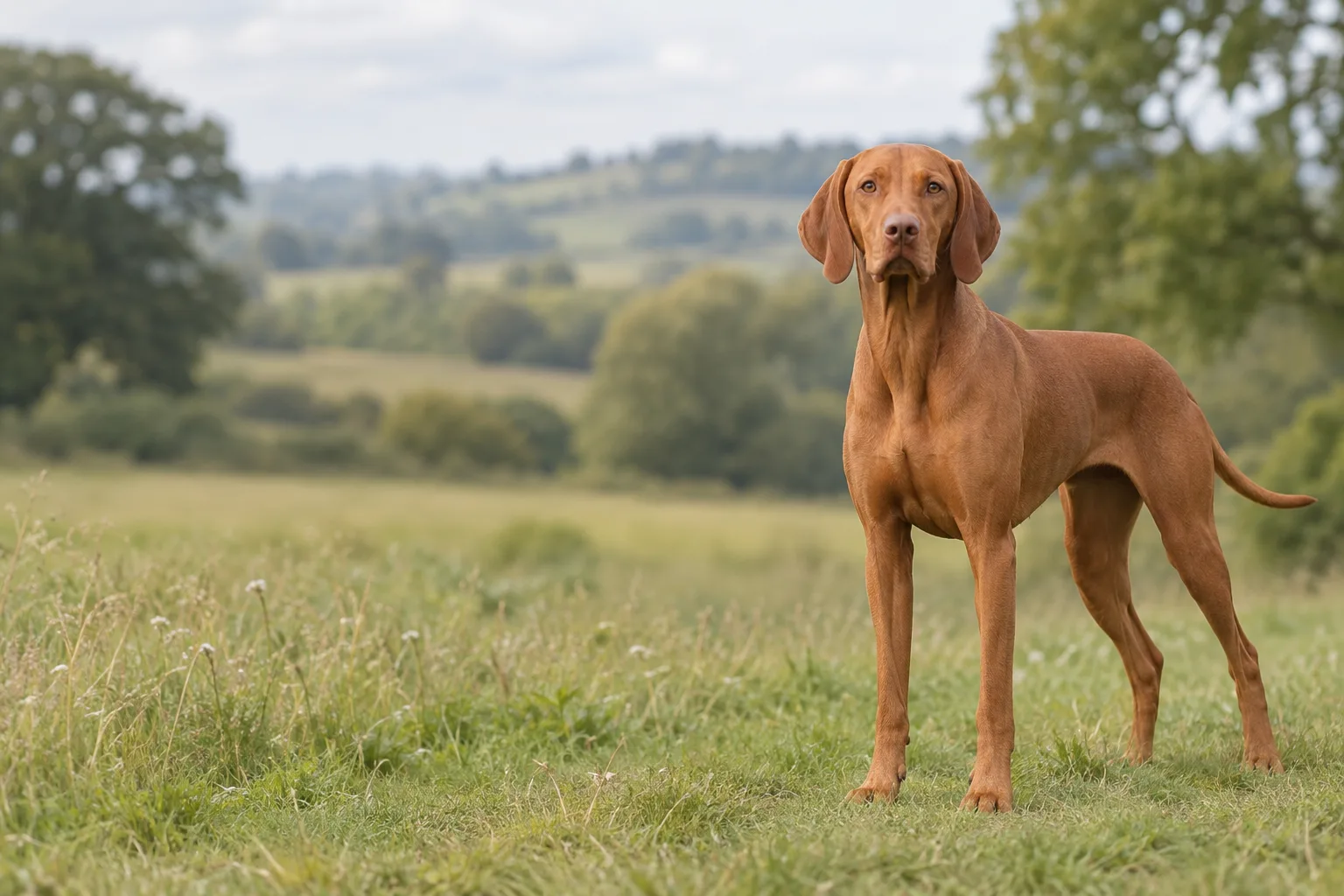
Why does a dog that looks so refined sit so close to your leg, and why does it seem to know what you are about to do before you do? Ask anyone who has lived with a Vizsla and you will hear the same answer sooner or later. It is in the history. This dog was made for a particular kind of partnership, and the shape, the coat and the temperament all follow from it.
At the archive we like to start with what can be supported and be plain about what cannot. The Vizsla has more romance attached to it than most breeds, and some of it is lovely and some of it is only a story. We will try to tell you which is which.
A hunting dog of the Hungarian plains
The Vizsla is the pointer of Hungary, and Hungarians treat it as a national breed. The name is a Hungarian word, usually explained as meaning a searcher or one who tracks, which suits a dog whose whole job was to find game and show its handler exactly where it was.
The breed's traditional home is the Carpathian Basin, the broad country of plains, rivers, marsh and scrub that Hungary sits in. Breed histories say the dogs' ancestors came into the region alongside the Magyar peoples in the late ninth century, and that hunters there worked with dogs of this general type for centuries. This is the part to hold loosely. Breed clubs and breed books often repeat it, and it may well be true in spirit, but a golden hunting dog in the background of an old picture is not the same as a documented line of Vizslas. You will also see a medieval manuscript illustration cited as the first portrait of the breed. It shows a hunter's dog of a similar sort, which is worth knowing about, but nobody can honestly say it is a Vizsla by pedigree.
What the histories agree on is the kind of hunting. For a long time the Hungarian nobility and landowners hunted with hawks and falcons, and a dog was needed to find and hold the quarry until the bird was flown. Later, as guns replaced birds, the same dog was asked to find, point and then retrieve. The Vizsla ended up as a genuine all-rounder: a pointer that could also fetch, and one that would work in open fields and go into water when the bird fell there.
How the work shaped the dog
Look at a Vizsla and you can read the job off its body. It is a lean, medium-sized dog with a lot of leg and a deep chest, built to cover ground for hours without falling apart. The head is fine and the ears hang soft and low. The coat is short, close and smooth, and the colour is a golden rust that seems to change with the light, which is its own kind of camouflage in dry stubble and autumn cover.
The coat also has a price. A Vizsla has very little insulation compared with a spaniel or a retriever, so the breed that was so well suited to the Hungarian season was never designed for standing about in a freezing wet field. Keep that in mind. It matters more in a British November than most new owners expect.
Temperament came from the same place. A dog that works close to one person, all day, has to watch that person constantly. It has to read a hand signal, a change in pace, a lifted shoulder. Over generations, breeders selected for exactly that attentiveness. It is why the Vizsla has its famous reputation for staying near you, and why people call it a shadow or, more often, a Velcro dog. That closeness is not a quirk. It is the working trait, seen in a living room.
There is a softer side as well. Vizslas are known for being sensitive. A dog bred to cooperate with its handler tends to respond badly to harsh treatment, and the breed's own clubs say as much in the way they describe training. It wants to work with you, not be ordered about.
Outside blood and the years of near loss
Where did the dog actually come from? Here the honest answer is a mixture. Accounts of the breed's early development commonly point to yellow hunting dogs in the region, sometimes linked to the long period when Ottoman rule reached into central Hungary, and to local hound and pointing types. In the nineteenth century, breeders are said to have introduced other pointing breeds to sharpen the dog's nose and style, with the English Pointer and the German Shorthaired Pointer among the names most often mentioned. Exactly which dog was used, when, and how much, varies from account to account, and we would rather tell you that than pick the neatest version.
What is much clearer is the trouble the breed ran into. Hunting on the old estates depended on the people who owned them, and it was a smaller world by the late nineteenth century. Numbers were low, and the type was being diluted by crosses to other pointers. By the early twentieth century Hungarian enthusiasts were working to pull the breed back to a consistent standard, and it was in the years around the First World War and after that the Vizsla began to be shown and recorded seriously in its own country. The breed was recognised in Hungary and then internationally in the 1930s, which is the point where it stops being a regional hunting dog and starts being a recognised breed with a written standard.
Then came the Second World War. The Vizsla again came very close to being lost. War, the collapse of the old hunting estates and the political upheaval that followed in Hungary scattered the breeders and their dogs. Breed histories describe families leaving the country with Vizslas, and it is from those few dogs, carried out of Hungary and into Austria and further west, that much of the breed's recovery abroad grew. We would be careful not to make this sound grander than it was. There were not thousands of dogs and a dramatic rescue. There were a small number of animals and a small number of determined people, and that was enough.
One footnote is worth adding. The Wirehaired Vizsla is a separate coat type developed in Hungary in the 1930s, with wirehaired pointing blood added to give a coarser, weatherproof jacket. In the United States the American Kennel Club recognised it as its own breed in 2014. If you are researching the smooth Vizsla, you may run into it and wonder why the records look so different.
Recognition in Britain and America
After the war, the breed's future lay in the countries that took it in. In the United States, Vizslas began arriving in the 1950s, a national club followed, and the American Kennel Club admitted the breed to its registry in 1960. Britain's story runs on a similar schedule. Breed sources place the first imports in the early 1950s, and the Kennel Club recognised the breed soon afterwards. Exact dates and names differ between sources, so we have left them out rather than guess.
Both countries treated the Vizsla the same way at first: as a gundog for people who shot over pointers, and then, gradually, as a companion. Today you will meet Vizslas in field trials, in the show ring and in agility and scent work. You will also meet them on ordinary pavements, doing their best to look like a sofa dog. Some manage it, for about ten minutes.
What that history means for living with one
The history explains nearly everything about daily life with the breed, so it is worth reading it as a set of instructions.
First, the work. This was a dog bred to range and search for long stretches. It needs real exercise, and just as importantly it needs something to think about. A Vizsla left with nothing to do will invent a job, and you will not like the one it picks. Training, scent games and retrieving are not extras for this breed. They are the reason it was made.
Second, the closeness. A dog that was selected to stay tuned to one person does not always cope well with being left. If you are out of the house for long hours, be honest with yourself about whether a Vizsla is fair on the dog.
Third, the coat. In the UK, cold rain is the everyday enemy, and many owners reach for a warm layer for walks in winter. In much of the United States the opposite can apply, with heat as the bigger risk on long summer outings. Either way, the thin coat and the lean build are part of what the breed is, not a flaw to fix.
Fourth, the mind. Because the breed is sensitive, it does best with patient, consistent, reward-based handling. That fits the history too. Nobody built this dog by shouting at it.
If we had to sum up the breed in a single line drawn from its past, it would be this: a dog made to be half of a team. The Hungarian hunter and the Vizsla worked as a pair, and that pairing survived empires, wars and a great deal of upheaval. It is why the breed still asks so much of its owner and gives so much back.
We have drawn the breed as an original digital engraving for the archive. You will find the Vizsla plate on the breed page, and it is the best place to see the lean lines and rust colouring that this history produced.
See it in the archive: The Hungarian Vizsla archive plate