
Breed Histories · 26 September 2026
The History of the Irish Setter
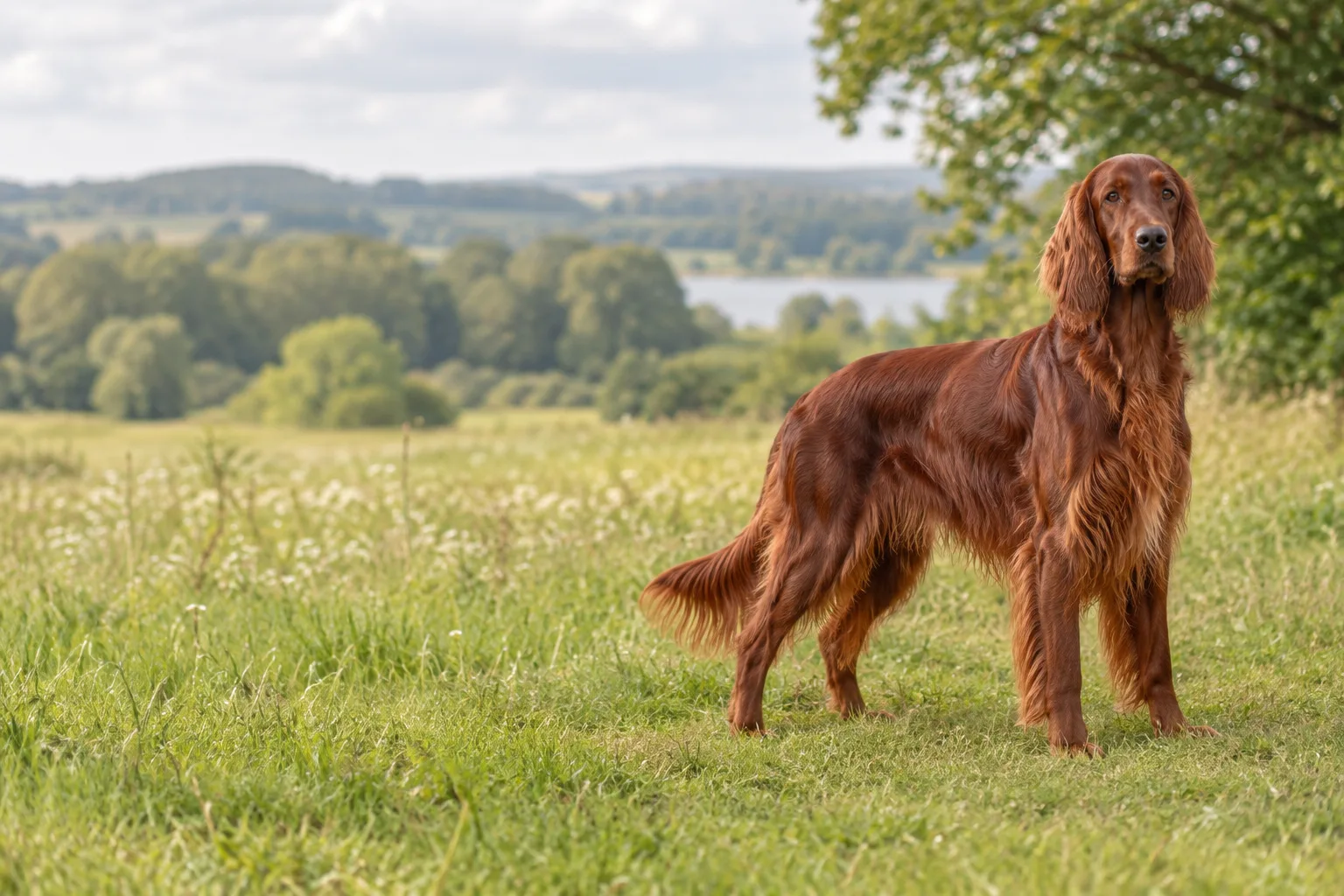
Why does a dog built like a racehorse, coated like polished mahogany and wired like a firework turn out to be a working gundog? It is the question I keep coming back to when I look at the Irish Setter, and it is the best way into the breed's history. Nothing about this dog was designed for the sofa. The beauty, the speed and the endless enthusiasm all began as tools for a job.
The breed page on our site gives you the short version. This is the longer one, written the way we write all the breed histories in the archive: where the dog came from, what it was bred to do, the turning points, and what all of that means if one is asleep across your feet tonight. Where the record is thin, I will say so rather than dress a guess up as fact.
A bird dog from Ireland
The Irish Setter comes, as the name says, from Ireland, and it belongs to the family of gundogs known as setters. The word is the clue to the work. Before shotguns were common, sportsmen used dogs to find game birds such as grouse and partridge and then to freeze or drop low, "setting" so the birds stayed put while a net was drawn over them. When guns arrived, the same instinct suited a shooter who wanted to walk up to a dog that had already found the birds and was holding them.
That job asks for a very particular animal. It needs a fine nose, and the courage to work ahead of the handler over rough open ground. It needs stamina, because a day on a moor is long. And it needs a dog that can go from flat-out running to complete stillness on the scent of a bird. Look at the Irish Setter's long, lean frame and deep chest and you are looking at a body designed for covering ground all day. The feathered coat, the long ears and the plume of a tail all came along with it.
Here I have to be honest about a gap. The setters of Ireland were developed over a long stretch before anyone kept careful written pedigrees, and the usual account is that spaniels, pointers and other setting dogs all fed into them. Precisely which dogs, in which order, is not something I can give you from a documented source, so I will not pretend otherwise. Anyone offering you a neat family tree for the early Irish Setter is, at best, telling you a tidy story.
Red and white, then solid red
This is the part of the story most people get wrong, so it is worth slowing down. The early Irish setters were not all the deep solid red we picture today. Many were red and white, and that pattern was common in the working dogs of Ireland. Over the nineteenth century, breeders and exhibitors increasingly favoured the solid red coat, and it became the fashionable look, especially as dogs began to be judged in the show ring.
The red and white dog did not vanish, but it came close to being lost as the solid red took over. Dedicated breeders revived it in the twentieth century, and it is now recognised as a breed in its own right, the Irish Red and White Setter. It is a separate breed with its own standard, not a colour variety of the one in this article. If you have met a red and white setter and wondered whether it was a mixed dog, that is the answer.
The solid red also had other names in its time. In Ireland it is still commonly called the Irish Red Setter, and you will find the older name "red setter" in a good deal of writing about the breed. The coat itself is described in the breed standards as a rich chestnut or mahogany red, with no black. A little white on the chest, throat or toes is allowed, which is a small echo of the red and white dogs that came before.
The show ring, the clubs and the two types
Dog shows changed the breed as they changed all breeds. The Kennel Club in Britain was founded in 1873, and the American Kennel Club followed in 1884. The Irish Setter was one of the breeds that took part in the early days of organised showing, and it sits today in the Gundog Group in the UK and the Sporting Group with the AKC. Breed clubs followed on both sides of the Atlantic, among them the Irish Setter Club of America, founded in the 1890s. The clubs wrote the standards that still describe the dog: the long, clean head, the racy outline, the flowing feathering, the rich red coat.
Something else happened as the ring grew, and it is the reason two Irish Setters can look surprisingly different. Where breeders selected mainly for the show ring, the dog tended towards a heavier coat, more feathering and a more elegant, sometimes bigger frame. Where breeders kept selecting for the field, the dog stayed lighter, leaner and often with less coat, built to work all day in cover. Both are Irish Setters, and both are registered as such, but the split is real. If you see one that looks like a glamorous show dog and another that looks like a wiry athlete, you are usually looking at the two lines of the same history.
Named dogs and a famous fall from favour
Show records from the nineteenth century mention celebrated individual dogs, but the dates and owners are easily muddled in retellings, so I will stay with the names that are firmly on the public record.
Two of them are famous for reasons that had nothing to do with the field. King Timahoe was the Irish Setter who lived at the White House with President Richard Nixon and his family in the early 1970s, and his name came from an Irish village. And Big Red, the title dog of a 1962 Disney film, was based on Jim Kjelgaard's 1945 novel of the same name. Big Red was a fictional dog, but the book and film put the Irish Setter in front of a huge American audience.
That exposure fits into a wider pattern. Through the middle of the twentieth century the breed became very fashionable in the United States. Whenever a working dog becomes a fashionable one, a familiar cycle follows: demand rises, careless breeding follows demand, and the dogs pay for it. Owners and breed clubs have since written about the health and temperament problems that followed fast popularity, and the breed's supporters have worked to correct them. I cannot give you a reliable number for how far numbers rose or fell, and I will not invent one.
As for wars or a near-loss, I have no documented crisis to report for the solid red Irish Setter itself. The one true near-loss in this family is the red and white dog described above. It is tempting to add a dramatic wartime rescue for the sake of the story, and a lot of breed histories do. I would rather tell you it is not part of the record I can support.
What all this means for living with one
Everything above lands in your hallway the moment you bring one home. A dog bred to run ahead of a hunter for hours needs real exercise, and not just a lap of the block. Whether you live in a flat in Manchester or a house with a yard in Ohio, the arithmetic is the same: this is an athlete, and an under-exercised athlete finds its own entertainment. Usually that means your cushions, your post or your garden.
The setting instinct has not gone anywhere. Many Irish Setters will still point at birds, and a bird on the horizon can take the dog's hearing away completely. For that reason, recall training matters more than you might expect, and off-lead time is best chosen with care, in a fenced or well-known space, until you trust it. This is a bird dog first and an obedient companion second, and it says so through its whole body.
You will hear the breed called clownish, silly or slow to grow up. Part of that is fair: Irish Setters are known for staying puppyish for a long time, so patience is part of the deal. But I would push back on the idea that they are not clever. A dog that can read a moor for hidden birds and hold still on a scent is doing sophisticated work. What looks like daftness is often joy with nowhere to go.
That coat needs regular brushing to keep the feathering free of tangles, and the long ears need checking, as they do on most setters and spaniels. The deep chest is worth a word too. Deep-chested breeds are known to be at risk of bloat, a serious emergency, and it is sensible to talk to your vet and your breeder about it before you ever need to. The same goes for eye conditions and other inherited problems that breeders in both countries screen for. A responsible breeder will happily explain what they test and why.
The breed was made to work alongside people, and it does not do well shut in a kitchen all day. If your life allows for long walks, real time together and a fair amount of red hair on the furniture, few dogs repay it so warmly.
The archive plate
The Irish Setter is a breed that rewards a second look, because the elegance is earned by the work. Every line of that body has a reason, from the narrow head that sniffs out a bird to the long stride that gets it there. That is what I tried to capture in the archive's plate for this breed, an original digital engraving, and you will find it beside this history on the Irish Setter page. If the story here has made you look at the dog differently, the plate is where I would send you next.
See it in the archive: The Irish Setter archive plate