
Breed Histories · 26 September 2026
The History of the Jack Russell Terrier
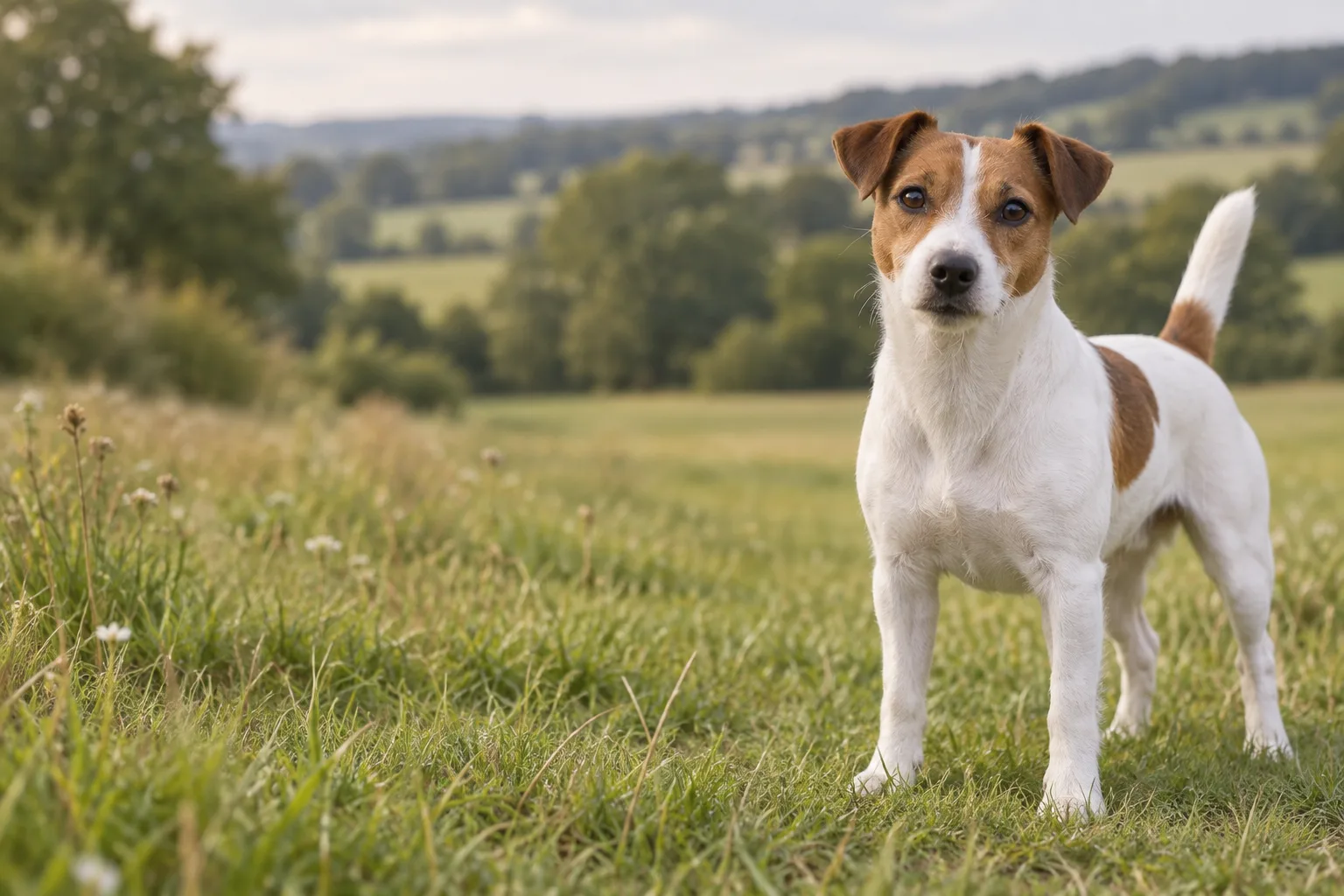
Why does a dog that fits under a kitchen chair behave as if it is in charge of the house? Ask anyone who has lived with a Jack Russell and you will hear the same answer sooner or later. It was not bred to sit. It was bred to work, and the work was hard.
We keep the archive's plates and histories to what we can support from breed clubs, kennel clubs and published breed histories. The Jack Russell has more myths attached to it than most breeds, so where a story cannot be supported we say so, and we leave out the rest.
A parson, a milkman and a white terrier called Trump
The breed takes its name from the Reverend John Russell, born in Devon in 1795 and known in his own lifetime as "Parson Jack". He was a clergyman, and he was a devoted foxhunter. Those two facts are not as odd together as they sound today. Sporting parsons were a recognisable part of nineteenth century country life, and Russell was one of the best known.
The story every breed history repeats is the one about Trump. While Russell was a young man at Oxford, he is said to have bought a small white terrier bitch with tan markings from a milkman, and the dog he called Trump became the foundation of his kennel. The details come to us through Russell's own circle and later writers, so we treat the exact scene with some care. What is well supported is the ideal he was after and the type of dog Trump is taken to represent: mostly white, with markings, and small and lean enough to go to ground.
That colour was not a matter of fashion. A terrier that worked with foxhounds had to be told apart from the fox at a glance, in a hedge, at dusk, with the hounds in full cry. A dog that was mainly white was in less danger of being mistaken for quarry. Look at a Jack Russell now and you are looking at a decision made for safety in the field.
The job that made the dog
Russell was not trying to produce a show dog. He wanted a terrier that could keep up with hounds and horses all day, and then go into an earth after a fox that had run to ground. The terrier's task was to find the fox and make it bolt so the hunt could continue. It was not meant to fight it to the death underground, and a dog that did was a problem rather than a prize.
Follow that job through and the breed's shape starts to make sense.
- Legs long enough to run with hounds. A terrier that tired or fell behind was no use to the hunt, so working types needed real length of leg for the pace. This is why the Jack Russell you see today is not a short, low dog.
- A chest small enough to fit a narrow earth. A dog with a deep, barrel body could not follow a fox underground. Breed standards to this day speak of a chest that can be spanned, and a body built for the job.
- A coat that sheds weather. Smooth, rough and broken coats all appear in the breed, and all are meant to be hard and weatherproof rather than soft.
- Nerve and stamina. This is the part you cannot see on a plate. A terrier working below ground has to be bold, and it has to think for itself, because nobody can give it instructions once it is out of sight.
Here is the misconception we would like to correct, because it explains a great many rehoming stories. People often assume that a small dog is a low-energy dog. Nothing in this history supports that. The Jack Russell was selected for generations to work all day, so a small body comes with a big engine.
Russell's later years and a breed without a fixed type
Russell lived a long life. He died in 1883, aged eighty-seven, and by then his name was attached to a kind of terrier as much as to a man. He was also among the people connected with the founding of The Kennel Club in 1873, and he judged terriers at an early show. That may surprise anyone who thinks of him only as a hunting man. Yet he kept his own kennel by the standards of the field rather than the show ring, and it is often said that he would not have wanted his dogs judged on looks alone.
After his death, the name drifted. Terriers of the white, working type were called Jack Russells by many people, whether or not they had any line back to his kennel. There was no register and no single standard. Owners bred for what worked in their own country, which is why you find Jack Russells that vary quite a lot in height, leg length and body shape. This is the root of the confusion that still surrounds the breed's name, and it is worth understanding before you look at any modern description.
There is a popular idea that the Jack Russell and the fox terrier are simply the same dog under two names. The truth is more tangled. Fox terriers and the working white terriers shared a common background in the terrier types kept for fox work, and the show fox terrier went its own way as a kennel club breed. Working terrier people, meanwhile, kept their own type going. The archive's plate for the Jack Russell shows the dog as a working type with a long enough leg for the field, so you can see the difference for yourself.
Registers, names and the split that followed
The twentieth century is where the breed's story becomes a matter of paperwork. Working terrier enthusiasts in Britain feared that a kennel club standard would do to the Jack Russell what shows had done to other working dogs: shift the emphasis to looks and gradually lose the working ability. Their concern was real, and it led to the formation of clubs devoted to the working terrier, among them the Jack Russell Terrier Club of Great Britain in the 1970s.
Others took the opposite view. They wanted the breed recognised and protected, with a written standard to keep the type from wandering. In 1990 The Kennel Club in the UK took the breed onto its register, and in 1999 the name was changed to Parson Russell Terrier. So there are now two things called by a similar name in the UK: the Parson Russell Terrier, a registered pedigree breed with a fixed standard, and the Jack Russell, which is the wider working type that many people still keep and that is not the same as the registered breed.
The American story runs alongside it. A Jack Russell Terrier club had formed in the United States in the 1970s, and its members, like their British counterparts, were wary of a conformation standard. The American Kennel Club eventually recognised the breed as the Parson Russell Terrier in the early 2000s. It has since also recognised a shorter-legged type under the name Russell Terrier. If you are looking at registries in either country, do check the current names and standards with the club itself, as they have changed more than once and can be confusing.
We should say plainly what we have not been able to establish. Popular accounts of the breed's fortunes in the twentieth century mention hardship, wars and near-losses, but we have not found a source that supports a specific story of the breed itself nearly disappearing. It has always been a widely kept, widely bred dog, and we would rather say that than invent a drama.
What the history means for living with one
Read the breed's history as a job description and most of the living advice writes itself.
- Expect to give it work. A walk round the block is not a day's work for a dog bred to run with hounds. Long walks, a proper game and something to think about will do more than any amount of shouting.
- Expect digging and chasing. A dog selected to go to ground is not misbehaving when it digs. It is doing the very thing its ancestors were valued for. Give it a place where that is allowed.
- Take the fencing seriously. A confident, quick terrier that has seen something to chase will test any gap in a boundary. Assume it will find the weak spot.
- Be careful with other small animals. This is a dog bred to find and pursue quarry. Living peaceably with a rabbit or a cat can be possible, but it is never something to take for granted.
- Train early and keep it varied. An independent dog that was bred to make decisions alone can be very clever, and very good at deciding it knows better. Short, interesting sessions work far better than long repetitive ones.
The same history has a kinder side too. The qualities that made a good working terrier, boldness, loyalty to its people and a real appetite for company and activity, make for a lively, funny and affectionate dog in a home that meets its needs. Most Jack Russells that end up in trouble are not bad dogs. They are working dogs with nothing to do.
Owners in the UK and the US will find the same advice holds on both sides of the Atlantic, though the names and registries differ. If you are planning to buy or adopt, it is worth asking which type you are being offered, a registered Parson Russell, a Russell Terrier or a working Jack Russell, and what the parents were bred and kept for. The answer tells you a good deal about the dog you are likely to get.
The Jack Russell is a dog made by a job, named after a man and argued over by clubs for the best part of a century. Through all of it, the animal has stayed recognisable: white, quick, bold and a little too clever. The archive's engraving plate for the breed is an original digital engraving of the dog, and you will find it on the Jack Russell page, alongside the dog's own picture.
See it in the archive: The Jack Russell Terrier archive plate