
Breed Histories · 26 September 2026
The History of the Labrador Retriever
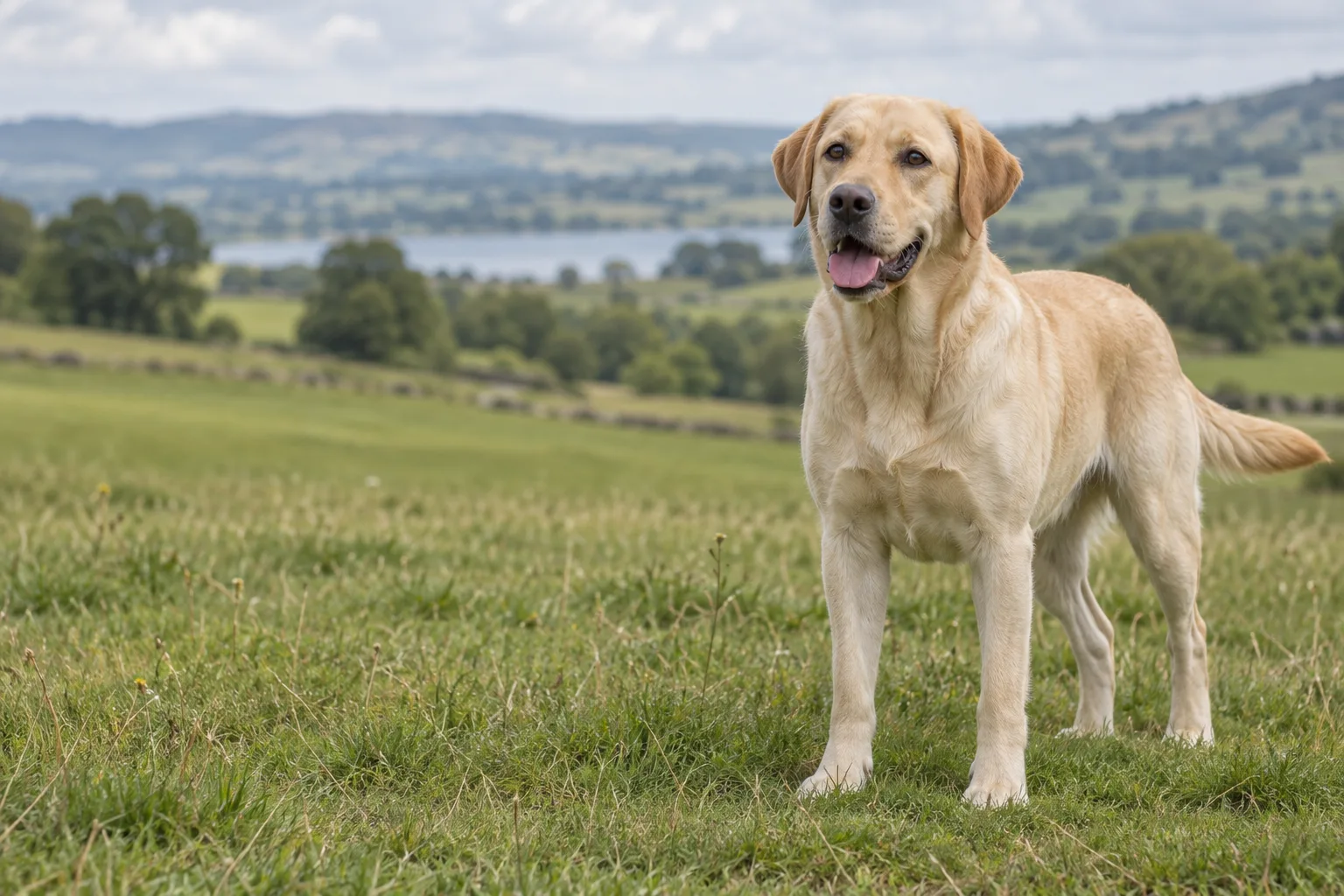
Where does a Labrador really come from? Most people would say Labrador, the Canadian region on the mainland coast. It is a fair guess, and it is wrong. The breed we know grew from the working dogs of Newfoundland, and the name is one of the odder accidents in dog history. We keep a short version of this story on the breed page. This is the longer one, for anyone who has ever wondered why their Labrador loves water, food and people in roughly that order.
Fishermen's dogs on the Newfoundland coast
Long before any show ring, there were dogs working beside the fishing communities of Newfoundland. They are usually called St John's dogs, or the lesser Newfoundland, after the port. They were not pets in the modern sense. They earned their place on the shore and in the boats.
The work was cold, wet and practical. Dogs went into the sea to bring back fish that had slipped off the lines. They helped to haul in nets and ropes. They swam out through surf that would have put most breeds off for good. A dog that could not stand the water, or would not carry something gently in its mouth, was no use to a fisherman, so those dogs were not the ones bred from.
You can still see that job written on the Labrador today. The coat is short and dense, with a harder outer layer over a softer, weather-resistant undercoat that sheds water. The tail is thick at the base and tapers, and is often called an otter tail, because it works like a rudder when the dog swims. The feet are partly webbed. The mouth is soft, which matters when you are carrying a fish or a bird and do not want to damage it. None of this was designed on paper. It was simply the dogs that got the work done and were kept.
There is one honest caution here. We know the St John's dog mainly from travellers' and sportsmen's accounts, not from studbooks, because nobody was keeping studbooks. Where the older stories say a particular cross made the breed, we cannot back them up, so we leave them out. What we can say is that the working type existed, that it was valued for water work, and that it was later carried across the Atlantic.
Poole, the aristocrats and the making of a British breed
The route to Britain ran through the cod trade. Ships travelled between Newfoundland and English ports, Poole in Dorset among them, and some of the dogs came back with them. Sportsmen noticed what these dogs could do. Colonel Peter Hawker, writing about shooting in the early nineteenth century, praised the St John's type as the best of all for wildfowling, a useful reminder that the dog was admired for its work long before it was admired for its looks.
The breed as a British creation was then developed on a few great estates. The Earl of Malmesbury, the Duke of Buccleuch and the Earl of Home all kept and bred these dogs for shooting. The best known written record comes from the third Earl of Malmesbury, who wrote in 1887 that his family had always called their dogs Labrador dogs, and that they had kept the breed pure from the ones his father had first obtained. That letter is one of the reasons we have the name at all. It is also a nice piece of evidence that the name was already in use by the time anyone thought to write it down. Why they chose it, nobody has settled. Some suggest it was simply a loose label for anything from that side of the Atlantic, and others point to the Portuguese word for a labourer. We would call both guesses, not facts.
Estate kennels gave the dogs something the fishing coasts could not: careful, written breeding. Names such as Buccleuch Avon and Buccleuch Ned turn up in early pedigrees, and the Malmesbury line matters too. Meanwhile the Newfoundland end of the story went the other way. Heavy taxes and restrictions on keeping dogs on the island, and later the rabies quarantine introduced in Britain in the 1890s, cut off the flow of new dogs. The original St John's dog faded, and the breed as we know it survived largely because it had been established in British kennels. It is one of the more striking cases in dog history of a type being kept alive far from where it began.
Recognition, colours and the dogs that shaped the breed
The Kennel Club recognised the Labrador Retriever as a breed in its own right in 1903. Before that, the dogs were shown and registered as a kind of retriever, and the early years were about getting a consistent type. The Labrador Retriever Club followed in 1916, in the middle of the First World War, which says something about how seriously the breeders took it. Kennel activity in wartime was hard, with rationing and fewer people to manage the dogs, and many breeds saw their numbers fall. We have no single figure for how far the Labrador dipped, and we will not invent one. What we can say is that a small group of committed breeders carried the lines through.
Colour is where the most persistent confusion lives. Black was the colour in the early registers, but yellow and liver (what we now call chocolate) puppies turned up in litters too. A yellow dog called Ben of Hyde, born in 1899 at Major C. J. Radclyffe's kennel, is usually named as the first recorded yellow of note. For years, yellow and liver dogs were treated with suspicion by some breeders, and there was talk that they were less pure. They were not. Colour in a Labrador is set by a simple genetic mechanism, and there is nothing in a pale coat that makes a dog any less of a retriever. Today all three colours are accepted by both the Kennel Club and the AKC, and the AKC registered its first Labrador in 1917.
Another name worth knowing is Lorna, Countess Howe, whose Banchory kennel in Scotland produced dogs that won both in the show ring and in the field. Banchory Bolo became one of the most celebrated dogs of his era, and the kennel is often credited with helping to set the pattern the breed still follows. This matters because the Labrador was never meant to be only one thing. The early leaders in the breed bred for looks and for working ability together, and the line between the two has been argued over ever since.
Which brings us to something owners in both countries notice. Show lines and working lines have drifted apart. Show-bred dogs tend to be heavier and calmer, with a broader head and a thicker coat. Working-bred dogs tend to be leaner, faster and far more driven, with the sort of energy that finds every gap in a garden fence. Both are Labradors, and both descend from the same dogs. If you are choosing a puppy, ask the breeder which type you are looking at, and how much daily work that dog will expect.
From the shooting field to the guide dog, and across the Atlantic
The Labrador's next chapter was one nobody had planned. The qualities that made a good retriever also made a good helper: steadiness, willingness, a strong wish to please and a mouth that could carry things without damage. The Guide Dogs for the Blind Association was founded in Britain in 1934, and over the decades the Labrador became a mainstay of guide dog work in the UK and the US alike. It has since been used for assistance work, search and rescue and detection, where a good nose and a calm head are worth more than anything else.
In America the breed took hold among wildfowlers and field trial enthusiasts, who found in the Labrador a retriever built for cold water and long days. From there it moved into family homes. The AKC listed the Labrador as its most popular breed for thirty years in a row, from 1991, until the French Bulldog took the top spot in 2022. British registration figures tell a similar story, with the Labrador at or near the top for a very long time before other breeds began to overtake it in recent years. Popularity brings its own problems, as anyone who has looked at rescue listings will know.
What that history means for living with one today
It is easy to treat the Labrador as a large, cheerful, slightly clumsy family pet. The history says otherwise. This is a dog bred to work for hours in cold water, alongside people, for a reward that was often just the job itself. That explains several things owners recognise instantly.
- The mouth is always busy. A dog bred to carry will carry your slippers, your post and, given time, your dinner.
- Water is irresistible. Puddles, ponds and the sea are a lifelong pleasure, and a dog that came from a fishing coast is not going to be talked out of it.
- Food matters enormously. Researchers at Cambridge reported in 2016 a gene variant linked to appetite in a notable share of Labradors, which fits what many owners describe. Keeping a Labrador lean is one of the most useful things you can do for its joints and its life.
- They need work of some kind. A retrieving game, scent work or a long swim will do more for a Labrador than another hour on the sofa.
- They are people dogs. A breed made to work in teams with humans does not enjoy being left alone all day.
Health testing is part of the story too. Responsible breeders in both the UK and the US screen for hip and elbow problems and for inherited eye conditions, and it is reasonable to ask to see the results. A breed with this much history behind it is worth choosing carefully.
If there is a single lesson in the Labrador's past, it is that character follows work. The steady temper, the patience with children and the eagerness to fetch were not accidents of fashion. They came from generations of people keeping the dogs that could do the job. That is worth remembering the next time yours drops a very wet, very muddy stick at your feet, again.
Our archive plate for the Labrador Retriever is an original digital engraving, and you will find it on the breed page, alongside the dog's own picture. If this history has made you look at your own Labrador a little differently, that is where we would send you next.
See it in the archive: The Labrador Retriever archive plate