
Breed Histories · 26 September 2026
The History of the Miniature Schnauzer
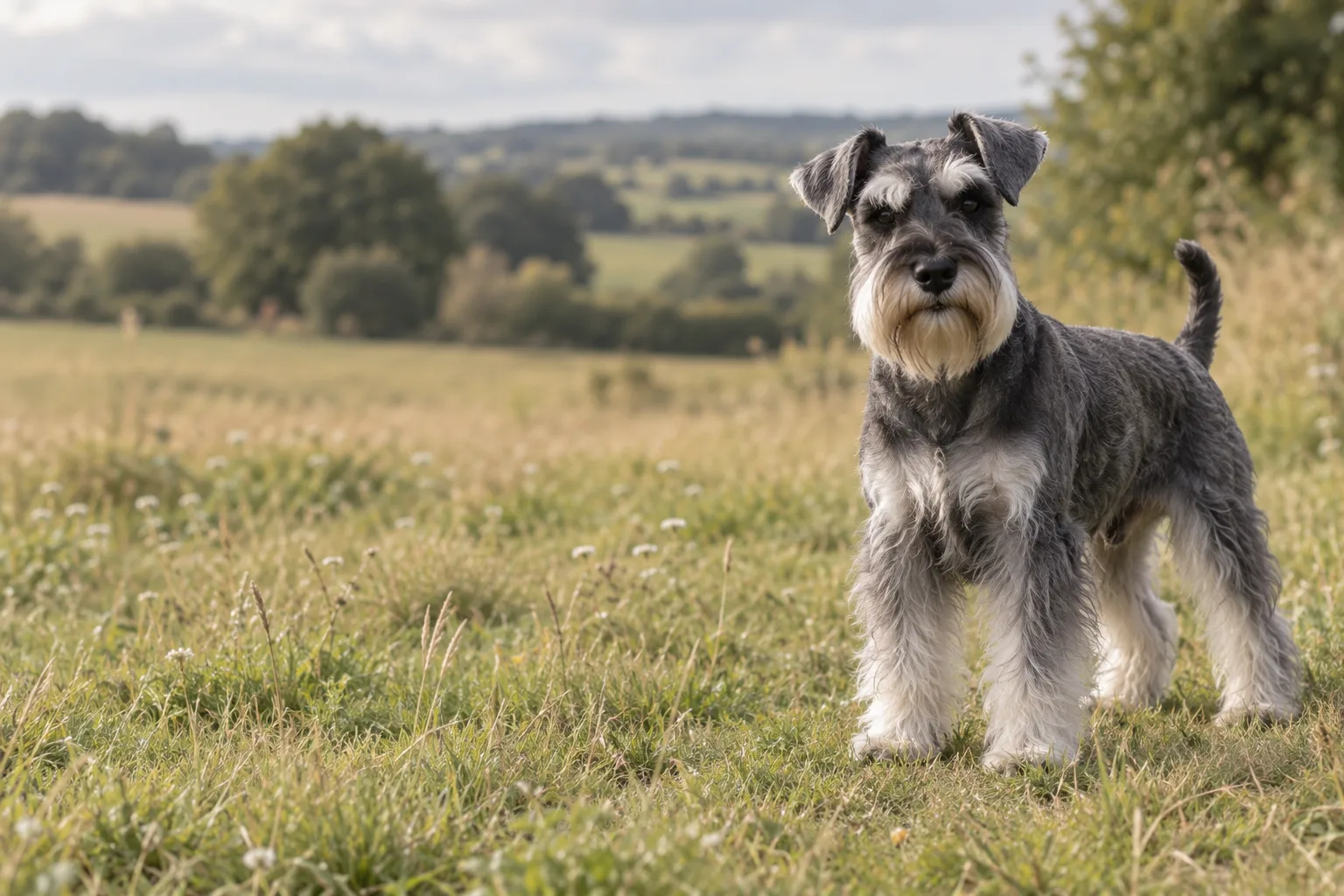
Anyone who has lived with a Miniature Schnauzer will tell you the same thing: it is a small dog with a large opinion. The beard and eyebrows make it look like a retired professor, but the behaviour is closer to a night watchman. That is not an accident of fashion. It is the trace of a job, and the job is where I would like to begin.
A farm dog, not a lap dog
The Miniature Schnauzer comes from Germany, and it is a nineteenth century breed in its present form. Its larger relative, the Standard Schnauzer, is much older as a type: a wire-coated, medium-sized farm and stable dog from the south of the country, the sort of animal that guarded the yard, kept the cart safe while its owner was away and dealt with rats around the barn and the feed store.
That work matters. A dog that lives among livestock and grain needs to notice everything, act without being told and cope with a rough, wet, dirty working day. It also needs a coat that shrugs off weather and brambles. The wiry outer coat with a softer undercoat is the Schnauzer answer to that problem, and the beard is often described as protection for the face when a dog goes nose first into a rat hole. I would treat that last point as the usual explanation rather than a documented fact, but it fits the job.
The name itself comes from the German word Schnauze, meaning muzzle or snout. Breed histories commonly tie the name to a wire-haired dog called Schnauzer shown in Germany in the late 1870s, after which it became the breed's name. Before that, these dogs were generally called wire-haired pinschers, and the Schnauzer and the Pinscher were once registered together in Germany, with the Pinscher-Schnauzer Klub founded in the 1890s. It is a useful reminder that the tidy breed names we use now were still being sorted out when the Miniature was born.
Making the small one
Farmers and small tradesmen wanted a smaller version: a dog that could live in a house or a workshop, keep the vermin down and take up less room and less food. The accepted account, repeated by the major breed sources, is that breeders in Germany reduced the size by choosing the smaller Standard Schnauzers, and that the Affenpinscher was used to help fix the smaller size. Some accounts also mention the Poodle. I would be careful with the detail here. The kennel records of that period were thin, and anyone who claims to know exactly which dog was bred to which is going further than the evidence goes.
What the breed histories do agree on is the first named dog. A black bitch called Findel is recorded as the first Miniature Schnauzer, dated to 1888. By 1899 the breed was being shown in Germany as its own type rather than as an oddity among the larger dogs. From then the Miniature followed its own path: a distinct breed, selected for a smaller size, keen ratting instinct and a cheerful attachment to people.
If you have ever wondered why the Miniature Schnauzer has such a peculiar mix of qualities, this is the reason. It is small enough to be a house dog, but nobody bred it to be decorative. Nobody was selecting for a calm ornament. They were selecting for a dog that would stay alert, work independently and still come home and sit under the table. It got all of that, and it never lost the terrier's sense of purpose.
War, recognition and the crossing of the Atlantic
The First World War and the Second World War both disrupted dog breeding in Germany, as they did nearly everything else. Breed clubs and kennels were affected, and it is part of why the story of the breed in the twentieth century is as much about its export as its homeland. I have not found a source I would trust for figures on how many Miniature Schnauzers were lost, so I will not offer any. What is safe to say is that the breed did not depend on Germany alone for its future, because by the 1920s it had already reached America.
The American Kennel Club recognised the Miniature Schnauzer in 1926, and it was placed in the Terrier Group. That is a curious detail, because the breed did not descend from the British terriers, and its own homeland thought of it as a Schnauzer, not a terrier. The placement reflects what the dog does rather than where it comes from: a small, bold, ratting dog with a terrier's temperament. The first imports arrived in the US in the mid 1920s, and a breed club followed in the decades after. The American breed clubs were where the standard was argued over and refined, and American breeders became a major force in shaping the show dog we see today.
In Britain the story is quieter. The Kennel Club lists the Miniature Schnauzer in the Utility Group, not with the terriers, which is a different reading of the same dog. British breeders imported dogs from the Continent in the twentieth century, and the breed became a familiar sight at shows and in ordinary households. I do not want to give you a precise date for the first British registration, because I could not verify one to the standard this archive expects. If you want to check for yourself, the Kennel Club's breed information and the breed clubs' own histories are the places to start.
Two countries, two groups: the terrier group in the US and the utility group in the UK. The dog has not changed, only the filing cabinet.
What the history means for living with one
A working history is a fair predictor of daily life. Here is how I read it.
They notice everything. A dog bred to guard a yard will announce the postman, the neighbour and the leaf that blew past. Teaching an early, calm "that will do" is more useful than trying to remove the instinct.
They need something to do. A ratter that spends the day on the sofa still wants a job. Scent games, puzzle feeders, training sessions and proper walks give that energy somewhere to go. A bored Miniature Schnauzer will invent its own work, and you will not enjoy the results.
They are thinking dogs. The breed has a reputation for being quick to learn, and that is worth taking seriously in both directions. They pick up good habits quickly and bad ones just as fast. Short, varied and consistent training works better than repetition.
The coat is a commitment. The wiry coat of the working dog, in the familiar salt and pepper, black and silver, or solid black, was made for a farmyard and not a hairdressing salon. Pet dogs generally need regular grooming and their coats kept tidy, and the beard collects water and food. If you like the look, plan for the upkeep.
Size is not temperament. They are small, but there is nothing timid in the breed's history. They were bred to face rats, not to avoid confrontation. Good early socialisation matters for that reason, in the UK and the US alike.
None of this is a criticism. It is what a job leaves behind. The Miniature Schnauzer's alert, brisk, slightly bossy character is the reason so many people love the breed, and it is the reason it has done so well in two countries that do not agree on which group it belongs to.
Whether you share your home with one or simply admire the breed, the archive plate for the Miniature Schnauzer is an original digital engraving, drawn to sit alongside this history. It is on the breed page, and it is the best way I know to see that beard and those eyebrows given the dignity they think they deserve.
See it in the archive: The Miniature Schnauzer archive plate