
Breed Histories · 26 September 2026
The History of the Old English Sheepdog
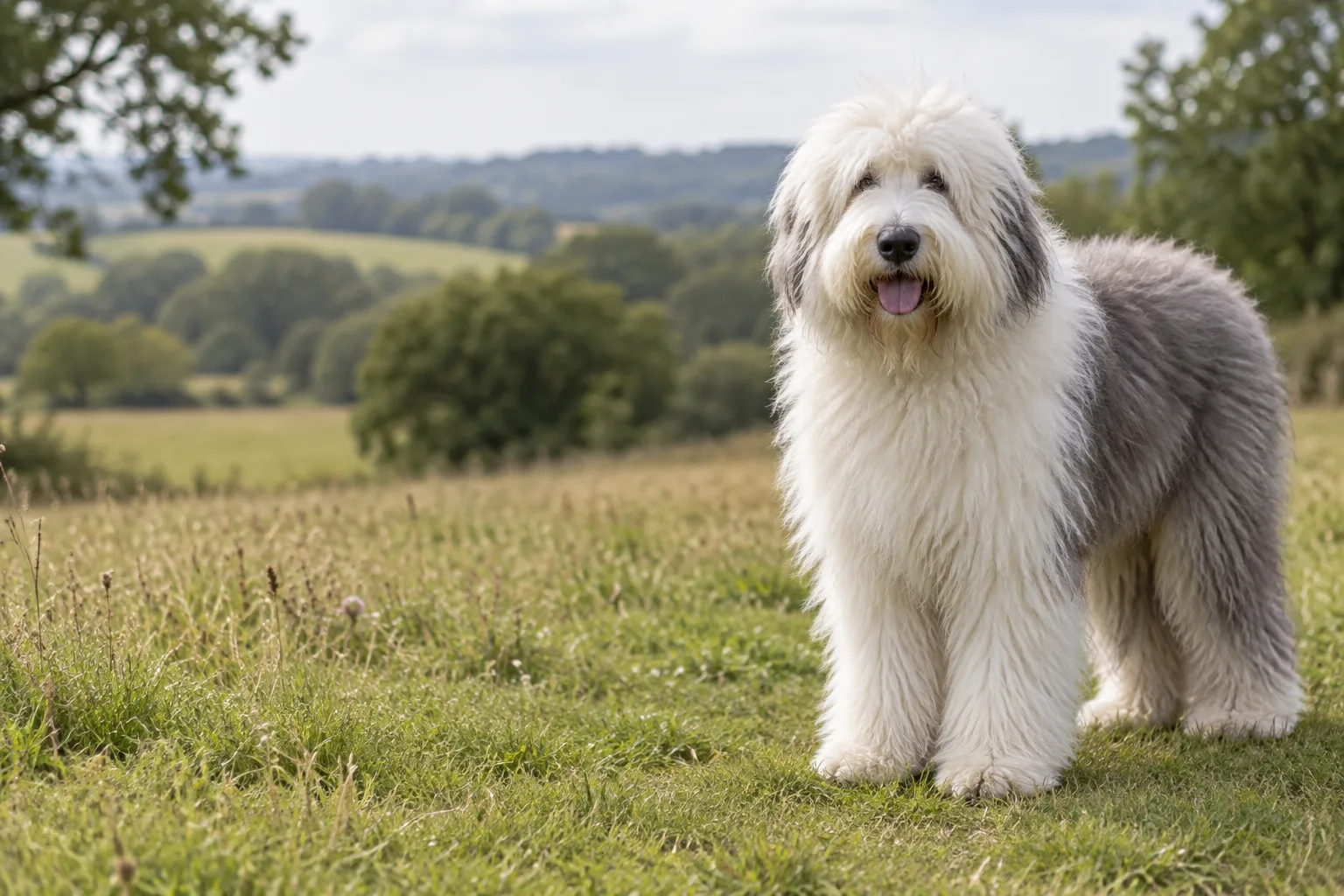
Why does a dog that looks like a walking hearthrug turn out to be a serious working animal underneath? It is the question we ask most often about this breed, and it is a good one. The answer starts with a job, not a fashion.
We keep the archive honest, so a word first about how this history is built. Every date and place below comes from breed club and kennel club records or published breed histories. Where the evidence runs out, we say so. Old English Sheepdog history is full of tidy stories, and some of them are lovelier than they are provable.
A working dog of the English West Country
The breed is generally traced to the west of England, to the farming counties of the south west, in the eighteenth and nineteenth centuries. The dogs were drovers' dogs. A drover's task was to move sheep and cattle across country to market, often over long distances, and often to the great London markets. It was hard, noisy and unglamorous work, done in all weathers.
That job explains a good deal. A drover's dog needed to be sturdy enough to stay on its feet all day, thick coated enough to shrug off rain, and steady enough to cope with a crowd of frightened animals. It also needed to use its body and its voice. Ask any owner about the bark and they will tell you it is not a subtle sound. The breed standard describes it as a loud, ringing bark with a distinctive "pot-casse" quality, a phrase that has stayed in the standard for a very long time. On a drove road, a bark that carries is a tool.
Where the dogs themselves came from is less settled. Writers over the years have suggested ancestors among older European herding dogs, and the Bearded Collie is often mentioned as a relative, as is a large Russian sheepdog type sometimes called the Owtchar. These are theories. None of them has been proved to the standard we would want for a plate in this archive, so we treat them as talking points and nothing more.
There is an early picture that gets quoted in nearly every history. Thomas Gainsborough painted a shaggy, grey and white dog in his 1771 portrait of the Duke of Buccleuch, and breed historians have long pointed to it as an early likeness of the type. It is a lovely piece of evidence, but it is a painting of a dog, not a pedigree, and we would not lean on it harder than that.
What the work did to the look
The coat is the thing everyone notices. It is a profuse, shaggy double coat, and it was never meant as decoration. It kept a working dog dry and warm through weather that would have soaked a lesser coat. The famous look of a dog with its eyes hidden behind a fringe is a working coat that has been allowed to grow, and it is why the breed asks so much of its owners in grooming today.
Then there is the tail. Old English Sheepdogs are known as Bobtails, and the nickname is worth a moment. Puppies can be born with a naturally short tail, and for a long time the tails of the rest were docked. You will often read that drovers docked their dogs' tails to show the dog was a working animal and so escape a tax on dogs. It is a story repeated in breed books and on breed pages. We have not found it firmly documented, so we call it a story. What we can say is that docking was the accepted practice for the breed for generations, and that in England and Wales it was restricted for pet dogs when the Animal Welfare Act 2006 took effect in 2007. Today many dogs in the UK carry a full tail, which is worth knowing if you are looking at photographs from different eras and wondering why the breed seems to have changed shape.
The gait is another clue. The standard describes a rolling, slightly ambling movement, often compared to a bear, with the dog seeming to carry its weight low and easily. That is the movement of an animal built to keep going, rather than one built to sprint.
From drove road to show ring
The breed's move from working life to public life is well recorded. Old English Sheepdogs were shown in England in the 1870s, and the Kennel Club, founded in 1873, was part of the same new world of pedigrees, stud books and show benches. The breed is recorded as appearing at a show in Birmingham in 1873, in the class for sheepdogs. The Old English Sheepdog Club was founded in England in 1888, and it set out to describe the breed in a written standard, which is the moment a working type began to become a defined breed.
The breed crossed the Atlantic in the same century. The American Kennel Club recognised the Old English Sheepdog in the 1880s, and the breed's American parent club, the Old English Sheepdog Club of America, followed in the early twentieth century. From those years the breed was among the dogs that Americans admired for their look, and it found a place in show rings and family homes on both sides of the water. The Kennel Club lists it in its Pastoral Group, and the AKC places it in the Herding Group. Different names, same job.
You may have expected a chapter here about famous named dogs, or about the breed nearly disappearing in a war. We looked for them. We could not find a named dog or a wartime near loss that we could support from the sources we trust, so we have left them out rather than repeat something we cannot check. If you have a properly documented story, we would like to hear it.
What we can point to is a very British turning point in the twentieth century. From 1961 an Old English Sheepdog appeared in television and print advertising for a well known paint brand, and for many people in the UK the breed became the paint dog. It made the breed instantly recognisable to people who had never met one. Fame of that sort is a mixed blessing. Popularity can send more puppies into homes that were not ready for a dog this size and this demanding, and in recent years the breed has been noted by the Kennel Club among its vulnerable native breeds, with registrations well below what they once were. Both things are true: the breed is famous and it is quieter in the show and registration figures than its fame suggests.
What the history means for living with one
An Old English Sheepdog is a herding dog, and it behaves like one. It wants a job, or at least a purpose. A bored one can become a noisy, fussy one. Some owners see herding behaviour at home, with a dog gently steering children or other pets around the garden. That is not a fault. It is the breed doing exactly what its ancestors did.
The coat is a commitment in every season. It needs regular, thorough brushing right down to the skin, and it can mat quickly if neglected. Many owners choose to keep the coat shorter to make life easier. That is a sensible choice, and it is a matter of how you want to live with the dog, not a question of how much you love the breed. In hot weather, US owners in warmer states and UK owners in a heatwave both need to think about how a heavy coat and a big body cope with heat.
Because this is a large breed with a long history of being bred for function, health is worth asking about before you take one home. Breed clubs recommend health testing of breeding dogs, and conditions such as hip dysplasia and inherited eye problems are the kind of thing a responsible breeder will talk about openly. Ask what tests were done and see the results. A good breeder will not mind the question.
Finally, remember what the dog was made for. It was made to work with people, all day, outdoors, in the rain. A dog like that does best with plenty of company and a good walk, wet weather or not. Give it that and you get a loyal, funny, slightly clownish companion. Leave it alone with nothing to do and you will hear about it, loudly, in that pot-casse bark.
The history of the Old English Sheepdog is a story of a hard-working farm animal that became a household favourite, and much of its character can still be traced to the drove road. If you would like to see the breed as we see it, look at the archive plate on the breed page, an original digital engraving made for The Canine Archive, drawn to show the coat, the outline and the expression that a century and a half of history has left us.
See it in the archive: The Old English Sheepdog archive plate