
Breed Histories · 26 September 2026
The History of the Pembroke Welsh Corgi
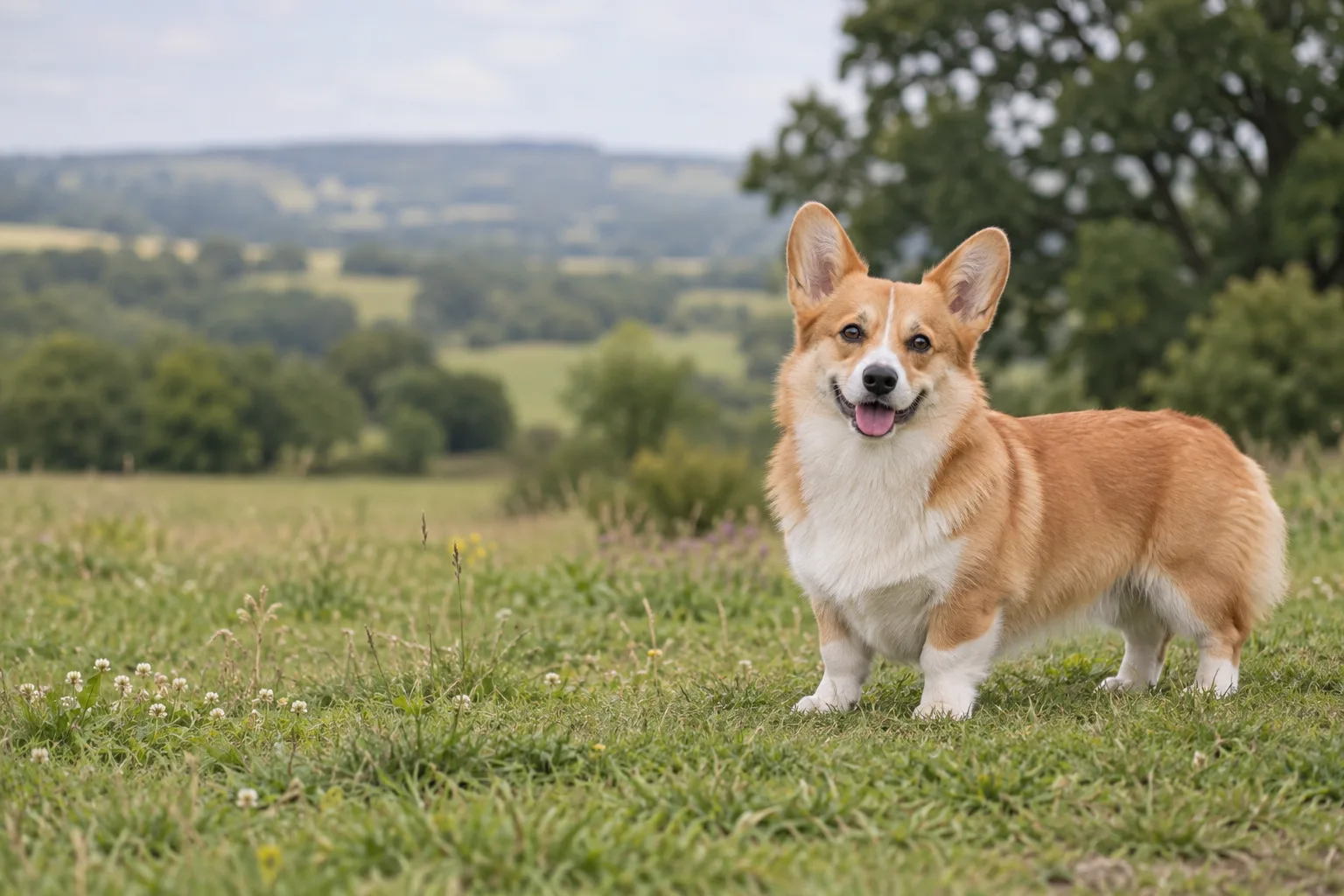
Have you ever watched a Pembroke Welsh Corgi trot across a field and wondered how something so low to the ground can look so certain of itself? That confidence was not bred for the show ring. It was earned in the yard and on the drove road, long before anyone thought of a corgi as a companion.
We keep a short history of every breed on its page in the archive. This one goes further, because the Pembroke's story is unusually well tied to its shape and its temperament. Where the evidence is thin, we say so. Corgi history has more than its share of pretty stories, and a few of them do not survive a close look.
A small dog with a big job in Wales
The Pembroke takes its name from Pembrokeshire, the south-western corner of Wales. That much is not in dispute. It was a farm dog there, kept by people who needed a hand with cattle rather than a pet.
The work was droving and driving: moving cattle from the yard to the field, along lanes, and, in the wider Welsh tradition, towards markets. The corgi's method was to nip at the heels of a cow and then get out of the way. A tall dog doing that risks a kick to the head. A dog built low to the ground passes under the swing of a hoof. This is the plainest explanation of the breed's outline, and it is the one breed clubs have long given. The short legs were not a curiosity. They were the point.
The rest of the build follows the same logic. The body is long and sturdy, giving a working dog stamina and enough length to turn sharply. The ears are big and upright, which suits a dog that has to listen for a farmer's call across noise and cattle. The coat is a weatherproof double coat, dense enough for the Welsh climate. And the character is bold, alert and quick to decide, because a small dog moving large animals cannot afford to be timid.
Anyone who has lived with one will recognise the leftovers. Corgis notice everything. They have opinions about who goes where in the house. Many will try to herd children, other pets and the occasional ankle, with the same low, firm nip their ancestors used on cattle. That is not bad behaviour. It is old training with nowhere to go.
Where did the corgi come from? The stories and the evidence
Nobody can point to a first Pembroke. The origins are old, undocumented and argued over, which is why the stories multiply.
The most repeated is that Flemish weavers settled in Wales in the twelfth century and brought herding dogs with them. It is a popular account and it shows up in many breed books. It is also a tale rather than a record. We have not found a document that connects those settlers to the dogs, so treat it as a tradition, not as a fact.
A related idea links the corgi to the Swedish Vallhund, a similar short-legged herding dog, perhaps through Viking contact with the Welsh coast. The resemblance is real. Whether it shows shared ancestry, or simply two farming cultures solving the same problem with the same shape, is something breed historians still discuss. It is a reasonable theory, not a settled one.
Then there is the fairy story. Welsh folklore says corgis were the steeds and hounds of fairies, and that the pale marking across the shoulders is the mark left by a fairy saddle. It is a lovely piece of folklore, and we are happy to repeat it as folklore. It says nothing about where the dogs actually came from.
What we can say with confidence is narrower and more useful. Small, low, heel-nipping cattle dogs lived on Welsh farms for a very long time, and a distinct type gathered around Pembrokeshire. Two types of Welsh corgi eventually came to be recognised: the Pembroke and the Cardigan, named for different parts of Wales. For a long stretch they were treated as one breed, and interbreeding between them is part of the record. That matters when you look at the modern Pembroke's tail and colouring, and we will come back to it.
The Kennel Club years: from farm dog to registered breed
The change from working farm dog to pedigree breed happened in the 1920s and 1930s, which is remarkably recent for a breed with such old roots.
A club for the Welsh Corgi was formed in 1925, and the Kennel Club recognised the Welsh Corgi as a breed in 1928. At first, Pembrokes and Cardigans were registered together under the single name. In 1934 the Kennel Club separated them into two breeds, the Pembroke Welsh Corgi and the Cardigan Welsh Corgi. The American Kennel Club, which also registered the two together at first, recognised them as separate breeds the same year.
The split was not a paperwork tidy-up. The two types had different looks and different histories, and breeders on both sides wanted them defined. Most people know the quickest way to tell them apart. The Cardigan has a long tail. The Pembroke is usually seen with a very short one, or none.
That tail is worth a moment, because it has changed within living memory. Many Pembrokes are born with a naturally short or absent tail. For decades, puppies with a longer tail were commonly docked, and a docked or naturally bobbed tail became the expected look in the ring. Docking of working dogs' tails is now heavily restricted in the UK, and in England, Wales and Scotland the rules changed in the years around 2007 (the details differ by nation and by whether a dog is a working dog, so check current guidance if it matters to you). The practical effect is that you now meet Pembrokes with full tails more often than you once did. If you see one, it is not a Cardigan in disguise. It is a Pembroke with the tail it was born with.
Colour tells its own story. The classic Pembroke colours are red, sable, fawn, and black and tan, usually with white markings on the chest, legs and neck. It is all the coat of a dog bred for the yard, not for a colour chart.
A palace, a puppy and a very public rise
If the Kennel Club made the Pembroke a breed, the royal family made it famous.
In 1933 the Duke and Duchess of York, later King George VI and Queen Elizabeth, brought home a Pembroke puppy called Dookie. The dog came from the Rozavel kennel, and it was the first corgi in the family that would become closely associated with the breed for almost a century.
The most famous name came in 1944. Princess Elizabeth, then eighteen, was given a Pembroke called Susan for her birthday. Susan went with her on her honeymoon in 1947, and through the decades that followed she was the founding dog of a long line of royal corgis. Elizabeth II went on to keep corgis for most of her reign, and their photographs on the palace lawns and at her side made them recognisable in homes far beyond the show ring.
Fame of this kind is a mixed gift for a dog breed. It gave the Pembroke a place in British life and helped carry it to the United States, where it still has a devoted following. It also meant that for many people the corgi became an accessory to a story about a queen, rather than a dog to be understood on its own terms. Some owners bought on the strength of the image and were surprised by the reality: a barking, herding, shedding, food-motivated small dog with a lot to say.
Near-loss, decline and what it means today
Popular breeds do not stay popular forever, and the Pembroke's run has not been smooth. In the UK, the Kennel Club has at times listed the Pembroke among its Vulnerable Native Breeds, a category for British breeds whose annual puppy registrations have fallen to worrying levels. The exact figures change from year to year, so we would rather point you to the Kennel Club's current list than quote a number that may be out of date. The point stands: a breed that was everywhere in the mid-twentieth century has, in the UK, sometimes been counted among those needing attention.
In the United States the Pembroke has generally been steadier. The AKC has kept it in its herding group since recognition, and it has remained a familiar breed there, though its popularity has moved up and down.
So what does all this history mean for someone thinking of living with a Pembroke today, in the UK or the US?
- Expect a herder. Nipping at heels, circling children and trying to steer the household is normal. Give it a job: training games, scent work, agility, long walks with plenty to think about.
- Respect the back. A long body on short legs is a design for low-level work, not for leaping off high sofas all day. Ramps, steps and sensible exercise help protect the spine. Ask your vet about the specific risks for your dog.
- Watch the waistline. A farm dog burned off its meals across a working day. A house corgi, offered every treat by every visitor, does not. A lean corgi is a healthier one.
- Plan for noise and shedding. A dog bred to be heard across a yard will use its voice, and a weatherproof double coat sheds heavily. Both are features of the job it was built for.
- Choose breeders carefully. Ask about health testing, and check the breed club and Kennel Club or AKC guidance for what is recommended for the breed.
The Pembroke has been through a great deal for such a small dog: farm work, folklore, a formal split from its cousin the Cardigan, a royal household and a sometimes anxious spell on the vulnerable list. Through it all the dog has stayed remarkably itself, short in the leg, long in the back, quick in the mind and unimpressed by anyone who tries to tell it what to do.
If you would like to see the breed as we draw it, the archive plate for the Pembroke Welsh Corgi is an original digital engraving. It sits on the breed's page, alongside the short history, and it is the quickest way to see all that history in a single image: the low body, the big ears, and the look of a dog who knows exactly where the cattle are supposed to be.
See it in the archive: The Pembroke Welsh Corgi archive plate