
Breed Histories · 26 September 2026
The History of the Rottweiler
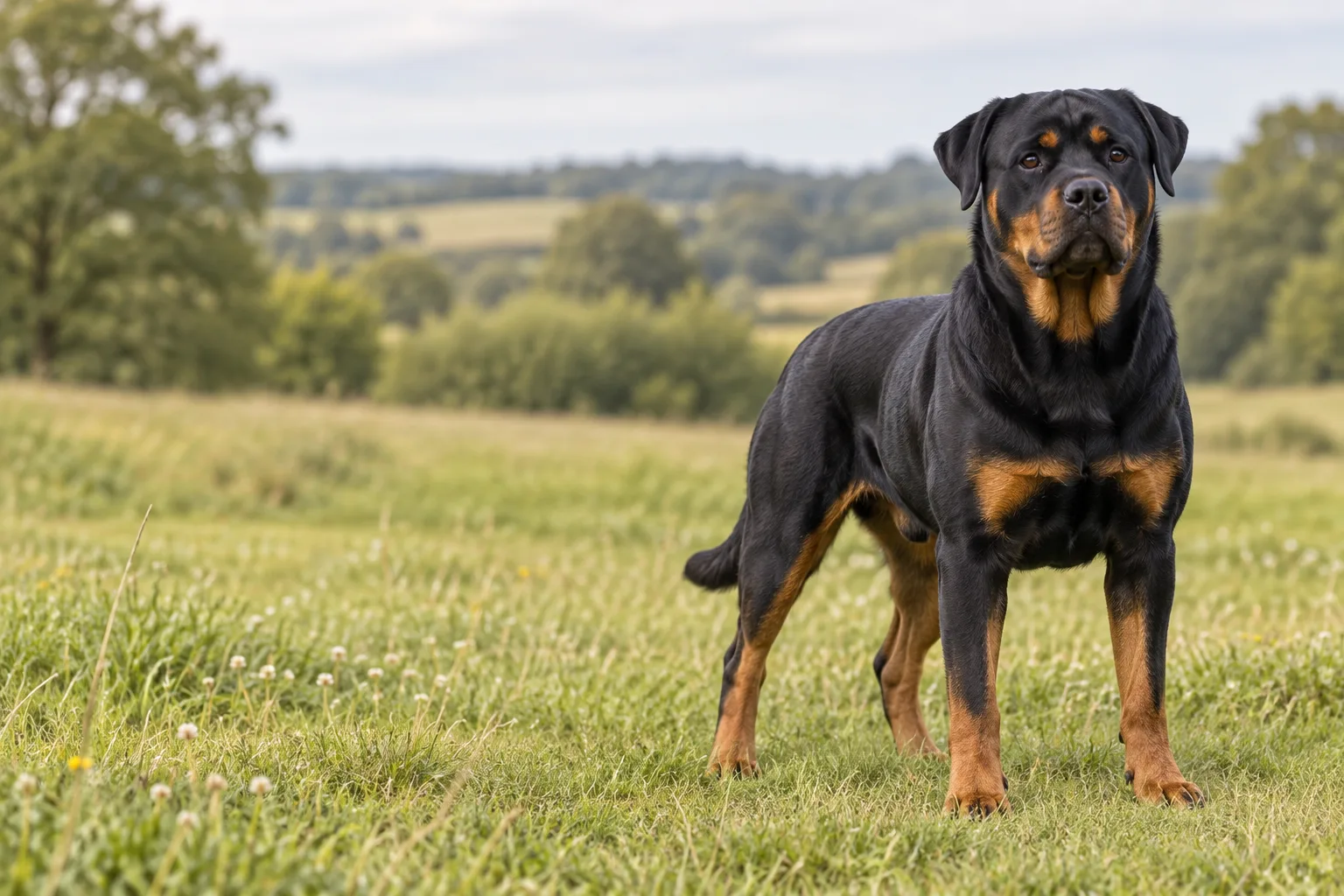
Why does a Rottweiler lean on your leg, watch the door and still look faintly offended when the post arrives? Most of the answer sits in a market town in south-west Germany, several centuries before anyone thought of the breed as a pet.
We keep a short summary of every breed on its page in the archive. This is the longer version for the Rottweiler, and I have tried to keep it honest. Where the story rests on tradition rather than a written record, I say so.
A market town and its butchers' dogs
The name is the first clue. The Rottweiler takes its name from Rottweil, a town in what is now Baden-Württemberg. The town was a Roman settlement, and that is where the most repeated part of the story begins. Breed histories commonly say the ancestors of these dogs walked north with Roman legions, working as drovers that kept herds of cattle moving and together on the march. It is a neat tale and it may well be partly true, but nobody can point to a document that proves a straight line from a Roman drover to the dog you know. I treat it as a plausible tradition, not a fact.
What is better supported is what happened later. Rottweil grew into a trading town, and cattle were a large part of that trade. Butchers needed a dog that could drive beef cattle to market, keep a stubborn bullock moving, and stay calm and steady among crowds and traffic. The dogs that did the job became known as Rottweiler Metzgerhund, the Rottweil butchers' dog.
Two further details turn up in almost every account. The first is that the dogs were also used to pull small carts loaded with meat. The second is that a butcher might tie his money pouch around the dog's neck on the way home from market, on the reasoning that a thief would think twice about going near it. Both are traditional stories in breed histories, and they fit the dog well enough. Whether every butcher really did it is another matter, so read the money pouch as colour, not as a record.
The work explains the look. A drover needs to be strong through the chest and hindquarters, with the bone to take a kick and the stamina for a long day on the road. The Rottweiler's broad head, deep chest and powerful build are what that job asked for, generation after generation, well before a show ring existed to describe them.
Near loss, then a new job
The breed's first great danger came from progress, not from war. In the nineteenth century, driving cattle on foot went out of favour in Germany, and railways and other ways of moving livestock took over. When the work disappeared, so did the reason to breed the dogs. Breed histories often tell how few Rottweilers remained in Rottweil itself by the early twentieth century, with the story of a single bitch left in the town being the one most often quoted. I would not swear by the exact number, but the direction of travel is not disputed. A working breed with no work is a breed in trouble.
The rescue came through organisation. A first club for the breed was founded in Heidelberg in 1907, and it was followed by further clubs and, in 1921, by the Allgemeiner Deutscher Rottweiler Klub, the ADRK, which still guards the breed in Germany. Those early clubs did what breed clubs do best. They wrote a standard, kept records and set out what a good Rottweiler should look and behave like.
They also gave the dog a second career. Around 1910 the Rottweiler was accepted as a police dog in Germany, and its steadiness, willingness to work and physical presence suited that role. Breed accounts also describe Rottweilers serving in the First World War as messengers, guards and draught dogs. The details vary from source to source, so I will only say that the breed's usefulness in uniform is well remembered and that it helped keep the numbers going while the old droving trade was gone.
I have not named individual famous Rottweilers here. The stories I have seen attached to particular dogs are hard to trace to a reliable source, and I would rather leave a gap than pass on a legend as a fact. If a dog in the breed's past deserves a place in the archive, I would like to see it in a kennel club or breed club record first.
Across the Channel and the Atlantic
The Rottweiler travelled slowly. In Britain, the first dogs arrived in the 1930s, and breed histories commonly credit early importers such as Thelma Grey of the Rodsden kennel with laying the foundations. Numbers stayed small for a long time, and the years of the Second World War made an already thin population thinner. The breed was rebuilt in the decades afterwards, mainly by breeders who imported carefully from Germany and paid attention to health and temperament as well as looks. The Kennel Club places the Rottweiler in its Working group, which is exactly where its history says it belongs.
In the United States, the American Kennel Club recognised the Rottweiler in 1931. The AKC also lists it in the Working group. Its popularity grew slowly at first and then quickly, and by the 1990s the breed had climbed high in American registration rankings. That kind of surge is a mixed blessing for any breed. More people wanted a Rottweiler than there were carefully bred, carefully raised ones to go round, and the breed has been paying off that reputation ever since.
That brings us to the myths, which deserve to be named. One is that a Rottweiler is aggressive by nature. Every version of its history points the other way: a dog bred to work calmly among cattle, crowds and carts, and later chosen for police work because it could be trained. Temperament in any dog comes from breeding, early handling and the life it is given, and the difference between a well-raised Rottweiler and a badly raised one is very large. Another myth is that the breed has a locking jaw. There is no such mechanism in the anatomy of any dog, and the Rottweiler is no exception.
It is also worth knowing that the Rottweiler is not one of the types banned under the Dangerous Dogs Act 1991 in Britain. Those are the pit bull terrier type, the Japanese Tosa, the Dogo Argentino and the Fila Brasileiro. The tail is a separate matter of tradition. Docked tails became a standard feature of the breed in the show ring, and the AKC standard still describes a docked tail. In England, docking for non-working dogs has been illegal since 2007, so British Rottweilers with natural tails are now the normal sight, and they look perfectly right.
What the history means for living with one
A dog shaped by centuries of work is not a dog that wants to do nothing. A Rottweiler is at its best with a job of some sort: training that goes beyond the basics, long walks that have a purpose, games that use its brain as well as its legs. Bored Rottweilers find their own work, and it is seldom the work you had in mind.
The drover's instincts also show up in everyday life. Many Rottweilers like to keep their household together, to position themselves between the family and whatever seems to be happening, and to lean, herd and shadow. That steadiness is what made them useful in the first place, and it is one of the reasons owners love them. It does mean early, calm socialisation matters a great deal, so a dog learns which visitors, dogs and noises are simply part of life.
Size matters as well. This is a strong dog, and a strong dog that pulls on the lead or jumps up is a problem however well meant. The time to teach manners is when the puppy is small enough to be moved by a gentle hand. Breed clubs generally advise buyers to ask for hip and elbow screening results from the parents, because joint problems are a known concern in large breeds, and to speak to the breeder about the wider health record. A reputable breeder will welcome the questions.
Seen against its past, the Rottweiler looks less like the fearsome dog of its reputation and more like what it always was: a practical, serious, loyal working companion that nearly vanished when its trade did, and was brought back by people who valued its character. It deserves owners who value the same things.
The archive plate for the Rottweiler, an original digital engraving, is on the breed page. If this history has made you look at your own dog differently, or made you curious about one, that is the place to go next.
See it in the archive: The Rottweiler archive plate