
Breed Histories · 26 September 2026
The History of the Rough Collie
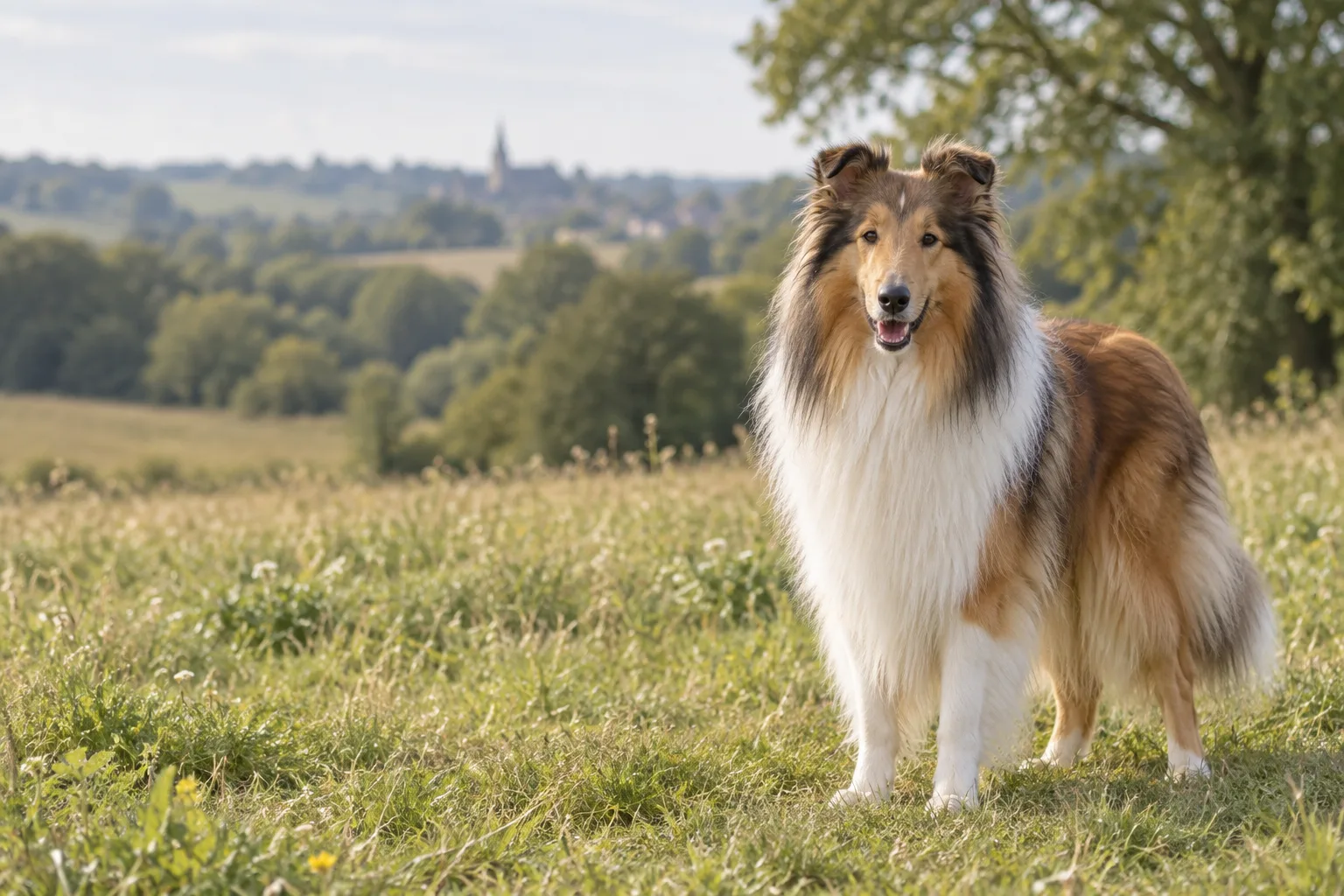
Most people meet the Rough Collie through a story before they meet one in a field. That is worth saying at the start, because the film star and the real dog are not quite the same animal, and the real history is more interesting than the legend. Here is what we can stand behind, and where we have chosen to say "nobody knows".
Sheep, hills and a name nobody can settle
The Rough Collie belongs to the herding dogs of Scotland and the north of England. Long before anyone wrote a breed standard, farmers and shepherds kept dogs that could move sheep across open hill ground, and they kept the ones that did the job well. Nobody was breeding for a look. They were breeding for a dog that could think, listen and work at a distance from the person who owned it.
That job left its mark. A dog that spends its days on cold, wet uplands wants a weatherproof coat, so the long, harsh outer coat over a soft, dense undercoat is not decoration. It is a working coat that later became a show coat. A dog expected to gather and turn stock needs to read a person's slightest signal, and this is where the collie's famous sensitivity comes from. The dog watches you because, for generations, watching the shepherd was the work.
Then there is the name. You will find several explanations for "collie" or "colley". One points to a breed of black-faced Scottish sheep, another to the word for coal, since many of the old working dogs were black. We have not found an account settled enough to state as fact, so we will simply say the origin is debated. Be wary of any confident single answer.
It also helps to be clear about what the Rough Collie is not. The Border Collie, the sheepdog of trials and farms today, grew from the same broad family of working dogs but was developed later with working ability as its only test. The Rough Collie went a different way. Over the nineteenth century it became a breed with a fixed appearance, a pedigree and a place in the show ring, while the working sheepdog carried on separately.
Balmoral, Birmingham and the making of a breed
The turning point came in the Victorian age, and it came through people as much as dogs. Collies appeared in classes at the early dog shows, and the Birmingham show of 1860 is often cited as one of the first to give them a class of their own. Shows gave breeders something they had never really had before: a place to compare dogs side by side and a reason to agree on what a good one looked like.
Queen Victoria did the rest. She came to know the collies of the Scottish Highlands during her time at Balmoral in the 1860s, and she kept them. Royal favour matters in the history of any breed, and here it took a working dog from the hills and made it fashionable in the drawing rooms of Britain. People who had never seen a sheep gather now wanted the dog that did it.
Among the early dogs, a few names keep turning up in the old pedigrees. Old Cockie, born in 1868, is treated as a foundation sire, a dog many later lines trace back to. Trefoil, born in 1873, is remembered as one of the great early sables. These are the dogs a serious breed historian reaches for first. We would rather name a few we can support than decorate the story with a dozen we cannot.
The institutions followed quickly. The Kennel Club was founded in 1873, and the Collie Club, formed in the early 1880s, drew up a written description of the breed. Across the Atlantic the American Kennel Club, which began in 1884, registered Collies from its earliest years, and the Collie Club of America followed in the 1880s. By then American buyers were paying notably high sums for the best British dogs. We will not quote a figure, because the published numbers vary, but the trade across the Atlantic was real, and it explains why the breed's American story runs so close to the British one.
The look changed during this period too. The head became longer and more refined, and the coat fuller. You will often hear that breeders crossed in other breeds to achieve this, with the Borzoi frequently named for the narrow muzzle. It is an old and much repeated story, but we have not found a source that settles it, so we file it as a claim rather than a fact. What we can say is that show breeders selected deliberately for a more elegant outline, and the modern Rough Collie head is the result of that selection.
The dog in the book, the film and the family
If the Victorians made the Rough Collie fashionable, the twentieth century made it beloved. In America, the writer Albert Payson Terhune bred collies at his Sunnybank kennels in New Jersey and wrote about them for a wide readership. His book Lad: A Dog, published in 1919, was a great success and gave a whole generation an image of the collie as loyal, brave and almost human in its understanding.
Then came Lassie. Eric Knight's novel Lassie Come-Home appeared in 1940, and the film followed in 1943. The dog who played Lassie was a male Rough Collie called Pal, and the part has been played by his descendants ever since. That detail surprises people, but it is well documented, and it says something about the breed. The long, full coat of a male photographs beautifully, and the collie's calm, watchful face carries a story without a word.
The effect on the breed was enormous, and not all of it was kind. Popularity brings demand, and demand brings people who breed for the market rather than the dog. Collies in the mid twentieth century were extremely common, and the breed has since become a quieter presence, which many owners would say is no bad thing. It is a useful reminder that a famous dog is not the same as a famous breed's welfare.
You may expect a chapter here about a war, or a brush with extinction. We looked for one and did not find a record we would trust. The Rough Collie has not been through the sort of near loss that some rarer breeds have suffered. We would rather say that plainly than borrow a dramatic tale from another breed's history.
One more point of tidiness for UK readers. The Kennel Club lists the Rough Collie and the Smooth Collie as separate breeds, with different coats but a shared heritage. In the United States the AKC treats them as one breed with two varieties. Same dogs, different paperwork, and worth knowing if you are searching breeders or club listings on either side of the Atlantic.
What all that history means for living with one
Put the history together and the modern Rough Collie makes sense. It was bred to work closely with a person, so it tends to be gentle, attentive and sensitive to tone. Most do badly with harshness and well with patience. It was bred to be watchful and to use its voice, so many are talkers, and a bark that once carried across a hillside can carry across a terrace of houses. It was bred to move, so it needs proper walks and something to think about, even if it never sees a sheep.
The coat needs honest attention. Brush a Rough Collie regularly and thoroughly, right down to the undercoat, because that is where mats begin, and expect heavy shedding at certain times of year. In a damp British winter you will bring in a good deal of the outdoors with you. In a hot American summer a coat built for Scottish hills asks you to think about shade, water and sensible exercise times.
There is one health matter every owner of a collie type should know about. Many collies carry a gene change, known as MDR1, that makes them sensitive to certain drugs, and it was identified through research in the United States. A simple test exists, and your vet can advise on it and on which medicines to be careful with. This is not a reason to be nervous, just a good reason to tell any vet you meet that your dog is a collie. Eye conditions have also been recognised in the breed, so ask any breeder about the health screening they do and the results.
The last thing history tells us is about temperament in the home. A dog selected for generations to stay close to its people and read their moods will often follow you from room to room. Some owners find that endearing and some find it a lot. If you want a dog who wants to be part of everything, the Rough Collie is a natural. If you want one that is content alone all day, look elsewhere.
That is the story as far as we can honestly tell it, from a working dog on Scottish hills to Victorian show benches, a famous novel and a very famous film. If you would like to see the breed as we have drawn it, the archive plate for the Rough Collie is an original digital engraving, and you will find it on the breed's page in the archive.
See it in the archive: The Rough Collie archive plate