
Breed Histories · 26 September 2026
The History of the Smooth-Haired Dachshund
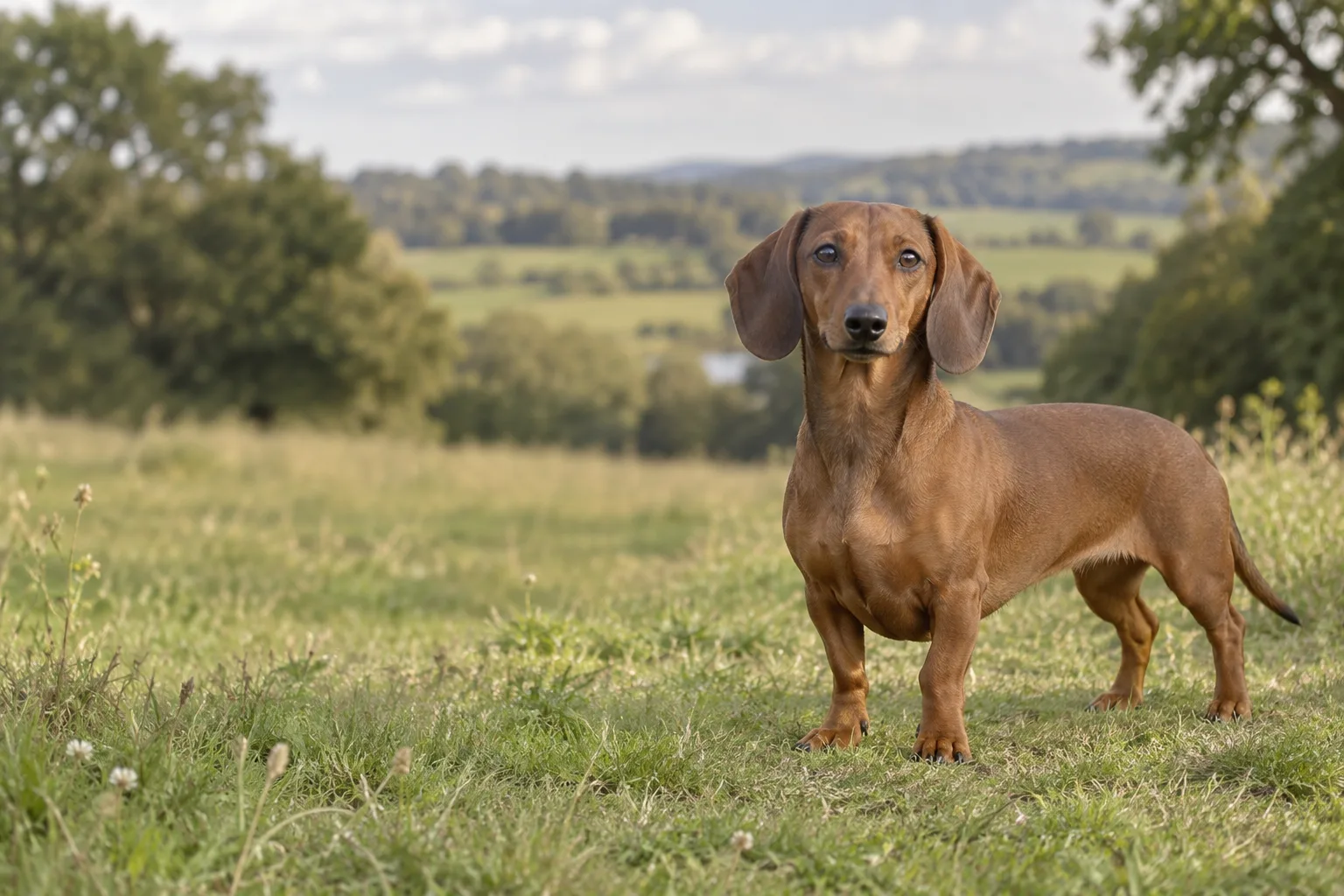
Why does a dog built like a draught excluder have the bark of something three times its size? Anyone who has met a Smooth-Haired Dachshund knows the puzzled affection that follows. The answer is not comedy. It is a job description, written in German forests long before anyone thought of the breed as a pet.
We keep the archive's breed histories to what breed clubs, kennel clubs and published breed histories support. Where a popular story cannot be pinned down, we say so, and this breed has a few of those.
A dog for the badger's front door
The name tells you most of it. In German, Dachs is badger and Hund is dog. The breed's homeland is Germany, and its purpose was to go to ground: to follow a badger down into its sett, find it, and hold it there or bring word of it to the hunter above. Foxes were worked the same way, and so were rabbits, with the smaller dogs. Above ground, the dogs tracked wounded game so that an animal was not left to suffer.
That is a strange brief for a dog. It needs courage out of all proportion to its size, because a badger is strong and well armed and the dog is working alone in the dark. It needs a body narrow enough to pass through a tunnel and turn round in it. It needs a nose good enough to follow a line, and it needs a voice, because once it is underground the hunter can only find it by sound. A big, deep, carrying bark is not a fault in a dachshund. It is the tracking equipment.
German foresters and hunters were writing about badger dogs by the eighteenth century, and dogs of this general kind were being kept for the work well before the breed as we know it was organised. Of the three coats the breed now comes in, smooth, long and wire, the smooth is generally regarded as the oldest. That is not surprising. A short, flat coat sheds mud and needs no attention, which is exactly what you want in a dog that spends its working hours in wet earth.
How the smooth coat first arose is less settled than some breed accounts admit. The commonly repeated explanation is that the type came from short-legged hounds crossed with other small hunting breeds, and that the long and wire coats came later through further crosses. Breed histories differ on which breeds were used, and the records of the time were a hunter's memory rather than a stud book, so we would be guessing to name them.
One myth is worth clearing away. You will read that the dachshund goes back to ancient Egypt, because some old carvings show short-legged hounds. It is an appealing idea, and we cannot find it supported by any breed club or published breed history. Short legs turn up in dogs all over the world. The dachshund as a recognisable breed is a German story, and it is more interesting for being one.
From forest work to a written standard
The nineteenth century is where the dachshund stops being a type and becomes a breed. German breeders began writing down what a good badger dog looked like, and a breed standard was drawn up in Germany in 1879. In 1888 the German breed club, the Deutscher Teckelklub, was founded. Note the word: in Germany the dog is more often called a Teckel or Dackel than a dachshund, and hunters there still care first about working ability.
That matters, because it explains a division you can still see today. The dachshund in the hunting field and the dachshund in the show ring have long been chosen with different priorities, though a good breeder in either world will tell you that a dog with no working sense and a ruined back is a failure of both. The look the standard describes is a working look: a long, muscular body, a deep chest with room for good lungs, a strongly developed forechest, short legs, and a head that tapers to a long muzzle. Nothing in it is decoration. The proportions that make the breed funny in a photograph are the ones that let it fit underground.
Britain came to the breed in the nineteenth century. Queen Victoria is widely recorded as having kept dachshunds, and Prince Albert is often credited with helping bring them into fashion here, which is a good reason the breed became a fixture in Victorian households. The Kennel Club had been founded in 1873, and the breed took a settled place in its Hound Group, where it sits today. The Kennel Club recognises the Smooth-Haired Dachshund alongside the Long Haired and Wire Haired, each in standard and miniature sizes.
Across the Atlantic, the American Kennel Club recognised the dachshund in 1885, which makes the breed an early arrival in the American stud book. The AKC treats size a little differently. Its standard divides dachshunds into miniature and standard by weight, and the coats are shown as varieties. It is a small difference of paperwork, but if you are comparing a UK breeder's description with a US one for the same dog, the words do not line up exactly.
Wars, names and a mascot
Every breed with German roots had a difficult twentieth century, and the dachshund is no exception. During the First World War, anti-German feeling in the United States is said to have hurt the breed's popularity, and a story survives that people renamed them "liberty" dogs, in the way some foods were renamed. We should be honest that this tale is repeated more often than it is documented, and we treat it as a widely told story rather than a firm fact. What can be said safely is that a German breed with a German name was not an easy thing to own in some places at some times, and that it recovered its standing afterwards.
The recovery was thorough. By the later twentieth century the dachshund was among the best known dogs in the world, and its silhouette had become shorthand for a stubborn, cheerful dog. The clearest public sign is Waldi, the dachshund chosen as the mascot of the 1972 Munich Olympic Games. He was a stylised dog rather than a real one, drawn in the colours of the Games, and he is one of the few named dachshunds whose place in history nobody disputes.
The smooth coat gives us a range of colours, and this too is part of the history. The Kennel Club's standard allows solid reds, and also black and tan, chocolate and tan, and dapple patterns, among others. The dapple, a mottled pattern of lighter patches on a darker ground, is often photographed and often admired. Breeders take care over it, because a dapple should never be mated to another dapple: the risk of serious eye and hearing problems in the puppies is known, and it is the reason responsible breeders avoid the pairing. It is one of the places where history and welfare meet. The breed's appearance is a matter of choices, and the choices have consequences.
What the history means for living with one now
Set the badger next to the sofa and the character of the modern dog becomes easier to read.
The stubbornness is the same trait as the courage. A dog bred to make its own decisions underground, out of reach of instruction, does not naturally treat a command as the last word. Training goes best when it is short, varied and rewarding, and worst when it becomes a contest of wills, which the dog is well prepared to win.
The digging is not a bad habit. It is the work. A garden, a duvet, a pile of cushions: all of these are, to the dachshund, a promising tunnel. Giving the dog a place where digging is allowed, or a blanket to burrow beneath, is kinder and more effective than trying to remove the instinct.
The bark is a working voice. Many owners find a dachshund alarming to visitors before it is welcoming to them, and it takes patient teaching to help the dog settle. Scent games and tracking walks suit the breed well, because they let a nose built for the job get on with it.
Then there is the back. The long body that made the dog good at its work also asks a great deal of its spine, and dachshunds are recognised as being prone to intervertebral disc disease. That is not a reason to avoid the breed, but it is a reason to think about ordinary things: keeping the dog lean, limiting jumping on and off furniture, and using ramps or steps where they help. Ask any breeder about the health of the parents before you agree to anything.
History also explains the coat. It is easy to keep, but thin, and it offers little protection against cold and wet. A dog bred for a burrow does not always enjoy an English November or a hard American winter, and a jacket on a cold walk is sensible rather than fussy.
The Smooth-Haired Dachshund is a dog whose shape is a piece of evidence. Every proportion is the record of a job done in the dark by a small animal with a very large opinion of itself. We have drawn that story into the archive's plate for the breed, an original digital engraving, and you will find it on the Smooth-Haired Dachshund's page, beside the short breed summary. Look at it with the history in mind and the low body, the deep chest and the long, alert head read differently: not as the outline of a cartoon, but as a working hound's blueprint.
See it in the archive: The Smooth-Haired Dachshund archive plate