
Breed Histories · 26 September 2026
The History of the Staffordshire Bull Terrier
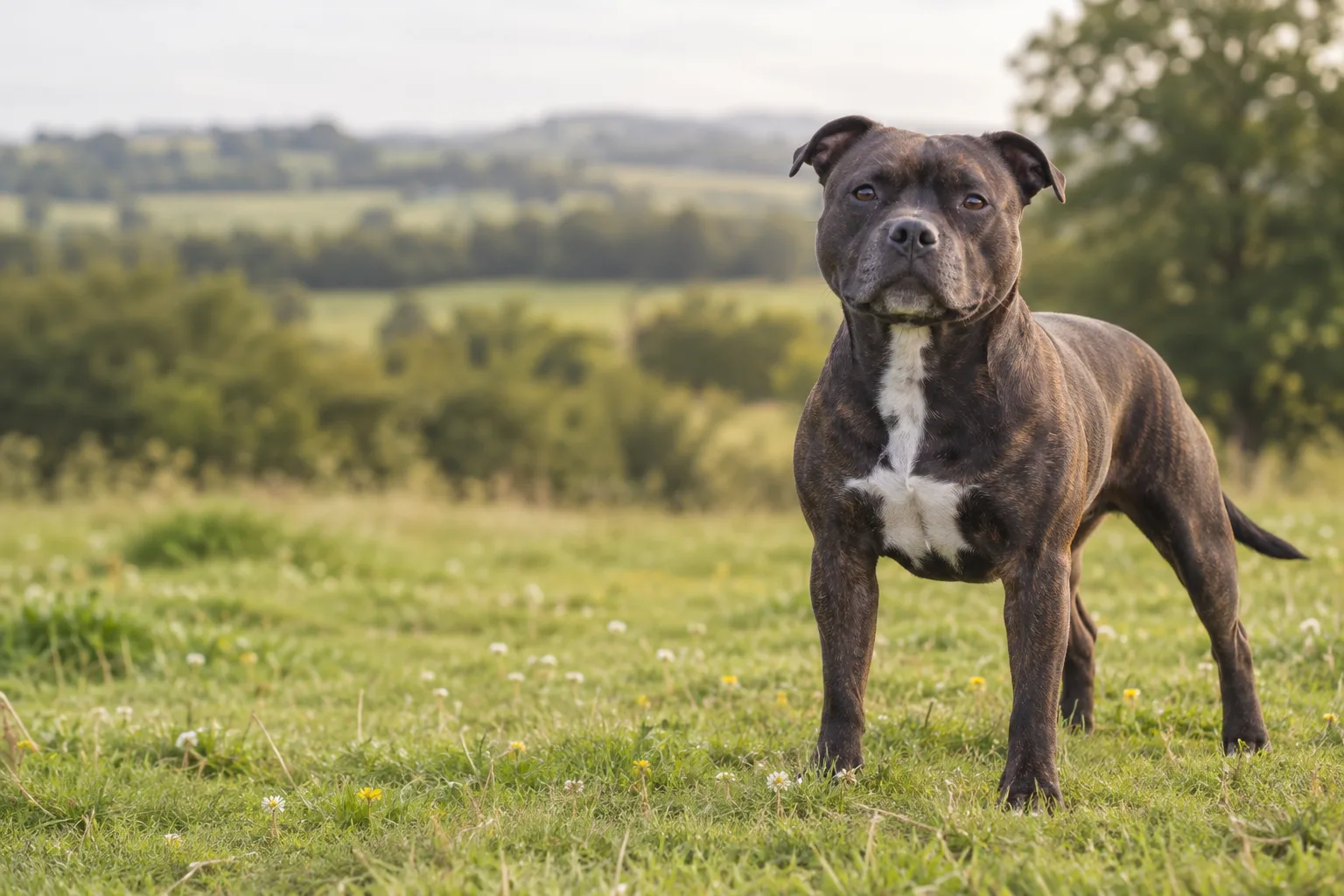
Why does a dog built like a small weightlifter also have a reputation for sitting in laps? It is one of the first questions people ask about the Staffordshire Bull Terrier, and the answer is in the breed's history. It is a long story, and a rougher one than the short version on our breed page. We think it is worth telling properly, myths and all.
Here at the archive, we only put down what a breed club, a kennel club or a published breed history will stand behind. Where a popular story cannot be supported, we say so.
Where the Staffordshire came from
The breed belongs to the industrial heartland of England: the Black Country and the south of Staffordshire, where the county gave the dog its name. In the early nineteenth century this was a landscape of forges, nail makers, coal pits and canals. The people who lived there worked hard, had little spare money, and wanted a dog that could earn its keep and cost little to feed.
The recognised story, repeated by the Kennel Club and by the breed's own clubs, is that the Staffordshire descends from crossing the old Bulldog with terriers of the day. The Bulldog of that time was not the flat-faced, heavy animal we know now. It was a more athletic dog, bred for strength and a determined grip. The terrier side added quickness, agility and a willingness to keep going. The result was known by plain names: the Bull and Terrier, or the Pit Dog. None of it was planned in the way we now plan a litter. Nobody had a written standard, a stud book or a show ring in mind. They wanted a dog that performed.
That matters when you read about the breed, because you will find confident claims about exactly which terrier was crossed with which Bulldog. The honest position is that the records of working people in the early 1800s are thin. We know the general shape of the cross. We do not know the precise recipe, and we would rather say so.
The work that shaped the dog
The job these dogs were bred for is uncomfortable to write about, but it explains almost everything about the breed. Bull baiting and other baiting sports were a fixture of English life for centuries, and dogs bred for them needed courage and a powerful bite. Parliament banned the baiting of bulls and bears in the Cruelty to Animals Act of 1835. The sport did not vanish overnight. It went underground, and dog fighting, which took place in pits rather than in public streets, carried on illegally. The compact, muscular Bull and Terrier suited that world better than the larger Bulldog. It was smaller, faster and easier to keep in a mining town.
Selection for that work produced the physical breed we recognise. Look at a Staffordshire and you can see the purpose in the shape:
- A broad, short skull with strong jaw muscles, from the Bulldog side.
- A deep chest and a low, balanced body, giving power without bulk.
- A compact size, with the Kennel Club standard asking for a dog of roughly 11 to 17 kilograms, so it can be strong yet nimble.
- A short, smooth coat that needs almost nothing from its owner.
Selection also shaped the temperament, and this is the part people get wrong in both directions. The fighting dogs were expected to be tenacious with other dogs, and that trait did not disappear when the pits closed. The Kennel Club's breed standard still describes the Staffordshire as traditionally known for its courage and tenacity, and it also describes it as highly intelligent and affectionate, especially with people. Both halves are in the record. The same drive that made the dog stubborn in a fight makes it devoted and eager to please in a home.
Handlers also needed dogs they could pick up, part and control in the middle of a scrap, which pushed breeders toward animals that were tolerant of people even when excited. We cannot give you a neat quotation from one Victorian dog man to prove it, so take it as a reasonable reading of how the breed developed rather than as a documented rule. What the breed clubs consistently report is that a good Staffordshire is people loving, and the temperament has been prized for that ever since.
There is a popular claim we should mention here: that the Staffordshire was the "nanny dog" of Victorian England, trusted to mind children in the cradle. It is repeated everywhere, and we cannot find a reliable source for it. Some breed writers have pointed out that there is no good evidence for it, so we treat it as a myth. Please never leave any dog alone with a small child, whatever you have read. The breed's warmth with families is real. The story that it was employed as a babysitter is not something we can support.
From the pit to the show ring
The turning point in the breed's story is not a battle or a famous owner. It is a group of enthusiasts deciding that the dog was worth more than its old job.
By the early twentieth century the Bull and Terrier was still around, but it had no official standing. The Kennel Club would not register it, partly because of its fighting associations, and there was no agreed type. Dogs varied a great deal from one town to another. A small circle of breeders in the Midlands, led by a man called Joseph Dunn, set out to change that. They wrote a breed standard, formed a club and asked the Kennel Club to recognise the Staffordshire Bull Terrier as a pedigree breed. The Kennel Club did so in 1935, and the breed club was formed the same year.
Choosing the name mattered. It tied the dog to its home county and gave it a distinct identity from the Bulldog and from the many other terriers. Recognition also meant that Staffordshires could be shown, registered and bred by pedigree, and that a puppy's parents could be traced on paper. The first champions followed in 1939, among them a dog called Gentleman Jim. It was a small moment, but it is the point at which the breed stopped being a working man's secret and became a dog people could proudly walk into a ring with.
Then came the Second World War, which interrupted breeding for nearly every breed in Britain, with food shortages and men away from home. The Staffordshire came through it and grew steadily in popularity after the war, and today it is one of the most familiar breeds in the country. We will not quote a ranking here, because registration figures change every year and we would rather send you to the Kennel Club for the current numbers.
Crossing the Atlantic
The American story has a wrinkle that catches people out. Bull and Terrier type dogs had gone to the United States in the nineteenth century, and there they were developed along their own lines, generally larger and heavier. The AKC recognised that American dog in 1936 as the Staffordshire Terrier, and renamed it the American Staffordshire Terrier in 1972. The smaller English dog is a separate breed, which the AKC recognised as the Staffordshire Bull Terrier in 1974.
The two share ancestors, but they are not the same breed, and they are shown and registered separately. That confusion sometimes matters in practice. The Staffordshire Bull Terrier is not the "pit bull" of the news headlines, and in the UK the breed is not on the list of types restricted under the Dangerous Dogs Act of 1991. Owners in the US should be aware that local rules about bull breeds vary widely, and that some insurers and landlords treat all these dogs alike. It is worth checking your own area before you commit.
What the history means for living with one
Everything above translates into daily life. Some of it in plain terms:
- They want to be with you. A breed developed to work closely with its handler does not do well left alone all day. Many owners report a dog that follows them from room to room.
- They are strong for their size. A dog of that build will pull on a lead if it is allowed to, so early lead training is kinder for both of you.
- Other dogs need careful introductions. The old tenacity with other dogs is a tendency, not a certainty, and the breed clubs advise sensible socialisation from puppyhood and caution with unfamiliar dogs.
- They like a job. Walks, tug games, scent games and training sessions all suit a breed made for purpose. A bored Staffordshire finds its own entertainment, usually involving your furniture.
- They are gentle with their people. Families who know the breed often describe them as clowns, and the softness you see in a good one is what the enthusiasts of 1935 were trying to preserve.
It is remarkable how much of the dog in front of you was decided by a small number of people in a small number of towns. A job that Parliament outlawed made the shape and the spirit. A handful of breeders in the 1930s made the reputation. The rest has been earned by the dogs themselves, in kitchens and on sofas, one loyal lap at a time.
We have drawn this breed as an original digital engraving for the archive, and it sits at the foot of the Staffordshire Bull Terrier page. If this history has made you look at the dog a little differently, go and see the plate. It is the portrait we think the breed deserves.
See it in the archive: The Staffordshire Bull Terrier archive plate