
Breed Histories · 26 September 2026
The History of the Standard Poodle
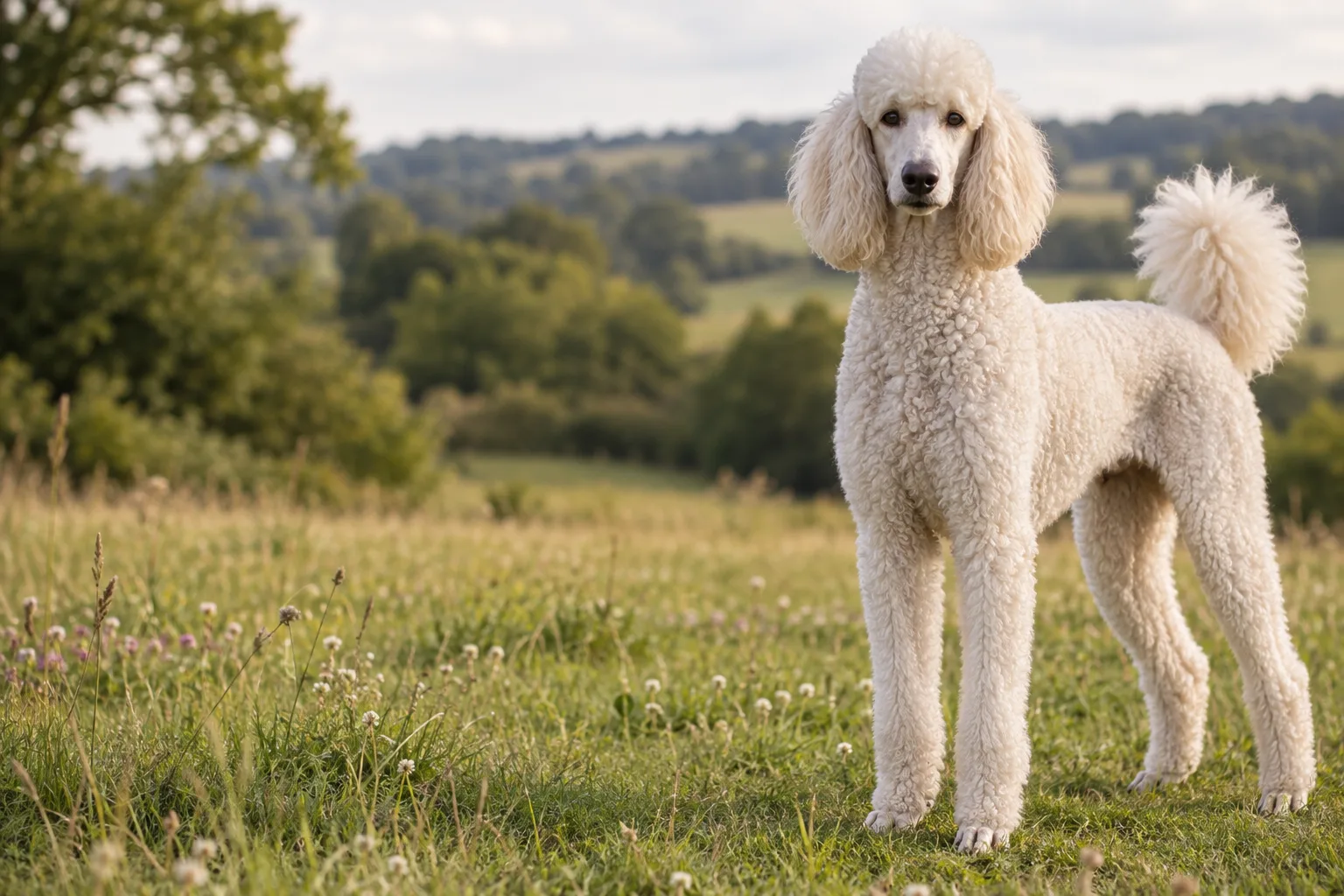
Most people picture a Standard Poodle in the show ring: sculpted, pom-pommed and faintly aloof. The history tells a wetter and muddier story. This is a dog that was made to go into cold water, find a shot bird and bring it back to the hand that sent it. The elegance came later, and a good deal of it grew straight out of the work.
We have gone well beyond the short summary on the breed page for this one. Where a date, a place or a dog's name is supported by the Kennel Club, the American Kennel Club (AKC), a breed club or a published breed history, we use it. Where a popular story cannot be backed up, we say so or leave it out.
A water dog, and an argument about where
Start with the name. "Poodle" is generally traced to the German word Pudel, connected to pudeln, which means to splash about in water. That alone tells you what people expected of the dog. The French name, caniche, comes from chien canard, the duck dog. Two languages, one job: this was a retriever of waterfowl.
Where the breed began is a friendly dispute rather than a settled fact. Germany is often credited with the origin of the water-retrieving type, and the French regard the Poodle as one of their own national dogs and developed it there for a long time. Breed histories accept that curly-coated water dogs were working across continental Europe for centuries, and that the Poodle we know was shaped in that mix. We would not pin it to one country and one year, and we are wary of anyone who does.
What is clear is that the Standard is the original. The Miniature and the Toy were bred down in size from it, and the breed histories are consistent on that point. So when someone tells you the Poodle was a lapdog first, they have it the wrong way round. The big dog came first, and the small ones were made from it.
Poodle-type dogs also turn up in European art from the fifteenth and sixteenth centuries onwards, which shows they were familiar to people at the time, though a curly dog in a painting is not always a Poodle in the modern sense. Later, in Goethe's Faust, published in 1808, the devil first appears to the scholar in the shape of a black poodle. That is literature, not breed record, but it tells us how well known the dog was in German-speaking lands by then.
You will also hear that Poodles were the great truffle hunters of France, and that they marched with Napoleon's armies. Both stories are repeated so often that they are treated as fact. We have not found them supported well enough to state them, so we do not. The retrieving is the part the histories agree on.
The clip was a job, not a joke
Nothing about the Poodle is more mocked than its haircut, and nothing is more misunderstood. The coat is curly, dense and continuous: the hair keeps growing rather than dropping out in the way a typical double coat does. That is why the breed is so often described as low-shedding, and why it needs regular brushing to stop the loose hair matting into the curls.
Now picture a working dog in cold water. A full, wet coat is heavy. It drags at the hindquarters and tires the swimmer. The traditional explanation for the classic show clip is that it was a compromise: shave the back end and the legs so they can move freely in the water, but leave hair over the chest and around the joints to keep the vital parts warm. Look at a Continental clip with that in mind and the strange-looking bracelets and the mane start to make sense.
There is a second story attached to the topknot and the ribbons: that owners tied them on so that a dog could be seen among the reeds. It is often repeated and it is plausible, but it is a piece of tradition rather than something we can trace to a record, so we pass it on as folklore and no more.
What we can say is that the show clips used today, such as the Continental and the English Saddle, are patterned on that working shape. The AKC standard, and the Kennel Club standard in the UK, both describe the accepted clips for adult dogs in the ring. Most pet Standard Poodles never see a ring and wear a plain, even trim instead. That is a sensible choice, and it does the same thing the old clip did: it keeps the coat manageable.
The work shaped the body as well as the coat. A Standard is a square, balanced, athletic dog with a long neck, deep chest and a light, springing step. It is built to swim, to run and to carry a bird. It was never meant to be a decoration, and it moves like a dog that knows it.
Into the kennel clubs, and the dogs people remember
As dog showing became organised in the nineteenth century, the Poodle went with it. The Kennel Club in Britain was founded in 1873, and Poodles were part of the early registers. The AKC, founded in 1884, registered its first Poodle in 1887, and the Poodle Club of America was formed in 1931. In Britain the Standard sits in the Utility Group. In the US it is in the Non-Sporting Group. Neither group says much about the original work, which is one reason the retrieving past is so easily forgotten.
A few named dogs stand out. In the United States, a Standard Poodle called Nunsoe Duc de la Terrasse of Blakeen won Best in Show at Westminster in 1935 and again in 1937, which the records list as a repeat win for a very well-regarded dog of his day. Much later, another Standard, Acadia Command Performance, took Best in Show at Westminster in 1973. And in 2020 the same show went to a Standard Poodle called Siba, in a breed that by then had a long record at the top of American showing.
Not every famous Standard Poodle was a show dog. John Steinbeck's Travels with Charley, his account of a road trip round America published in 1962, is built around his Standard Poodle, Charley. It remains one of the best-known books about a dog and its owner, and it shows the breed as a calm, watchful travelling companion rather than a fussy ornament. Winston Churchill also kept Standard Poodles, and one of them, Rufus, is a well-known part of his household story.
The bigger turning point was popularity. In the United States, the Poodle became the most registered breed with the AKC in 1960 and held that place for 22 years, until 1982. That level of demand is what the breed's own enthusiasts sometimes describe as a mixed blessing. When any breed is suddenly the fashion, the wrong people breed it for the wrong reasons. Most of that pressure fell on the smaller varieties, but the Standard felt the effect too, and breed clubs have spent years encouraging careful, health-tested breeding.
Then there is the near-loss. Wartime is a hard time for any pedigree breed: kennels close, feeding is rationed and breeding stops. Published breed histories describe European Poodle numbers being thin after the Second World War and rebuilt by dedicated breeders, though we would treat any precise figure with caution, and we have not given one. The point we take from it is simple. Every Standard Poodle alive now comes from people who kept the line going when it would have been easier not to.
What the history means for living with one
Here is where the past becomes practical. A dog bred to work closely with a hunter, in difficult conditions, is a dog that pays attention. Standard Poodles are widely described as highly trainable and quick to learn, and the breed's history explains why: a retriever has to take direction and think for itself in the same moment. That is a gift, but it cuts both ways. A bored Standard will invent its own jobs, and you may not like them.
So they need work, not just walks. Fetching, scent games, training classes, swimming where it is safe: these are the things the breed was made for, and they suit the dog far better than an extra lap of the block. If you live in the UK, a wet and muddy walk is not a problem for a dog like this. It is a reunion with its past.
They also want company. This was a dog that worked beside a person, and breed clubs and rescue groups consistently say Standards do badly when left alone for long stretches. If your working day keeps the house empty for hours, think about that honestly before you choose the breed.
The coat asks for a routine. The curls that once shrugged off cold water will knot if they are not brushed properly, and most owners need a groomer every few weeks, whichever clip they choose. That upkeep is part of the cost of the breed, and it should be planned for before the puppy comes home.
Health deserves the same honesty. Breed clubs and veterinary sources note that Standard Poodles, like other deep-chested dogs, can be at risk of bloat, and that conditions such as hip problems and Addison's disease are seen in the breed. Ask breeders what health testing they do, and ask to see the results. Both the Kennel Club and the AKC publish guidance on responsible breeding, and a good breeder will welcome the questions.
The last thing to take from the history is that the Standard Poodle was never a trend. It is an old, capable water dog that happened to look magnificent, and it has been valued for its brains and its loyalty in Germany, France, Britain and America for a very long time. The people who admire the breed most tend to admire the working dog underneath the clip.
We have drawn this breed as a piece of archive work as well. The Standard Poodle plate is an original digital engraving, made to sit alongside the history you have just read. Have a look at it on the breed page, and see whether you can spot the water dog in the lines.
See it in the archive: The Standard Poodle archive plate