
Breed Histories · 26 September 2026
The History of the Weimaraner, the Grey Ghost
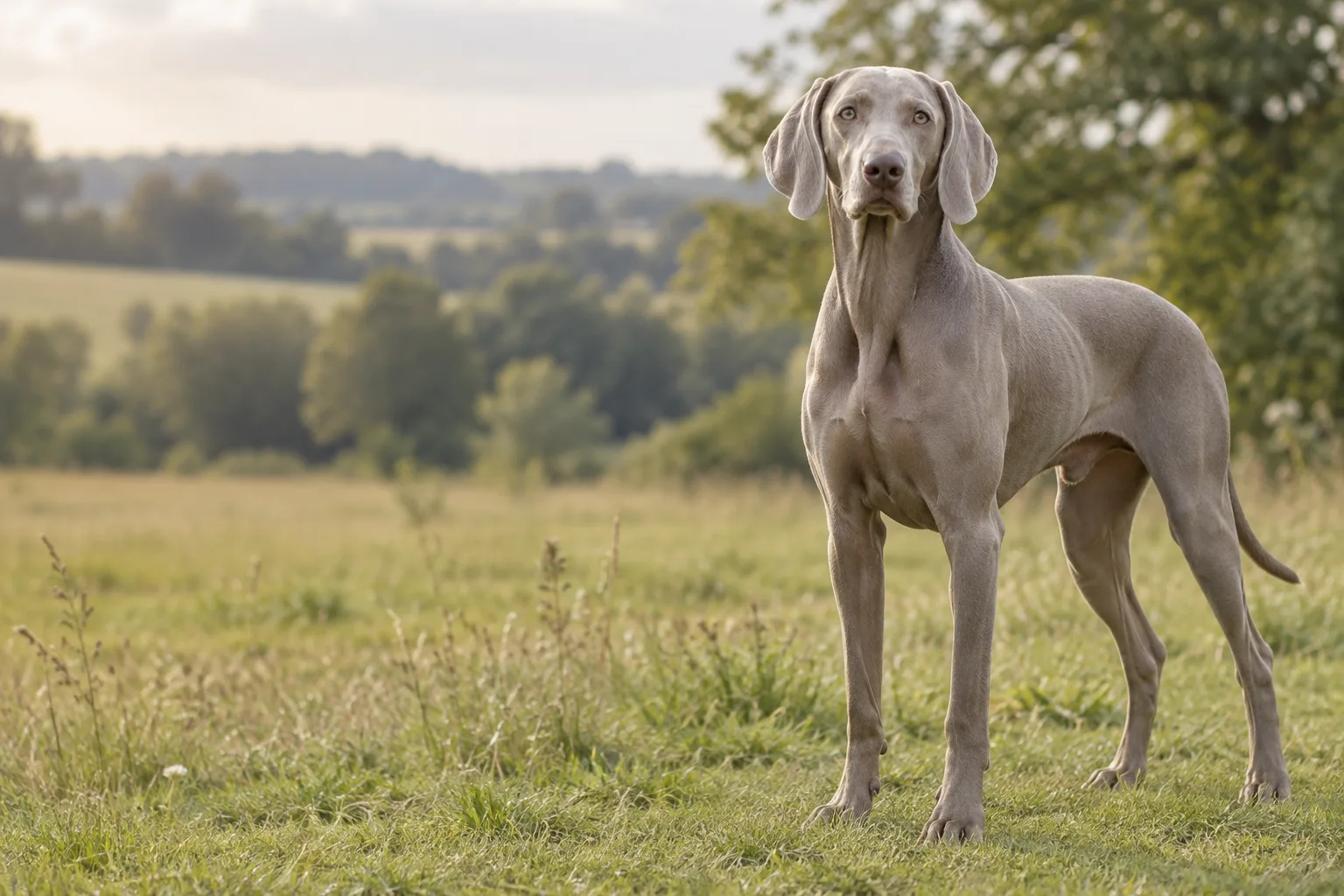
Why does a dog that looks like a museum piece behave like a toddler on a sugar rush? Anyone who has lived with a Weimaraner knows that contradiction. The coat is silver, the eyes are pale and the outline is sleek and almost sculpted. Yet the dog attached to it wants to be on your lap, in your car and, ideally, in your bed.
The contradiction has a cause, and it is written into the breed's history. We have tried to keep to what the breed clubs and kennel clubs actually support, and to name the tidy stories that cannot be pinned down. Where the record goes quiet, we say so.
A court, a duke and a very demanding job
The breed takes its name from Weimar, in the German state of Thuringia. The usual account credits the court of Grand Duke Karl August of Saxe-Weimar-Eisenach, in the early nineteenth century, as the place where the type was refined and the name took hold. Nobles of that period hunted large and dangerous game, and they wanted a dog that could follow a scent, stay with an animal for a long time and hold its nerve near it.
Nobody has a tidy family tree for the earliest Weimaraners. The breed is generally described as a product of German hunting dogs of the time, with scent-hound blood, often the old bloodhound-type tracking dogs, mixed with pointing breeds. That is a description of a mixture, not a recipe, and we would be wary of any source that names the exact parents with confidence.
There is also a popular tale that the breed is centuries older, and that silver-grey dogs turn up in the portraits of the Flemish painter Anthony van Dyck. It is an appealing idea, and you will find it repeated. But a grey dog in a seventeenth-century painting is not evidence of a breed, and we treat this one as a myth rather than a fact. The documented story begins in Germany in the nineteenth century, and that is where we start.
What the court asked of these dogs matters for everything that follows. A dog that trails deer or boar has to be tough, have stamina and be steady. It also has to be close to its handler, because a hunt is a joint effort. A dog that wanders off to please itself is no good on a job like that. So the qualities we now call "clingy" were, at the start, something a hunter selected for on purpose.
From big game to the all-round gundog
As the nineteenth century went on, large game became scarcer across much of Europe and shooting habits changed. The Weimaraner's work moved from the great hunts of the court towards the smaller, everyday hunting of fur and feather. Here the breed became what the Germans call a Vorstehhund, an all-purpose pointing dog, and it is still classed with the versatile hunt, point and retrieve breeds.
Look at what that job requires and you can see the dog. The breed needs a long, athletic body and a deep chest for stamina. A short, close coat is enough for most terrain. It needs a strong nose for tracking and a pointer's freeze on the scent. It also has to retrieve, sometimes from water, and work with its handler. The fact that one dog was expected to do all of that explains a good deal of the breed's mind. A Weimaraner is not a specialist that does one thing brilliantly and then switches off. It is a generalist that wants to be doing something, and wants you involved.
The look followed the work as well. The famous silver-grey coat, sometimes described as mouse-grey or roe-grey, is the breed's signature, and the early German breeders prized it. The eyes are usually amber or a pale grey-blue, and puppies can show faint tabby-like striping that fades. There is also a longhaired variety, and both coat types are recognised by the AKC. We would not claim more than that for the origin of the longhair. The details of how it arose are less well documented than the story of the shorthair.
Formal recognition came in the closing years of the nineteenth century. A German breed club was founded in the 1890s to protect the type and to keep it working. It also did something that shaped the breed's future. It kept the dogs on a short lead, so to speak, controlling who could own a Weimaraner and restricting the sale of breeding stock. The breed's reputation as a somewhat exclusive, protected dog in Germany is largely due to that policy, and it explains why the rest of the world came to Weimaraners so late.
Guarded, then exported
The breed's arrival in the United States is one of the best-documented turning points in its history, and it is tied to one man. Howard Knight, an American sportsman from Rhode Island, joined the German club and in 1929 brought the first Weimaraners across the Atlantic. It took persistence. The German club was deeply protective of its dogs and reluctant to let good breeding stock leave the country. The Weimaraner Club of America was founded in the same year, 1929, and the American breed's story starts there.
Growth was gradual. The American Kennel Club recognised the Weimaraner in 1943, placing it in the Sporting Group, where it remains. After the Second World War, American servicemen who had been posted to Germany and others in the sporting world helped to spread interest, and the breed gained ground in the United States through the late 1940s and 1950s. We prefer to say that plainly, and without inventing numbers, because the exact counts of imports from those years are not something we can support from the sources we trust.
Two American names have done more than most to fix the breed in the public imagination. The first is Heidi, the Weimaraner who lived at the White House during the presidency of Dwight D. Eisenhower in the 1950s. It is a small, friendly detail, but it shows how far the breed had travelled from the German hunting field to the American home in a couple of decades. The second is Man Ray, the dog of the artist William Wegman, who began photographing the dog in the 1970s. Wegman's pictures, with their dressed-up, deadpan grey dogs, gave the Weimaraner a cultural profile that no field trial could have done. If you have a picture in your head of a Weimaraner sitting solemnly in a costume, that is probably why.
Britain came to the breed later still. Weimaraners reached the UK in the early 1950s, and The Kennel Club places the breed in the Gundog Group. Like their American cousins, British Weimaraners have divided into two camps: those bred and worked for the field, and those living as companions. Both share ancestry, and the two lives can look very different once a puppy leaves the breeder.
One point on the wars: you will read that the Weimaraner was nearly lost in one or other of them. We could not find a source that gives us a clear, supportable account of a near-extinction, so we will not repeat it. What we can say is that the breed was controlled and small in numbers for a long time, and that its spread beyond Germany took place mainly in the twentieth century.
What the history means for living with one
Set the history beside daily life and the reasons for the behaviour become practical.
First, the need for company. A dog selected for close work with a handler does not do well alone for long stretches. Owners often describe a Weimaraner as a shadow, and the breed is widely known to struggle when left. If nobody is home for most of the day, think hard before choosing one.
Second, the need for work. A dog bred to cover ground and use its nose needs more than a lap of the park. Good owners give it a job: proper off-lead running where it is safe and legal, scent games, training, retrieving, or a gundog sport. A bored Weimaraner is inventive, and rarely in ways that suit the furniture.
Third, the hunting instinct. The dog that could work a scent all day will do exactly that on a walk, whether or not you asked it to. Recall needs patient, early and steady training, and the presence of small animals, in the garden or the countryside, needs to be taken seriously. Living in a city, in either the UK or the US, does not remove the instinct. It only removes the outlets.
Fourth, the deep chest. Deep-chested breeds are known to be at risk of a serious stomach condition called bloat, and the Weimaraner is one of them. It is worth reading about the signs, and about feeding and exercise routines, before the puppy comes home, and worth having a vet's number to hand. This is general advice for the breed shape and not a claim about any individual dog.
Last, the temperament that sits under the elegant coat. Weimaraners are clever, sensitive and sometimes stubborn, and they tend to respond better to consistent, kind training than to harshness. The dog that once had to think alongside its handler in the field still wants to be asked, not simply told.
Seen that way, the Weimaraner is not a difficult dog. It is a dog whose original job is still there, quietly, under the modern life it has been given. The owners who do best are those who understand what it was made to do.
If you would like a keepsake of the breed's look, the archive plate for the Weimaraner is an original digital engraving, drawn for this collection. You will find it on the Weimaraner page of the archive, beside the short story of the breed.
See it in the archive: The Weimaraner archive plate