
Breed Histories · 26 September 2026
The History of the Whippet, the Working Man's Racehorse
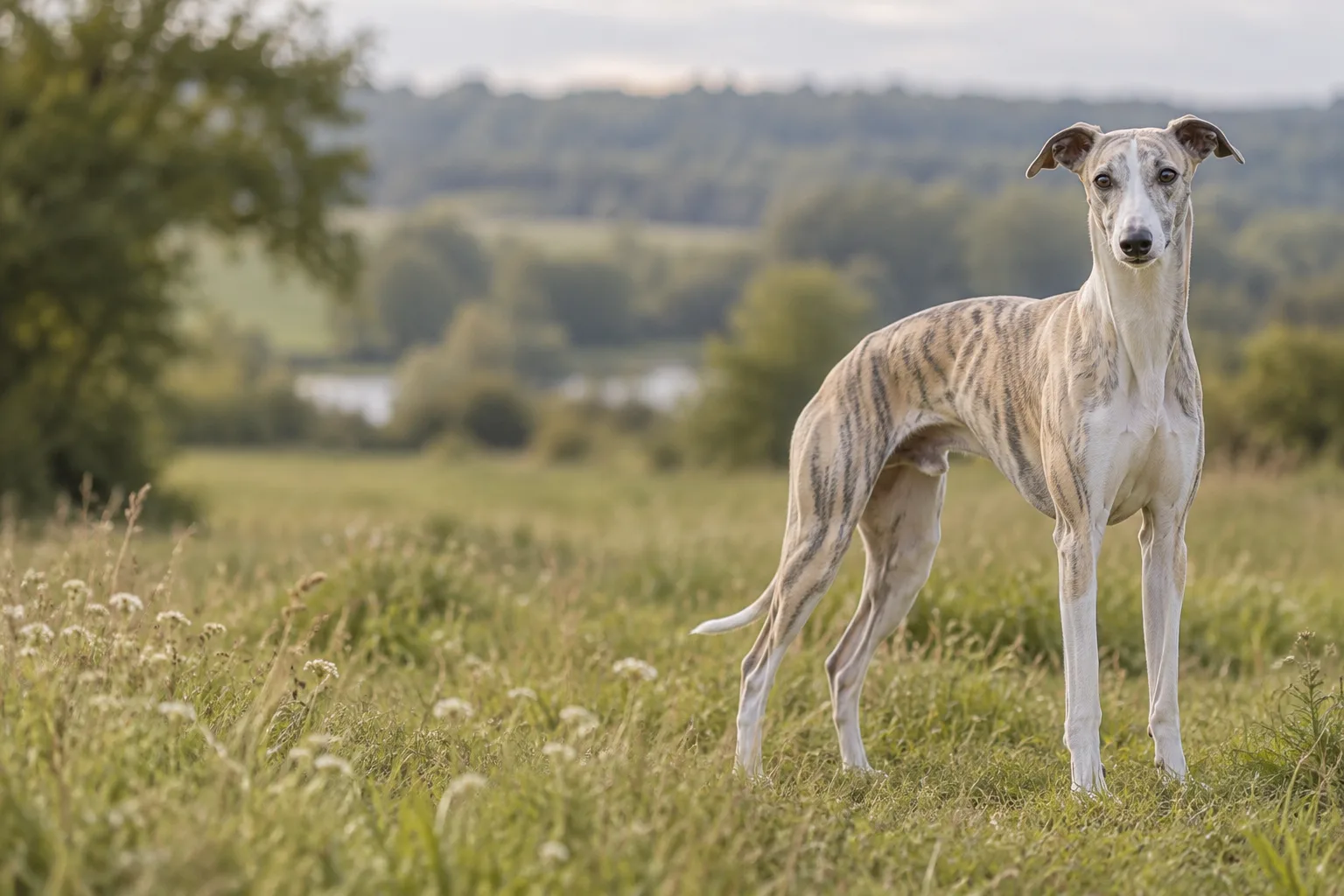
Why does a dog that can outrun almost anything in the park spend most of the day flat on a duvet? The answer is in the Whippet's history, and it is a better story than the short paragraph on our breed page lets on.
We keep the archive, and we have a rule about it. If a date, place or person cannot be backed by a kennel club, a breed club or a published breed history, it stays out, or we say plainly that it is a myth. The Whippet has more than its share of tidy legends, so this piece is as much about what we can say as what we would like to.
Where the Whippet came from
The Whippet is a nineteenth century breed from the north of England. That much is well supported. Lancashire and Yorkshire are the counties most often named, with the mining and mill communities of the north generally in the frame. These were not the households that kept packs of full-sized Greyhounds. Coursing hares over open country belonged to landowners and those who could rent the ground.
Working people wanted a dog of their own, one that suited a terraced house and a small yard. The result was a smaller running dog, and the usual account is that it was built from small Greyhounds crossed with terrier types, with other blood added along the way. Some accounts also mention a later cross to the Italian Greyhound to refine the outline. Here we have to be honest: the breeding records of the early days were mostly kept in people's heads, so the exact recipe is not something we can document. Anyone who gives you a precise formula, with percentages, is guessing.
The same goes for the name. It is often said to come from the old English word "whappet", a small yapping dog, or from the idea of a dog that "whips it" along. Both are plausible, neither is settled, and we would rather leave the question open than pick a winner.
What we can say is that the breed was shaped by function. It came before any written standard, and before anyone was thinking about the show ring. It was made by people who wanted something specific and who culled and bred toward it, generation after generation.
The jobs that made the dog
Two jobs are named again and again in the published histories: rabbit catching and racing.
The first is sometimes called snap-dog work. A small, fast dog could be slipped at rabbits, either in an enclosed space or over rough ground, and would put food on the table as well as provide entertainment. It also gave the dog a job that a household could keep going without much outlay. A quick turn, a burst of speed and a clean, light way of going were the qualities that mattered.
The second is the one the breed is best known for. Whippets were raced, and the old name for the sport is rag racing. Dogs were held at a mark and released together, while their owners stood at the far end of a set course, waving a rag and shouting to draw them on. The distance is often given as 200 yards, though local practice varied and we would not swear to one figure for every town. Wagers were placed, of course. Prize money and local pride could be worth a great deal to a household with little to spare, and it is easy to see why a dog that could win at the mill-town track earned its keep.
That is where the nickname comes from: the poor man's racehorse. It is a good label, and it has the advantage of being a fair description of how the dog was used and valued, not a slogan invented later.
Now look at the dog and ask how the work shaped it. A dog that has to accelerate hard over a short course needs a deep chest for heart and lungs, a long, flexible back, a lean, muscular hind end and a tucked-up waist. It needs a light frame, because every extra ounce is carried at speed. It needs a thin, close coat, because it lives in a house and not on a moor. All of this is what the Whippet looks like today. The breed's outline is a working drawing, not a fashion.
The temperament followed the same pattern. A racing dog that was handled at home, shared the fireside and was picked up and carried to the start needed to be biddable and gentle with people, and it needed to be quiet indoors. Whippets are famously calm in the house for that reason, and it is not an accident.
Recognition, and crossing the Atlantic
By the closing decades of the nineteenth century the Whippet was established enough to be written down. The Kennel Club recognised the breed in 1890, which brought it into the show ring and into a stud book, and with that came a written standard. The English clubs devoted to the breed followed in the years after. From this point the racing type and the show type had a reason to drift apart, and breed histories do note a difference in emphasis between dogs kept for the track and those bred for the ring, though a well-made Whippet of either sort is recognisably the same dog.
The American story is a little earlier. The AKC recognised the Whippet in 1888, two years ahead of The Kennel Club. The breed is said to have reached the United States with English mill workers who emigrated to the textile towns of New England, bringing their racing dogs with them, and Massachusetts is the state usually named. We can support the broad outline: the breed came with working-class emigrants from the north of England, and American racing took root among them. We would be careful about naming individual dogs or people from the early days, since the sources we trust are thin on it, and the archive does not print a name it cannot stand behind.
That thinness matters, and it brings us to two things you may have expected from a breed history. One is a famous named dog that changed the breed. The other is a war or a near disappearance. We looked for both. We can find no well-supported account of the Whippet being brought to the edge of extinction by either World War, and we would not write one to make the story more dramatic. The truth appears to be duller and rather nicer: the breed stayed popular with ordinary owners, it was easy to keep, and it simply carried on.
There is one more change of scene worth noting. As the industrial communities that made the breed changed, the racing culture went with them, and the Whippet found its second life as a companion. In both countries it now sits in the Hound Group, and it turns up in the show ring, in lure coursing and racing, in agility and in ordinary homes.
What all this means for living with one
Here is where the history earns its keep.
A Whippet is a sprinter, not a marathon runner. It wants a short, wild, joyful run and then a very long rest. Many owners are surprised that a dog this fast is happy with a modest amount of walking, provided it gets a proper gallop somewhere safe. That is the racing dog's rhythm, carried down the generations.
It will also chase. The breed was made to notice small, fast, moving things and to go after them without stopping to think. This is not disobedience, it is the job. Recall around rabbits, squirrels and cats is a real challenge, and a fenced field is a far safer place to let it loose than an open common. If you live near livestock, road or riverbank, that instinct deserves respect, and so does a long line while you build trust.
Then there is the coat. A thin, short coat suited a dog that lived in a warm terrace house and raced in a mild burst of effort. In a British winter or a cold American one, most Whippets are glad of a coat, and they will find the warmest spot in the house, usually yours. Thin skin goes with the thin coat, so brambles and barbed wire can do more harm than they would to a rougher-coated dog.
And there is the character. The Whippet's gentleness, its quiet and its liking for company all come from being a working dog that lived inside the family home. It is rarely a barker, rarely destructive when it is well exercised and rarely a dog that needs to be busy every minute. Those who own one often describe it as a cat that happens to run at 35 miles an hour, and although that top speed is a figure commonly quoted and not one we have tested, the sentiment is common enough that we suspect it is fair.
The lesson from the mill-town tracks is a simple one. Give the dog its short, fast run, its warm bed and its people, and it will repay you in full. That is what it was bred to do.
If you want to see the breed as we see it, the Whippet has its own place in the archive. The plate for the breed is an original digital engraving, drawn in our own house style, and we would be glad if you looked at it next. It shows the long line of the back, the deep chest and the narrow waist that this history has just explained.
See it in the archive: The Whippet archive plate