
Breed Histories · 26 September 2026
The History of the Yorkshire Terrier
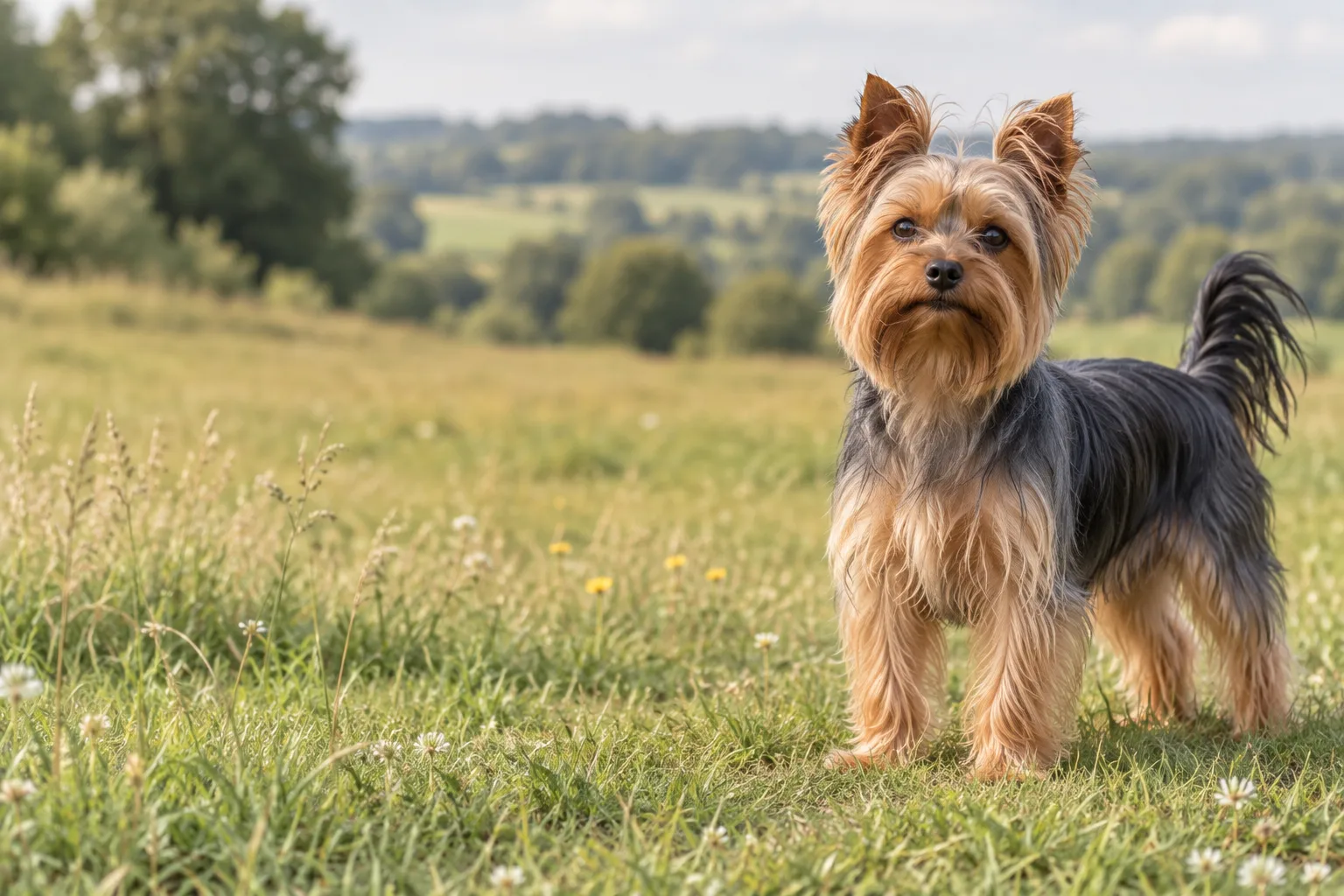
Would you guess that the smallest terrier in the show ring started out as a working dog in a mill? Most people meet a Yorkshire Terrier as a silky, bow-topped little companion, and it is easy to assume it was always a lap dog. It was not. Here at The Canine Archive we like to start with the job, because the job explains almost everything about the dog.
A word on how we work. Where the record is firm, we say so plainly. Where the early story rests on memory, family tales and guesswork, we say that too. The Yorkshire Terrier's beginnings are a good example: the breed was made by working people who were not writing down pedigrees, so some of its earliest chapters cannot be proved.
From Scottish weavers to Yorkshire mills
The usual account begins in the nineteenth century, during the Industrial Revolution. Workers, among them weavers from Scotland, moved south to find employment in the mills and mines of northern England, particularly in Yorkshire and neighbouring Lancashire. They brought their dogs with them. Those dogs were small, hardy terriers of the kind kept in Scottish working households, and the names usually given to their ancestors include the Clydesdale or Paisley terrier and the Skye terrier, with other terrier types in the mix in the north of England. Some breed histories also name the Maltese, and the Manchester Terrier is often mentioned too. You will find the exact recipe argued over, and it deserves to be, because nobody at the time recorded it.
What is not in doubt is the work. Mills and mines of the period had a rat problem, and a small, quick, fearless dog that could get into tight spaces was worth its keep. The story of Yorkshire Terriers hunting rats in mills is widely told. A tale that they were carried down mines in pockets is repeated as well, but we would treat the finer details of that one as folklore rather than fact. The safe version is this: the breed's ancestors were working ratters among working people, and the dog was valued for nerve and size before it was valued for its coat.
Think of it like a mill town's answer to a pest control van. Nobody was breeding for beauty. They were choosing dogs that did the job, and that meant grit, speed, a sharp eye and a body small enough to get where a bigger dog could not.
Those early dogs were known by other names before the one we use today. They were often called broken-haired Scotch terriers, or simply Scotch terriers, which tells you how the people who owned them thought of where they came from. The Yorkshire name came later, and it came because of what Yorkshire did with them.
Huddersfield Ben and the making of a breed
If the Yorkshire Terrier has a founding father, the record gives us one by name: Huddersfield Ben. He was born in 1865, bred in Yorkshire, and owned by a Mrs Mary Ann Foster of Huddersfield. Ben was shown widely, won often, and, importantly, was used at stud, so that his type spread. Breed histories describe him as the dog who fixed the look that other breeders then followed. He died in 1871 after an accident, which is a short life for a dog so influential. Six years is all he had, and the breed still counts him as its foundation.
The name of the breed followed within a few years. It is generally recorded that by around 1870 people were saying that these dogs, so improved in Yorkshire, ought to be called Yorkshire Terriers rather than broken-haired Scotch terriers. The rename mattered. A dog with its own name is a dog with its own class at a show, and a dog with its own class has breeders who compete to refine it.
This is where the job began to change the look. The blue and tan colouring, the long, straight, silky coat parted down the back and the small, neat, upright ears all became fixed as breeders selected for them. That coat is worth a moment. It is hair rather than fur, often compared to human hair in texture, and it grows and grows if it is left alone. A show dog's coat is kept long and cared for with great patience. The working ratter and the show dog are the same breed, but they are not the same haircut.
Recognition came in the 1880s. The Kennel Club in Britain, which had been founded in 1873, recognised the breed in 1886. The American Kennel Club is recorded as recognising it a little earlier, in 1885, so the two countries brought the Yorkshire Terrier into their stud books within about a year of each other. In Britain a specialist club for the breed followed in 1898. In America, the Yorkshire Terrier Club of America was formed in 1951. Clubs matter to a breed's history because they write the standard, and the standard is the description breeders measure their dogs against. The standard for the Yorkshire Terrier has always kept the terrier temperament at its heart, even as the dog itself became a small one.
Size is the part of the story people find hardest to picture. Yorkshire Terriers were larger in the early years of the show ring, and over time breeders worked towards a smaller dog. The modern breed standards set an upper weight of seven pounds, or a little over three kilograms. The very smallest dogs do not make a better Yorkie. A dog that is too tiny can suffer for it, and a responsible breeder will tell you the same.
Smoky, the war years and the move to the sofa
The Victorian era took a working terrier and turned it into a fashionable pet. That shift is well documented across breed histories: the same qualities that made the Yorkshire Terrier a good ratter, alert, bold and quick, made it a lively companion, and the beautiful coat made it a dog people wanted to show off. It moved from the mill to the parlour in the space of a generation or two, and it never quite lost the attitude it arrived with.
The best known Yorkshire Terrier of the twentieth century is a small dog named Smoky. In 1944, during the Second World War, an American soldier, Corporal William Wynne, came across her in the jungle in New Guinea. Nobody knew where she had come from. She weighed only a few pounds. Wynne took her in, and she stayed with him for the rest of the war, serving in the Pacific with his unit. Her best recorded feat was carrying a telegraph wire through a long, narrow pipe beneath an airfield, a job that would otherwise have taken men considerable time and left them exposed. After the war she visited hospitals and became one of the earliest recognised therapy dogs. There is a memorial to her in Ohio, and she is honoured as a war dog, even though she was never officially issued to any unit.
Smoky matters to this history for a reason beyond the story itself. She showed the wider public that a dog small enough to be tucked into a bag could also be brave, steady and useful. It was the ratter's old reputation returning in a new setting, in front of a much larger audience. If you have ever wondered why so many Yorkshire Terrier owners talk about their dogs as though they are far bigger than they are, this is part of the reason.
What the history means for living with one today
Knowing the job makes the dog make sense. A Yorkshire Terrier was bred to notice things, to go after them, and to have opinions about them. That is why so many Yorkies bark at a doorbell, dash after a small moving thing and seem entirely unaware that they are the size of a loaf of bread. It is not bad manners. It is a hundred and fifty years of selection for nerve. Early, calm training and plenty of everyday exercise suit the breed better than any attempt to treat it as a decoration.
The coat is the other legacy. If you are keeping a Yorkie with a long coat, expect regular brushing to stop tangles, and a groomer's help for shaping. Many pet owners choose a shorter cut for daily life, which is common and perfectly sensible. Either way, the coat asks for a routine, not a special occasion.
Because the breed became so small, some health matters are worth raising with your vet and your breeder. Toy breeds are commonly discussed in connection with knee problems, delicate teeth and, in some small dogs, windpipe trouble. We are not vets and we will not tell you what your own dog needs. What we can say is that the history points the same way as good sense: ask a breeder about the health of the parents, and choose a sturdy dog over the tiniest possible one.
The same story holds on both sides of the Atlantic. A British owner and an American one are looking after the same dog, brought into the stud books of both countries within a year of one another in the 1880s. The Yorkshire Terrier lives in flats and houses, in cities and in the country, and it does well wherever it is given company, sensible boundaries and something to think about.
Ben, the mills and the Scottish weavers give the breed its roots. Smoky gives it its legend. The dog beside you gives it its present. If you would like to see how we have drawn the breed, our archive plate for the Yorkshire Terrier is an original digital engraving, and you will find it on the Yorkshire Terrier page of the archive. It is our way of putting a small, stubborn, silky-coated working dog on the record, where it belongs.
See it in the archive: The Yorkshire Terrier archive plate