
Breed Histories · 26 September 2026
The History of the Pug, From Imperial China to Your Sofa
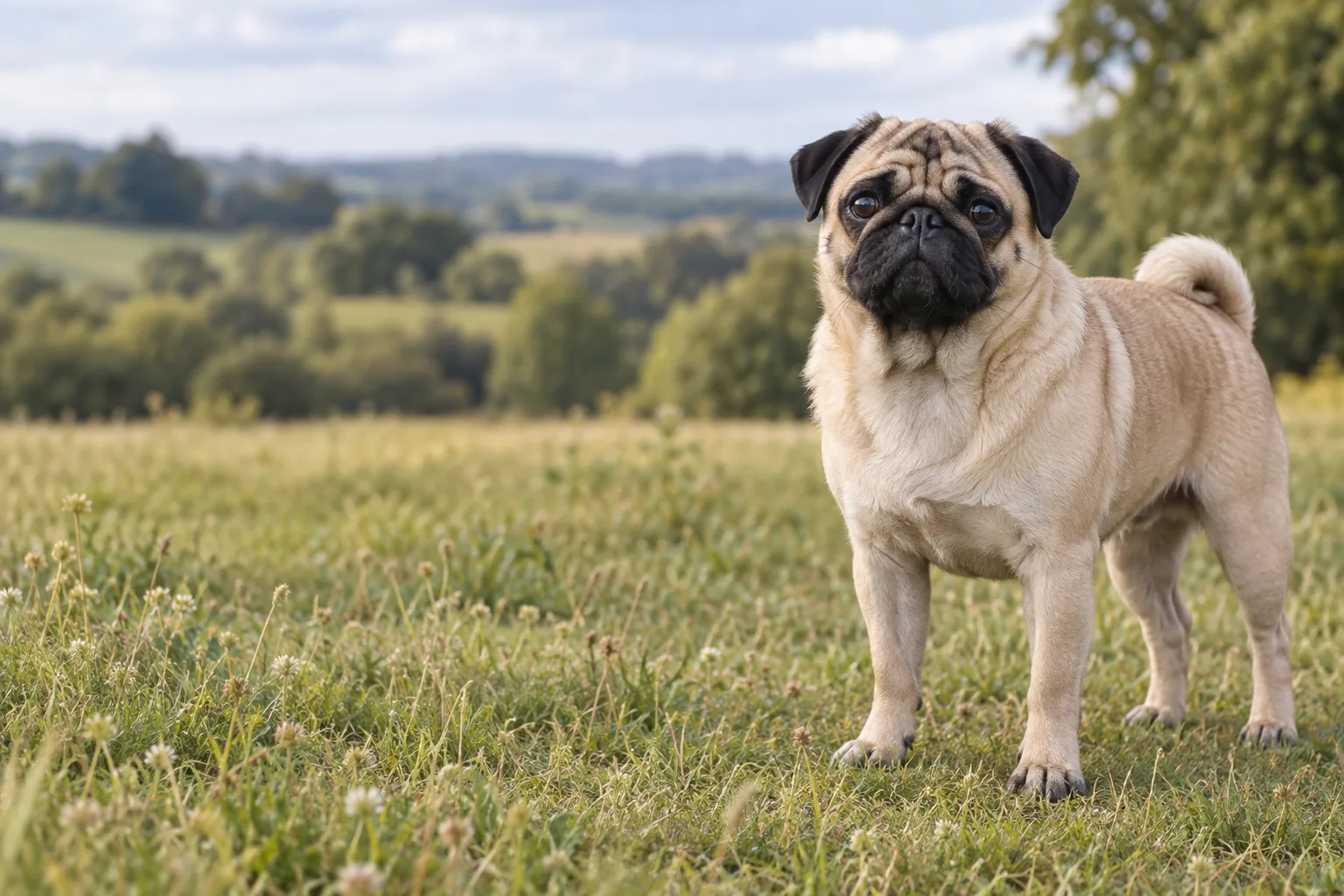
Why does a dog with such a serious face seem to find everything so funny?
It is a fair question, and the answer sits in the Pug's past. Few breeds have been kept so consistently for one purpose over so many centuries, and that purpose shaped almost everything you see when a Pug looks up at you from the hearthrug. We are The Canine Archive, and this is our fuller account of the breed than the short summary on its page. Where a story is well recorded, we say so. Where it is tradition, we say that too.
One thing to state at the outset. The Pug was not bred to herd, hunt or guard. Its job was company, and the history is the story of that job being done very well.
An Eastern beginning, and what we can and cannot prove
The Pug is generally traced to China, where short-faced small dogs were kept by the ruling classes and in religious households. Breed clubs and kennel clubs on both sides of the Atlantic agree on the broad picture: a small, flat-faced companion, prized at court, that reached Europe through trade.
What nobody can honestly give you is a precise date for the first Pug. Early records of short-faced dogs in China are scattered, and ancient descriptions rarely say clearly whether the dog in question was a Pug, a Pekingese or something else that has since disappeared. If you see a confident claim that the breed is a set number of thousands of years old, treat it with caution. We have not found a source that supports that level of precision, so we do not repeat it.
There is a well known detail about the face. The wrinkles on a Pug's forehead are often said to resemble the Chinese character for "prince", and the markings were treasured for it. It is a charming tradition and it is repeated by many breed writers. It is a tradition rather than a documented fact, and we offer it in that spirit.
What the record does support is the outcome of all those centuries of keeping dogs for company. Breeders in that setting valued a small, sturdy body, a broad expressive head, dark eyes and a temperament that wanted to be near people. That is the blueprint for the modern dog.
The Dutch, the House of Orange and a dog called Pompey
Dutch traders are credited with bringing these dogs to Europe, and the Netherlands is where the Pug first became a fashionable name. In Dutch the dog was known as a mops, and the German name, Mops, survives today. The English word "pug" is of debated origin. One suggestion is that it comes from a Latin word for a fist, given the shape of the face. Another is that it simply grew out of an old affectionate term. We do not think anyone can settle it.
Then there is the most famous story in the breed. In 1572, the tale goes, the Prince of Orange, William the Silent, was saved from a surprise attack when his Pug, Pompey, barked and woke him as Spanish troops approached. It is repeated by the Kennel Club, the AKC and countless breed histories, and it is the reason the Pug became linked with the House of Orange. It is also a legend of the kind that grows in the telling, and we would not swear to the details. What is not in doubt is that the Pug became associated with the Dutch royal house.
That association travelled. When William III and Mary II came to England in 1688 to take the throne, Pugs are recorded as coming with them, and the breed gained a place in English society. Orange ribbons on Pugs are a detail that often appears in accounts of the period.
Across the continent the dog gathered stories quickly:
- The painter's dog. William Hogarth owned a Pug named Trump and painted himself alongside the dog in a self portrait of 1745. It is one of the best documented early Pugs, and the dog's blunt, stubborn expression is instantly recognisable today.
- The secret society. In the 1740s, after the Pope condemned Freemasonry, a German society called the Order of the Mops took the Pug as a symbol of loyalty and steadfastness. The name tells its own story.
- The Empress's dog. Josephine, wife of Napoleon, is said to have kept a Pug called Fortune. There is a popular tale that the dog carried messages to her when she was imprisoned. We treat that as a story told about her rather than a proven event.
Queen Victoria's fondness for Pugs is well recorded too, and it did the breed's standing no harm in Britain in the nineteenth century.
From drawing rooms to the show ring
By the Victorian era, the Pug was moving from private favourite to organised breed. The Kennel Club in Britain was founded in 1873, and the breed was recognised as part of the emerging world of pedigree dogs. A club dedicated to the breed, the Pug Dog Club, was formed in 1883, giving breeders a body to argue over the standard.
The colour of the Pug is part of that story. Fawn, with a dark mask and a black line down the back, is the classic look. Black Pugs became widely known in Britain after Lady Brassey brought some in from China in the 1880s, which is a neat reminder that the link with the East stayed alive long after the breed became European.
The American Kennel Club recognised the Pug in 1885, and it sits in the Toy Group there, as it does in Britain. Enthusiasts in the US later formed the Pug Dog Club of America, in 1931. Both countries use a version of the same motto for the breed, multum in parvo, which means "a lot in a little". It describes a compact, muscular dog with plenty of personality. The UK standard puts the ideal weight at roughly 6.3 to 8.1 kilograms, which is about 14 to 18 pounds, and the AKC gives the same range in pounds.
We have looked for a dramatic tale of the Pug nearly vanishing during wartime, since so many breeds have one. We could not find a reliable source for it, so we will not invent one. The Pug's survival looks less like a rescue and more like steady, quiet popularity.
One change is worth naming, because it matters later. Paintings and photographs from the eighteenth and nineteenth centuries often show Pugs with longer muzzles and longer legs than many of the dogs seen in shows now. The modern face is flatter. That shift came through selection over the generations, and it has consequences.
What that history means for living with a Pug
Start with the good news, because it is the whole point of the breed. A dog bred for centuries to be a companion tends to want to be with you, and Pugs usually do. They suit a household that is home a fair amount, and they are often happy with modest exercise, whether that is a flat in a city or a house with a garden. The AKC gives a typical lifespan of 12 to 15 years, so this is a long friendship.
The same history also explains the sofa. A dog that was kept for warmth and company at court has never had a strong reason to be independent. Expect a shadow in the kitchen and an opinion about your dinner.
Then the harder part. The flat face that made the Pug so appealing is also the source of its main health worries. Short-nosed breeds can struggle to breathe, cope badly with heat and get eye problems more easily, and the Pug is a well known example. The Kennel Club lists the breed among those it watches for health concerns, and breed clubs in both countries encourage breathing and eye checks in breeding dogs. There is also a serious neurological condition seen in the breed, known as Pug dog encephalitis. We would rather you knew about all of this before you chose a puppy than after.
A few practical points follow from the history:
- Ask for the health evidence. A responsible breeder in the UK should be willing to talk openly about breathing assessment and eye testing. In the US, the Pug Dog Club of America is a sensible place to start looking for guidance.
- Look at the muzzle. A Pug with a little more nose and open nostrils generally has an easier time. It also looks a lot more like the dogs in old paintings.
- Plan for the weather. A British heatwave or an American summer barbecue can be dangerous for a flat faced dog. Walk early or late, and keep the dog cool.
- Watch the waistline. A dog bred for lap duty will happily accept every biscuit offered, so weight needs steady attention.
None of this is a reason to avoid the breed. It is a reason to choose carefully and to look after one well. The centuries of companionship are real, and they are the reason so many people who own one cannot imagine life without it.
If you would like to see the breed as we have drawn it, the archive plate for the Pug is an original digital engraving, and you will find it on the Pug page of the archive. It is our own small tribute to a dog that has spent a very long time making people smile.
See it in the archive: The Pug archive plate